



 Newsletter
 Search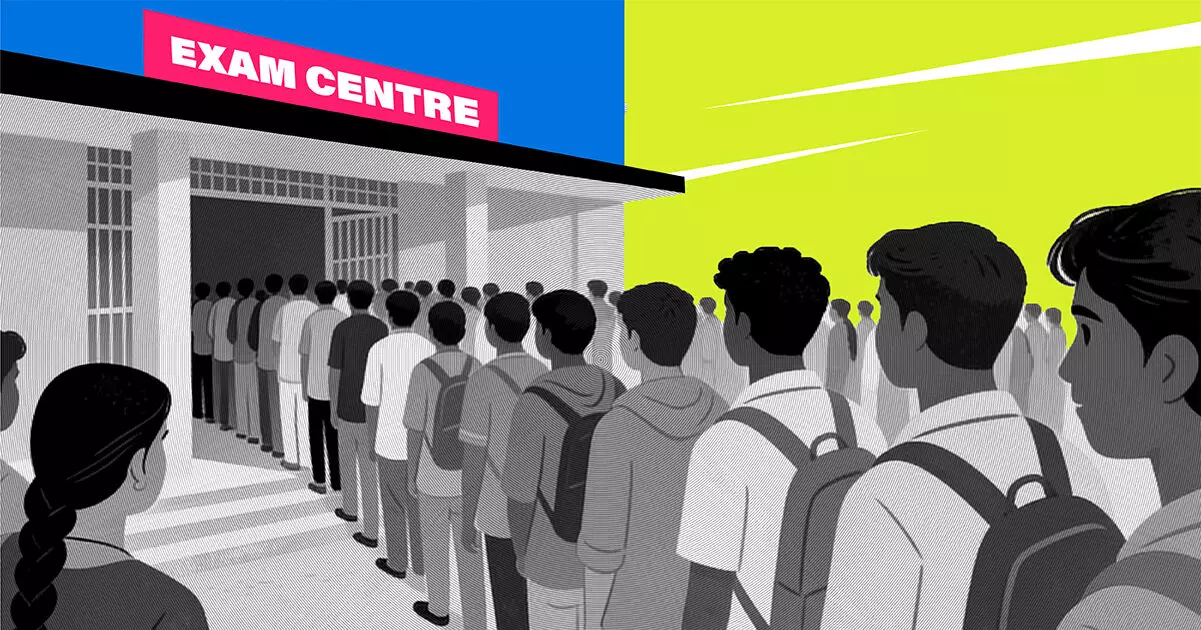
Why Arrests Won't Salvage India's Broken Government Recruitment System
- Opinion
- Published on 17 Jun 2026 6:00 AM IST
As lakhs chase scarce public jobs, underfunded agencies and high-tech cheating expose a crisis beyond police fixes.
The Gist
The article discusses the systemic issues in India's examination and recruitment processes, revealing how students exploit loopholes for admission and job placements.
- In 2019, medical students engaged in exam fraud while technically adhering to regulations.
- Government job recruitment is plagued by nepotism and scams, limiting opportunities for deserving candidates.
- Despite attempts at reform, such as the National Recruitment Agency, the fundamental problems of corruption and inefficiency persist.
Did you know, some years ago, in 2019, the Enforcement Directorate hauled in several students of a premier Indian medical college for alleged money laundering. The checks went nowhere because these bright students had taken care to ensure they did nothing illegal. But yes, they earned huge pots of money through exam fraud.
The students were approached by a clutch of medical colleges in Karnataka to write their entrance examination. Of course, none of them planned to join the Karnataka-based, erstwhile capitation fee-charging colleges. But there was also no doubt that these students would top the examinations, given a chance. They got the chance.
The management of this college was also sure these students would do well. So they offered a deal. The students would apply as genuine candidates to write the exam, stick to all the procedures and appear on the exam date, in person, to write it. After they passed the exam, they would all decline the admission offer.
The rules came into play now. Those rules stated the college had the right to hawk the seats as management quotas. You can see what happened. The premier medical students broke no rules, but gave the management a prized set of seats to offer the highest bidders.
The courts were satisfied that at the first instance, no seats had been blocked by the college from being placed for a general admission test. And of course, the students who had cleared the exam got some massive cash for their efforts.
The incident offers only one salutary lesson. Given the huge stakes for admission to all sorts of occupations through public examinations, all those vying for the seats will try every possible strategy to game the system.
The spate of arrests following the Central Board of Secondary Education (CBSE) and National Testing Authority (NTA) blowout will do nothing to block this trend. Next year, the candidates and their families will try some new techniques to break through.
Unequal Incentives
Every year, recruitment to government jobs is mired by scams, ultimately going to a favoured few.
In a 2024 investigation, The Indian Express found that after exams to fill vacancies for the Uttar Pradesh Assembly and Legislative Council in 2020-21, a fifth of the 186 vacancies for which approximately 2.5 lakh people had applied went to relatives of officials, with at least five successful candidates connected to owners of the two private firms that had conducted the recruitment test. And that isn’t the only instance.
The National Recruitment Agency (NRA), set up by the Government of India as a COVID-19 reform in 2020, also seems to have been forgotten. It was supposed to provide a common admission process for all central government and even state government jobs.
The Department of Personnel and Training has not even set up a homepage for the body in the six years that have passed since then.
Why would you expect the CBSE and the National Testing Agency under the Ministry of Education to fare any better?
The core of the problem is the rush for government jobs and seats in recognised institutions. The demand-and-supply mismatch creates a huge opportunity for smart people to con the system. Remember the Vyapam scam in Madhya Pradesh?
The number of deaths related to the cases reached close to triple figures in the last decade. Yet the courts finally gave up, and no meaningful prosecution has ever happened.
In several states, exams through their respective Staff Selection Commission often get held up for years, as reports of leaked question papers and of fudged results surface.
The Varied Challenges
The challenges are complicated.
The central government-run agencies spend fairly low amounts. The cost of a CBSE exam per student is Rs 2493, and for NTA it is Rs 1200. No agency maintains this cost data upfront.
How do I get this number? The annual financial report of each agency shows its spending on various heads. The most transparent among them is the UPSC, and the least transparent are the state service commissions.
The UPSC shows these costs under the entry “Examinations and Selections” under the Receipts and Expenditure. Dividing the total (Rs 225.3 crore for the financial year 2023-24) by the number of students (25.7 lakh) appearing for the written exams in the same year, offers a ballpark cost estimate of Rs 877.
We, of course, make some assumptions here, excluding capital expenditures and other running expenses like salary and travel, but it has the virtue of making the data comparable across all agencies. But this exercise becomes difficult, as none of the others is comparably transparent.
These agencies, especially CBSE, also include several non-examination expenditures like running of programmes like Pariksha Pe Charcha, which have been lumped under this head, and are impossible to exclude from the budget.
The state-level agencies have puny sums to pay for the sanctity of the exams, including the fees for the person who sets the paper, the security of the question papers and that of the answer papers are finally much lower. In GTB University in Delhi, the fees for setting the question paper hover at less than Rs 1000 (one thousand rupees).
The annual reports of the state selection commissions in states like Bihar have not been updated for several years. Haryana is an exception. For the cash-strapped state governments, these expenditures cannot be displayed as either a scheme like that of the provision of cycles for girl students or as a buildup of a capital asset. It is a drain on the state's resources.
An incident from Rajasthan tells what they are up against. The sales of Bluetooth chappals spiked for several years, where candidates bought these chappals, which had the device planted with a SIM Card. The paired listening device was planted deep in their ears to tell them the answers.
The art was exposed in the statewide recruitment test for teachers, after which students were directed not to even wear shoes in the exam halls.
During this year's Jharkhand police constable recruitment exam, some test centre superintendents and their staff rigged the system. They set up computers less than 50 metres from the exam hall, hacked into the testing network over the internet, and solved the questions for candidates.
To get the leaked answers, candidates just had to restart their computers.
Limitations Exposed
In fact, if a book on the technologies used to cheat at exams in India were published, it would run into several volumes.
However, no officials of the exam-taking agencies will read the hypothetical book. They still believe that exams are rigged by friends and guardians of the candidates, scaling high walls to throw papers or even shout answers into the exam halls.
This was a primitive but effective modus operandi used in some of the Eastern districts of Uttar Pradesh till the last decade. Photos of people clambering up the walls to help the candidates were quite visible at one time. The plan to use the Indian Air Force to transport question papers to the halls or ferry back the answer papers stems from the same luddite mindset.
Another huge risk the examination agencies face is the compromised nature of the staff. This is never discussed, but so often is the weakest link in the chain.
This has spiked in recent years. Data from CBSE, SSC and others show the trend vividly. There are again several behavioural reasons for it. Broadly, it runs as follows. In any of these offices, an employee picked up from just about any department often immediately comes to recognise the huge trade-offs involved.
The Vyapam scam showed the scale at which employees could be compromised. Employees would either steal or replace OMR (optical mark recognition) sheets, sell question papers, swallow those while exiting the office and so on. In response, in Haryana, one of the chiefs of the Staff Selection Commission took to manually writing the question papers outside the office and carrying those to the printing press on the day of the examination to ensure the integrity of the process.
There are limitations to these escape routes. With India’s massive job hunger of 9 million plus candidates entering each year, these limitations are getting painfully exposed.
Setting up national testing agencies made sense at first. Keeping them chronically understaffed and run by borrowed administrators makes zero sense. And then, of course, there’s the money.
Even if every state doubled what they spend on public exams, it would still be peanuts compared to their total budgets. "Follow the money" is a rule that never fails.
Core.
Core.


