



 Newsletter
 Search
Two-Wheeler Battery Swapping Isn’t Working Beyond Gig Workers. Here’s Why

Despite rising demand from delivery fleets, tax hurdles and regulatory uncertainty are keeping private buyers and the sector's growth on the sidelines.
The Gist
The rise of battery swapping models in India is transforming the gig economy, particularly for delivery riders who rely on quick vehicle uptime.
- Swapping reduces costs by lowering the upfront price of electric vehicles.
- Gig workers benefit from faster turnaround times compared to traditional charging methods.
- However, challenges such as lack of standardization and high taxation hinder market growth.
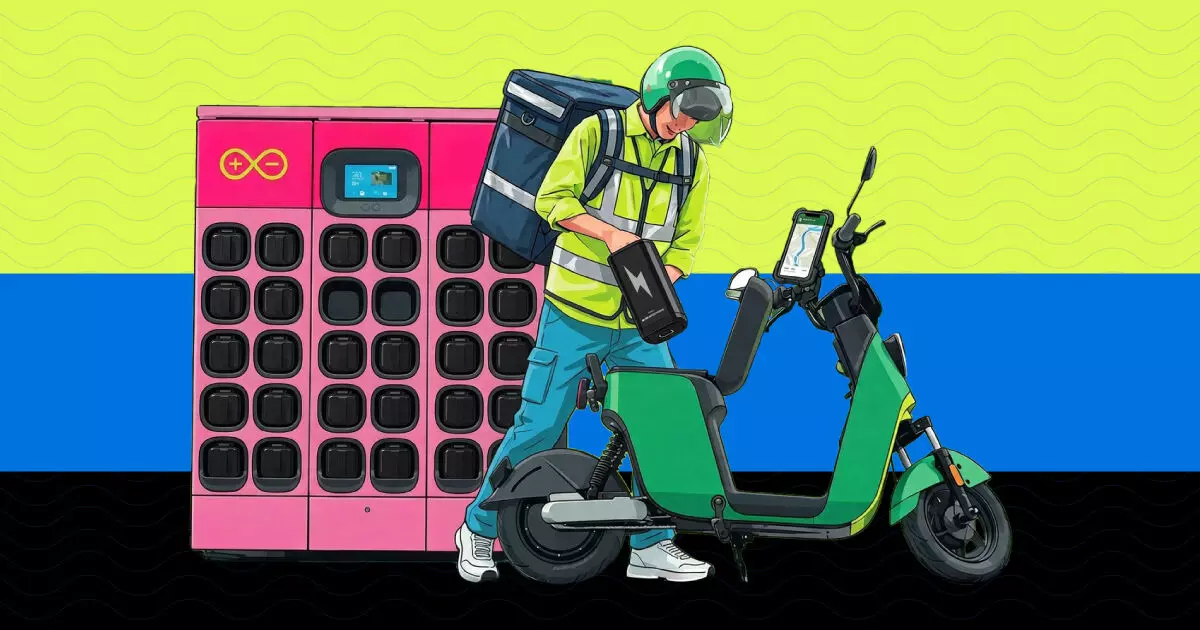
Kamlesh, 34, pulls up on his small Baaz electric scooter in front of a charging station near Delhi’s business hub Bhikaji Cama Place. He steps off and slides a depleted battery out from under the seat. He drops it into the swapping station, lifts out a fully charged one, fits it into the scooter and rides off.
He manages the swap through an app on his phone. The whole process takes about three to four minutes.
Kamlesh is among the thousands of gig workers in Delhi who have switched to an electric scooter. But he doesn’t own it. It is a low-speed electric model from Baaz Bikes, rented for about Rs 1,700 a week.
Battery swapping at Baaz Swap, the company's own battery network, is bundled into the rent. And because it is a low-speed vehicle, which Indian law does not require a licence to ride, there are no licensing formalities either.
The arrangement works for him. "I earn between Rs 1,200 and Rs 1,500 a day via deliveries. And renting the vehicle has helped me get to this sustained source of work and income," he said.
Renting battery-swapping bikes has become a common arrangement for delivery riders who depend on quick turnarounds.
Baaz Bikes has a fleet of nearly 6,000 scooters and about 370 swapping stations across Delhi-NCR, co-founder and CEO Anubhav Sharma told The Core. Swapping suits gig workers, he said, because they cover roughly six times more distance each day than a typical consumer.
It does not always work smoothly, though.
"Many times the stations are not working and we have to report it, or the batteries are found depleted, especially in the summer months when the grid load is too heavy," Kamlesh said.
Baaz claims its stations run at about 75% utilisation, and that it is the only company in the segment that both manufactures its own scooters and runs its own battery-swapping network.
While this sounds promising, battery swapping has yet to win over private buyers beyond captive fleets. Most automakers also sell scooters with fixed batteries. Honda Motorcycle and Scooter India launched the Activa e, a swappable-battery version of its Activa, but it has sold in small numbers.
There is no finalised national policy as well, no common battery standard, and a tax treatment that penalises the swapping operator.
As a result, just a few new companies are entering the swapping infrastructure market.
What’s Working For Gig Economy
The battery makes up 40 to 50% of the price of an electric vehicle. With swapping, the battery is not fixed to the vehicle, so the purchase or rental price falls. The swapping operator owns the battery and the rider pays per swap or through a subscription.
For a delivery rider, every hour spent charging is an hour without earnings. A fixed-battery EV needs at least four to five hours on a slow charger, or about an hour on a fast one.
Amit Bhatt, India managing director at the International Council on Clean Transportation (ICCT), said swapping makes sense where it saves users the opportunity cost of charging.
“This is particularly relevant for gig workers, for whom time spent charging translates directly into lost income. Swapping makes the most sense in applications where vehicle uptime has a clear economic value,” he told The Core.
Two-wheeler rental provider Bijliride started in 2020 with students and working professionals as its core customers. But it stayed open to everyone, and has since found that about 95% of its fleet is used by gig workers.
“Most of them are migrant workers who do not have permanent homes or fixed electricity connections, so swapping works best for them,” co-founder Vishal Vikram told The Core.
Bijliride operates a fleet of about 6,100 rented scooters across Delhi, Mumbai, Hyderabad and Bengaluru, and Vikram said he is confident it will turn profitable by the end of the current fiscal year.
Riders typically make three to five swaps a day, most at partial discharge.
Bharath Krishna Rao, CEO and co-founder of the Bengaluru-based electric two-wheeler OEM EMOBI, said a rider using battery swapping spends about Rs 1.2-1.5 per km, compared with Rs 3-3.5 per km for a similar petrol vehicle, making swapping significantly cheaper to run.
“The actual frequency of swapping and the savings in time and money depend on daily distance travelled, riding patterns, swapping charges and the availability of battery stations,” Rao told The Core.
A June 2026 report by the policy research institute Council on Energy, Environment and Water (CEEW) estimated the running cost of an electric two-wheeler on swapping at an average of Rs 1.46 per km. That compared with Rs 1.67 for a fixed-battery electric scooter and Rs 2.40 for a petrol one.
According to Muthu Subramanian, the managing director at the Bengaluru-based battery-swapping company Yuma Energy, it costs under Rs 1 to swap its batteries.
While the savings over a fixed-battery scooter may seem modest, the larger gain is in uptime and in the lower entry cost.
Baaz plans to roll out a second generation of its swapping infrastructure by early December. The upgrade will bring larger batteries with better cooling, faster charging and longer range, Sharma said.
How Big Is The Market?
While there is no official data on total swaps or the utilisation rate of swapping stations, the pool of potential users is only growing.
India had 12 million gig workers in FY25, up from 7.7 million in FY21, according to the Economic Survey 2025-26. NITI Aayog's 2022 projection puts the number at 23.5 million by 2029-30.
Investors are betting on that growth.
In a funding round announced at the end of August this year, Canadian auto parts maker Magna International put $35 million (about Rs 333 crore) into Yuma Energy, the company it co-owns with shared-mobility firm Yulu. The investment raises Magna's stake from the 51% it took when the joint venture was formed.
Yuma said its daily swaps grew from 50,000 to 85,000 over the past year, a rise of roughly 70%. "We are working toward EBITDA profitability on the back of a fast-growing customer base," Subramanian told The Core. He added that a franchise station can start at a minimum investment of around Rs 5 lakh.
The sector, however, remains concentrated in a handful of battery-swapping infrastructure operators, and their number has not grown significantly over the years, Randheer Singh, CEO of ForeSee Advisors and a former director at NITI Aayog, told The Core.
The Standardisation Fight
The biggest reason new players are staying away, Singh said, is the lack of policy clarity and of a standard for battery configuration and safety.
Batteries from different vehicle makers and models differ in chemistry, power and energy density, and form factor. Those variations limit interoperability, which in turn limits how widely swapping can spread.
The industry players are split on the fix. Some want regulations around standardised batteries. Others argue a single standard could discourage innovation and strand the investments existing operators have already made.
"Industry stakeholders have remained divided on the way forward, which has contributed to the lack of formal regulations following the release of the draft battery-swapping policy," Bhatt said.
"Greater industry alignment and regulatory clarity will be essential to enable wider adoption,” he added.
The policy has stalled in the meantime. NITI Aayog released a draft battery-swapping policy for public consultation in 2022. Several consultation meetings have followed, but no national policy has been finalised.
Tax Barriers
The tax system also treats the battery in a swap station far less kindly than the one that comes fixed into a scooter. A battery bought by a swapping operator is taxed at 18%, while an EV sold with its battery fitted attracts 5% GST.
And with no policy development, this has not changed.
The government cut GST on EVs to support them. A separate battery, however, attracts the higher rate because it could also be used for storage applications and not only in EVs, an industry veteran who is close to the developments and did not wish to be named, told The Core.
The higher rate of 18% matters, the CEEW report argued, because swapping networks need 30 to 50% more batteries than are in use at any moment, so that riders always find a charged pack.
Swapping operators expect to recover that investment over five to seven years, depending on battery life. But because the input tax credit is blocked for these many years, a significant amount of capital stays tied up, which is a heavy burden for an industry made up mostly of early-stage start-ups.
The report argued that GST parity would level the playing field.
The GST Council has so far rejected industry requests for parity, the report noted. It urged a 5% rate for all batteries certified under the AIS 156 standard (the safety standard for batteries in EVs), whether used for swapping or fixed in vehicles.
Subramanian makes the same case. Batteries offered through swapping, he said, should get the same GST treatment as an EV sold with its battery, so that a model that lowers the buyer's upfront cost can reach more riders and fleets.
“Swap stations should get the benefits charging units already receive, including capex support and easier access to land and power connections, since they do the same job of keeping EVs on the road,” he added.
Lack Of Basic Standards
Safety standards for swap stations date from 2022 and remain at the draft stage for light electric vehicles.
There is no battery liability as well. This means if a battery catches fire at a station or in a vehicle, responsibility could fall on the vehicle manufacturer, the battery manufacturer or the swapping service provider.
Bhatt stated that the key challenges for this sector include battery safety, maintenance, and ensuring interoperability across different vehicles and swapping networks. “In the absence of a comprehensive battery swapping policy and regulatory framework, addressing these issues remains difficult,” he said.
Swapping is also left out of the auto production-linked incentive (PLI) scheme. According to the CEEW report, operators face limits in the homologation process (the certification needed to approve a vehicle or battery for road use), exclusion from large government vehicle tenders, difficulty finding real estate for stations, and inconsistent rules across states.
Rao pointed out the need to encourage investments in shared swapping networks and expand their availability beyond a few urban centres. “India does not have a battery problem. It has a standard problem. Make batteries interchangeable and the swap network builds itself.”
Road Ahead
Singh is unconvinced that swapping will be sustainable among two-wheelers in the long run. As lithium-ion battery prices fall, he said, scooters with fixed batteries are becoming more affordable and getting closer in price to swapping models, which narrows the upfront cost advantage the model relies on.
Resale is another problem. A buyer would have to find someone living near battery swapping stations of the same company, or there is little point in owning the vehicle.
Globally, only a handful of swapping models have succeeded, and most rely on a dominant player, Bhatt said.
In Taiwan, Gogoro entered early, built a strong customer base and made swapping a familiar practice. In China, CATL has emerged as a major player in swapping for heavy-duty trucks, supplying batteries in a way that enables standardisation and swapping across vehicles.
For Kamlesh, those questions are distant. What matters is whether the station near his delivery zone has a charged battery when he pulls up on a hot afternoon.
For now, swapping is working for riders like him, as long as the stations do. Whether it can grow beyond them depends on whether the industry can agree on a standard, and on whether policymakers are willing to treat a swapped battery the same as one fixed into the scooter.
Core.
Core.


