



 Newsletter
 Search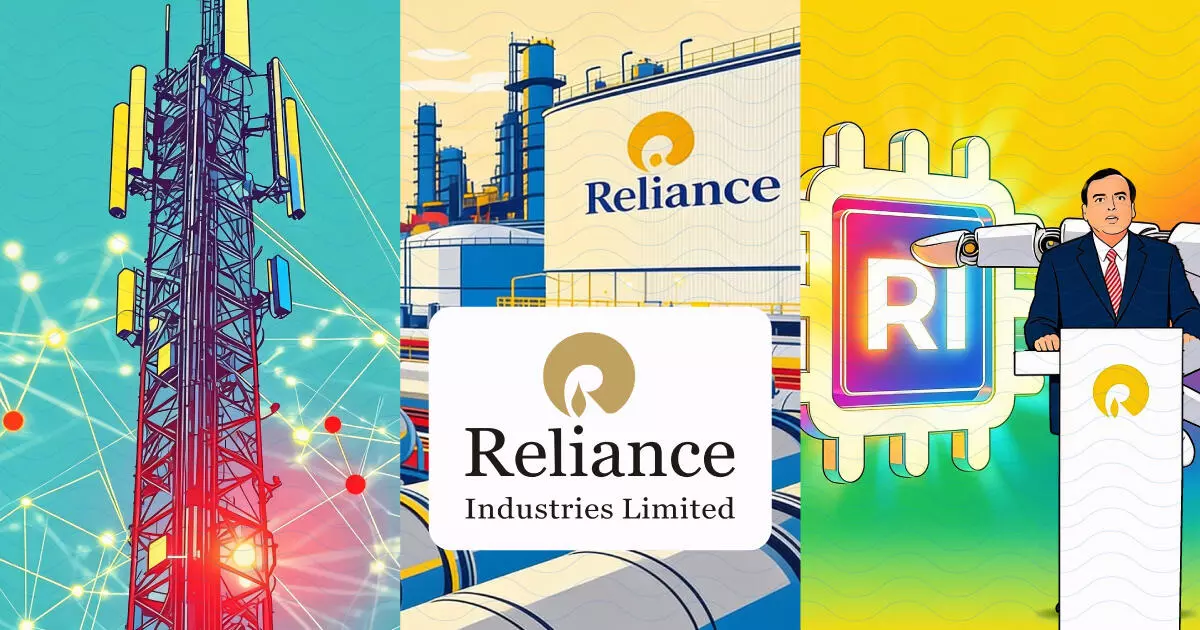
RIL Is Becoming A Platform Company. The Jio IPO Is Just The Beginning

The telecom IPO signals a bigger overhaul of Reliance's structure, capital strategy and long-term growth ambitions.
The Gist
The proposed Jio Platforms IPO marks a significant shift for Reliance Industries, emphasizing independent valuations and new growth engines.
- Jio's listing will allow for clearer growth trajectories and separate capital pools for each business.
- Reliance aims to transition from a traditional energy conglomerate to a diversified platform company.
- Analysts predict that the IPO will attract new investors and enhance Reliance's institutional credibility, especially for future green energy projects.
For decades, Reliance Industries Ltd's annual general meetings have served as a roadmap for the company's next phase of growth. This year's gathering may prove more consequential than most.
With the proposed listing of Jio Platforms, announced at the annual general meeting in June, Mukesh Ambani has set in motion more than India's most anticipated initial public offering.
The move advances three objectives of the company — monetising a decade-old telecom business, sharpening succession plans and accelerating Reliance's transition from a sprawling energy conglomerate into a platform company built around digital, consumer and energy businesses.
It reflects how Reliance wants investors to value the group. Rather than one conglomerate trading on a blended multiple, each business would increasingly stand on its own, with separate capital pools, independent valuations and clearer growth trajectories.
Jio's listing is the first major step in that direction, with retail widely expected to follow, while the parent company increasingly focuses on its new energy ambitions.
Ambani has described Reliance's future around three platforms, which are digital, consumer and energy. Last month, he took the first formal step towards that vision by announcing the proposed listing of Jio Platforms, the group's telecom and digital services arm. Investors expect the retail business could eventually follow, potentially leaving energy within Reliance Industries.
That matters because the consumer businesses have always cushioned the cyclicality of Reliance's traditional energy operations. As one of those businesses prepares to trade independently, the parent company will need fresh growth engines, and RIL appears intent on building them.
In terms of what changes, Hemant Bhattbhatt, CEO at Hmsa Consultancy, a strategy and management consulting company, said, 'The parent (RIL) may no longer get the same quarterly earnings smoothing inside one listed company, but it can continue to benefit through its shareholding, dividends and value appreciation in the listed subsidiary.'"
More Than Just An IPO
Jio is expected to issue 270 million shares, resulting in equity dilution of about 2.9%. Media reports estimate proceeds of $2 billion to $3 billion, with the telecom business expected to be valued between $117 billion and $127 billion.
Reliance Industries currently owns 66.43% of Jio Platforms, while Google holds 7.73%, Meta owns 9.99%, and the remaining 15.85% is with other strategic and financial investors. But analysts argue the significance of the listing extends beyond fundraising.
Shriram Subramanian, founder and managing director of Ingovern, believes the biggest change will be greater visibility into Jio's value rather than any structural shift for Reliance.
"Jio already has a non-RIL set of shareholders, with the IPO it expands to slightly more with public shareholders. … In the initial period, RIL benefited from the upswing in Jio, and later it brought in other investors. The only impact I see is that Jio's valuation becomes more visible as a listed entity, and how that valuation moves in the future will also have an impact on RIL's valuations."
The listing announcement has also laid the groundwork for what comes next.
Although Jio will have public shareholders, Reliance will continue to own a controlling stake, allowing it to benefit from future value creation while creating a separate currency for capital raising.
Analysts at Ambit Capital said there is another advantage. Independent valuations, they argue, could help attract capital for Reliance's green energy platform.
They said that as the “undisputed market leader”, Jio Platforms was uniquely positioned to drive periodic telecom tariff corrections over the next decade.
According to the firm, pricing power should keep revenue growth ahead of nominal GDP growth, helping early private equity investors earn more than a 10% dollar-based internal rate of return. It said successful investor exits would also enhance Reliance's institutional credibility and make it easier to raise capital for future green energy projects.
A Different Reliance
The timing is significant as Reliance's earnings mix has already changed dramatically.
As of FY26, roughly half of the company's Rs 2.07 trillion EBITDA came from its consumer businesses. Telecom alone accounted for Rs 76,255 crore, or 37% of consolidated EBITDA, underscoring how far Reliance has travelled from its refining-led past. The digital services and retail business have often helped offset cyclical weakness in the oil-to-chemicals business.
Bhattbhatt argued that investors increasingly favour transparency over conglomerate complexity.
"Investors would rather value Jio, retail and energy on their own merits than apply one blended multiple to the whole group."
That changing investor preference is arriving just as another of Reliance's long-term bets begins moving from promise to execution.
New Energy Takes Centre Stage
As RIL’s telecom business heads towards a listing, RIL’s new energy is inching towards its own first year of operations.
The company expects 2026 to mark the operational start of its new energy business, with battery and electrolyser giga factories in Jamnagar, Gujarat scheduled to begin operations before the end of the year.
Ambani has repeatedly described new energy as a large growth engine for RIL, spanning solar, batteries, wind power, green hydrogen, underground coal gasification, compressed biogas and bioenergy.
Analysts at Nuvama expect the new energy business to do exactly what telecom did for RIL’s stock prices in the early part of the last decade.
“.. could trigger a valuation re-rating for RIL’s stock price—similar to the trend seen following RJIO’s launch in 2017. RIL’s New Energy rollout shall not only add 50%-plus to PAT, but also re-rate valuations, including the O2C business given its net zero-carbon target by 2035,” the analysts said.
Between 2016 and 2019, Reliance's shares climbed largely on expectations surrounding Jio and its future earnings potential. Nuvama expects the new energy business to follow a similar trajectory, moving from a Rs 300 crore loss in FY27 to contributing about 8% of Reliance's profit after tax by FY30.
“However, we believe additional businesses in the NE segment shall also start to contribute in a phased manner. This shall enable RIL to meet its target of increasing PAT contribution from the New Energy segment to 50%-plus by 2030,” the analysts added.
Yet the strategy differs from the one Reliance adopted while building Jio and retail.
Ambit Capital noted that during 2010-19 the company largely funded those businesses from internal cash flows. This time, it is relying more heavily on partnerships and external pools of capital rather than materially increasing capital expenditure. Platform structures allow companies to tap diverse investors while using one part of the ecosystem to finance another.
A Potential Growth Engine — AI
Even before the new energy business has fully scaled up, Reliance has begun building what could become its next platform.
Its latest venture, Reliance Intelligence, is less than a year old but is expected to commission its first 120 megawatts by the end of 2026 while operationalising an initial fleet of advanced NVIDIA GB300 GPUs.
Some analysts believe the business could eventually prove as consequential as Jio, although it remains at an early stage, with larger investment plans yet to be disclosed.
The Company After Jio
The proposed IPO also gives investors greater clarity on succession.
During the AGM, Ambani mapped out leadership responsibilities across the group's three core businesses.
"Isha (his daughter) leads Consumer Businesses. Akash (the elder son) leads Technology Businesses. Anant (the youngest son) leads the Energy Businesses."
Bhattbhatt said the listing was far more than a capital-raising exercise.
"In Reliance’s case, a Jio listing is not merely a fund-raising event. It is a value-unlocking, governance and succession-clarity event. Jio has its own business model, investor appeal and growth trajectory. A separate listing gives it an independent market identity and a sharper benchmark against global digital and telecom peers."
Ambani also reiterated his confidence that Reliance's EBITDA would double over the next five years.
Brokerages, however, suggest investors may have to wait for the newer businesses to materially change the earnings profile.
Nomura expects the key catalysts after the Jio IPO to be the ramp-up of the new energy business, revenue contribution beginning FY27, growth in the AI business and a potential listing of the retail business. Multiple brokerages estimate that new energy may account for only 8-10% of total profits by FY30 unless other businesses scale up more rapidly.
Views also differ on how much value the Jio listing itself will unlock.
Dolat Capital believes the IPO should attract a new class of investors and command a premium valuation, benefiting Reliance's minority shareholders. Nuvama is more cautious.
"While premium valuation is likely, RIL shareholder gains may be limited by holding company discount," the analysts said.
Until 2016, Reliance was largely viewed as an energy company. Jio changed that perception. The proposed listing could redefine how the group is valued over the coming decade.
Analysts at Systematix said, "FY30 could mark the period when these emerging businesses begin contributing meaningfully to earnings, potentially reshaping Reliance's valuation framework from a traditional energy conglomerate to a diversified technology, consumer and energy transition platform."
Ambit Capital also made a similar observation.
"RIL is evolving beyond a traditional conglomerate into a closed-loop digital and physical ecosystem."
Bhattbhatt describes it as a shift by the parent company from "being only an operating conglomerate to also being a strategic capital allocation platform”.
Core.
Core.


