



 Newsletter
 Search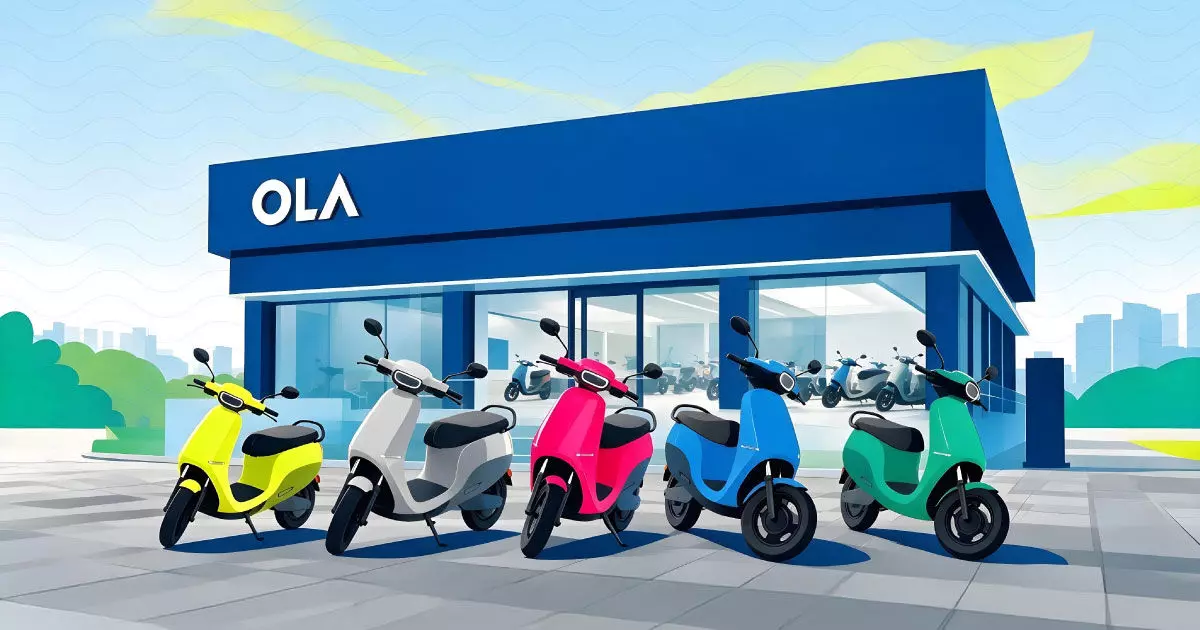
Ola Electric's Dealer U-Turn Is Too Little Too Late

Facing collapsing market share and service breakdowns, Ola Electric ditches its direct-to-consumer model for dealerships, betting on a fix years in the making.
After five years of chasing a Tesla-style direct-to-consumer (D2C) model, electric two-wheeler maker Ola Electric Mobility has finally thrown open its doors to third-party dealerships.
On Friday, it launched the first batch of dealer-operated stores across six states, a reversal that comes after years of customer complaints, service failures and regulatory notices.
At the company's Q1 earnings call, Ola Electric’s chairman and managing director Bhavish Aggarwal told analysts the pivot to finally go to distributors was a strategy that would “meaningfully enhance” Ola’s growth. He claimed that dealers had been asking to come on board "from almost the time we started this company five years ago."
Aggarwal claimed that going through dealerships earlier than this would have slowed growth, and the dealer ecosystem itself wasn't yet confident about EVs. "That has materially changed as our scale, and the industry, have evolved," he said.
The carefully worded statement was also an admission that Ola's D2C experiment had run its course, one that industry experts warn may prove too little, too late. And its customers have paid the price for that delay.
Ola’s board has also approved a fundraise of up to Rs 1,500 crore on Friday, even as the company's chief operating officer Hyun Shik Park resigned on the same day, citing personal reasons.
Moving On, Finally!
When the Bengaluru-headquartered EV maker entered the two-wheeler market with its first electric scooter, the Ola S1, in August 2021, it explicitly borrowed Tesla's playbook of company-owned experience centres, app-based service bookings, and no middleman dealers standing between the brand and the buyer.
While it set the company apart from other automakers and sounded disruptive at the time, that bet has not really paid off.
As per retail data from the Federation of Automobile Dealers Associations (FADA), Ola’s sales volumes fell over 50% to 1.99 lakh units in CY25, from its peak of 4.07 lakh units in CY24.
Rising customer complaints over servicing delays, intensifying competition, and falling market share have pushed the company to open its sales and service network to traditional dealer partners nationwide.
"The automotive industry is still traditional at its core; it needs customer support. If something goes wrong, where else can a consumer turn to?" said Amit Kaushik, co-founder of MobiDx AI, an automotive-focused consulting and analytics firm.
According to its official website, Ola had over 800 stores in March 2024. By December, the company said this had grown fourfold to 4,000, with expansion into Tier-2 and Tier-3 towns.
Against that backdrop, the first cohort of nine dealer-operated outlets, launched last week, marks Ola's actual entry into third-party retail, spanning a deliberately dispersed footprint rather than a metro-first rollout.
This includes Ganesh Motors in Latur (Maharashtra); Bechelal Autosales in Bahraich (Uttar Pradesh); Autocity Motors in Jaipur (Rajasthan); Virat Motors in Hanumakonda (Telangana); The EV Store in Neemuch (Madhya Pradesh); Jattari Auto Wheels in Aligarh (Uttar Pradesh); Durai Agencies in Pudukkottai (Tamil Nadu); Arihant Automobiles in Chhindwara (Madhya Pradesh); and Kailash Motors in Gadarwara (Madhya Pradesh).
This mix of Tier-2 and Tier-3 towns across six states signals Ola's opening bet is on exactly the kind of local, on-ground retail presence its D2C model never built. The company is targeting a network of more than 500 dealerships over the next couple of quarters.
Harshal Dasani, business head at INVasset PMS, suggests that the dealer network is the correct structural fix, since it is the model legacy automakers have relied on for years.
"It is also a tacit admission that the D2C thesis on which the IPO was priced did not work," he told The Core.
Specific queries sent to Ola Electric did not elicit a response.
Catching Up
Not everyone is convinced that the pivot is well timed, though.
Deepesh Rathore, founder of automotive consultancy firm Insight EV, called the move "unethical" in one sense, as it comes after years of accumulated service complaints. It is now the dealers who will have to absorb customer frustration built up under Ola's own watch.
"It could actually be a nightmare for the dealers," he told The Core.
The timing has cost Ola dearly. Its sales began declining about a year ago, and had the company opened up its channel then, there might still have been room for damage control on volumes.
“With confidence in the brand still low and cash reserves tightening, signing up and sustaining quality dealers won't be easy,” Rathore added.
Cost Parameters
US-headquartered Tesla remains the only success story in pure D2C for auto retail, and for reasons Ola could never match. Its products are reliable, and over-the-air updates significantly reduce downtime.
"Even though Ola's move was radical in going for D2C to save costs, it has now cost them too much," Rathore said.
Without a dealer network, Ola had to manage vehicle registration compliance itself, a function dealerships would normally absorb, but one the company had to run on its own under its D2C model. Since December 2021, it had relied on two vendors, Rosmerta Digital Services and Shimnit India, to process registrations at RTOs across the country.
The arrangement with the agencies held for over two years, until February 2025 when the company attempted to negotiate the contracts to cut costs, informing the exchanges that the change would only "temporarily" dent registration numbers on the government's VAHAN portal.
However, it did far more than that as customer deliveries that typically took a week began stretching to nearly a month, and by March that year, Ola's claimed sales of 25,000 scooters for February matched close to a third of that in actual VAHAN registrations, a gap that drew formal queries from the Ministry of Heavy Industries and the road transport ministry.
Industry estimates suggest it costs more for an EV maker to sign on a dealer partner compared to a petrol one. Commissions for electric two-wheeler dealers run at an industry average of 10-12%, close to roughly double those for internal combustion engine (ICE) dealers. That gap exists primarily because traditional dealers earn a large share of their revenue from servicing over a vehicle's life. And EVs, by design, need far less of it beyond routine wear and tear.
Servicing an electric scooter is fundamentally different from servicing an ICE vehicle, since it involves a heavy load of electronics as well.
On The Ground
The service breakdown driving Ola's dealer pivot is not abstract for customers like Prasanna K Ram, a Chennai-based Ola S1 owner.
According to Ram, the company has shut down the majority of its service centres across the city. The Anna Nagar service centre near him now carries a sign reading "Temporarily Service Closed."
His own scooter has been non-functional for over two weeks now, after its battery drained while he was on vacation. Reaching customer support has been just as difficult. “Calls take roughly 15 minutes to connect, and while representatives repeatedly promise to raise a service ticket, nothing has come of it despite multiple attempts,” he told The Core.
What has struck him most, though, is that even as his own scooter sits dead, he continues to receive sales calls for new Ola scooters, increasingly from an AI voice agent that claims to be human. Ram argues that the company’s more urgent task should be clearing the backlog of scooters stuck in service limbo, rather than pushing new sales.
Ola’s story of service breakdowns has been one for the record books, and has earlier played out in public as well.
In October 2024, comedian Kunal Kamra posted a photo of Ola scooters gathering dust outside a dealership. This was followed by a public exchange with Aggarwal, which wiped out crores in market value in a single session and resulted in a wave of Ola owners airing their own complaints.
Weeks later, the Central Consumer Protection Authority (CCPA) ordered a formal probe as Ola's claim of resolving 99.1% of complaints failed cross-verification. The National Consumer Helpline had logged over 10,000 complaints. HSBC analysts who visited service centres around the same time found most overwhelmed and understaffed.
By 2025, Maharashtra transport authorities reportedly found 121 Ola experience centres lacking valid trade certificates and asked to shut them down.
Ola's retail sales market share has collapsed from about 35% in FY24 to 30% in FY25 and 12% in FY26. It has shrunk, while TVS Motor, Bajaj Auto, Hero MotoCorp and Ather Energy have grown.
In FY27 so far, Ola's market share has averaged 8% over the four months from April to July.
"Losing share that fast in a segment growing that fast means the demand exists and customers are choosing competitors," Dasani said.
The Numbers Behind The Pivot
Ola Electric, the first pure-EV company in the country to go public, made its market debut in August 2024. The current strategic reset comes against a struggling financial backdrop.
Ola’s revenue fell for the seventh straight quarter in April-June, even after heavy discounting aimed at reviving sales volumes in the market.
Its operating cash flow also turned negative at Rs 215 crore, reversing a positive Rs 91 crore in the January-March quarter.
Average selling price (ASP) per vehicle has dropped to Rs 1.14 lakh in Q1 FY27, down from Rs 1.31 lakh in Q4 FY26 and Rs 1.21 lakh in Q1 FY26, directly impacting margins.
The company's troubles aren't limited to recent times, either. Senior management churn has been especially high at Ola during the past five years, with multiple leadership roles turning over in quick succession. Close to half a dozen of Ola's senior employees whom The Core spoke with suggested that the management prioritised speed over getting the outcome right.
Park's exit, coming the same day as the fundraise approval, fits that pattern, according to Dasani. "It does not help the governance read," he said, on a balance sheet already carrying roughly Rs 2,763 crore of debt against Rs 709 crore of cash.
What Comes Next
The new retail strategy, Aggarwal said, will see company-owned stores shrink in number while dealer stores become "the backbone for volumes, transactions and service."
He pointed to two draws for prospective dealers. One, a large existing customer base, much of it now past the three-year warranty window and in need of paid servicing, and a broad product portfolio. He said the unreleased models have been shared confidentially with some dealers.
According to Kaushik, under the new dealer model, Ola will need to back its partners heavily.
"Dealers cannot handle it alone, as they will need technical support and training from the company on their specific products," he told The Core. Vehicles, unlike commodities, live on the road every day and require sustained aftersales support.
Aggarwal acknowledged the brand had weakened over recent quarters but insisted dealers are betting on a turnaround.
"The stronger dealers see the underlying product pull, and they believe the service challenges are areas they can address effectively," he said, calling the shift a relevant pivot that should meaningfully move the needle on scale and industry penetration “over the next few months."
Whether that confidence survives contact with reality is the open question, and will most definitely define Ola’s next sales chapter.
For the stock, Dasani laid out a checklist the market will look for before any re-rating. This includes market share stabilising above 10% for three straight months, the 500 dealer stores actually generating throughput rather than merely being signed, the automotive business reaching adjusted EBITDA breakeven, and four consecutive quarters without another dilutive raise.
A return to Ola's August 2024 high of Rs 157.40, against a current price near Rs 38.20, would require the stock to more than quadruple on an already-enlarged share count, which is "a multi-year outcome even in the best case," he said, adding that “on any estimate I can defend today, not one the current trajectory supports."
The larger risk over the next 12 to 24 months, according to Dasani, is that Ola's share loss stops being cyclical and becomes structural, with TVS and Bajaj now together holding over half the market and Ather and Hero also ranked above Ola. "The base case for the next two years is a company that must win back customers one dealer at a time while its two largest competitors are compounding from a position of strength."
Indeed, Ola built its five-year story on skipping the middleman. It is now betting its survival on the same middleman to clean its mess.
Core.
Core.


