



 Newsletter
 Search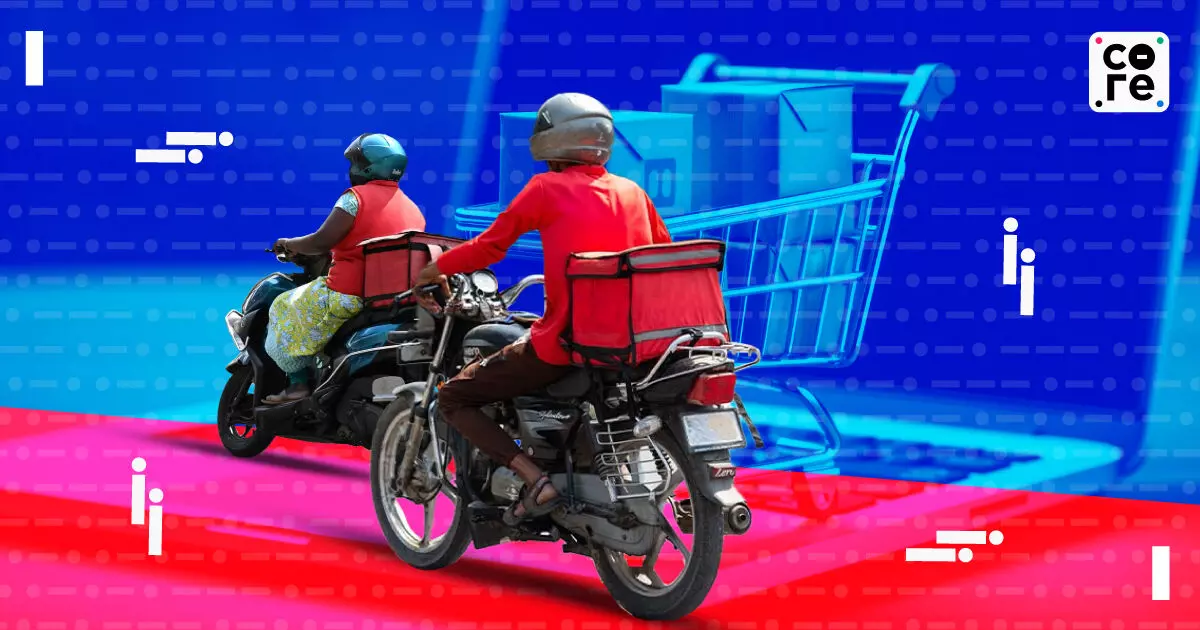
Neither Formal Nor Informal, Gig Workers Ecosystem Influences New Labour Policies
 By Katya Naidu
- Business
- Published on 7 Nov 2025 6:00 AM IST

With 270 million online shoppers, India’s gig economy is surging, outpacing staffing services and reshaping employment norms through policy reforms
The Gist
India's gig economy is rapidly expanding, with a projected growth in gig workers from 10 million to 23.5 million by FY30.
- Urban cities increasingly rely on gig workers for essential services, including food and groceries.
- The government is implementing measures for social security, including The Code on Social Security, 2020.
- Challenges remain regarding fair compensation and working conditions, as many gig workers face seasonal income fluctuations.
Food, groceries and even services — most urban cities are now dependent on gig workers for their daily essentials. As India’s online shopper ecosystem swelled to over 270 million in 2024, the gig worker economy has also grown exponentially.
A NITI Aayog report said that India had around 10 million gig workers as of FY25, which is expected to zoom to 23.5 million by FY30.
The market and regulations are also evolving to accommodate this growing workforce.
Gig workers can be defined as those who work for digital platforms or organised gig workers, unlike casual labour or farm workers.
Of the 10 million such workers, 6 million are riders or last-mile delivery partners, the rest are on cab aggregator platforms, sales or hospitality.
The gig ecosystem has overtaken the staffing services ecosystem in size, which stands at around 6.5 million. Unlike the latter, the former was at zero around 15 years ago and has grown at an exponential pace.
But one of the biggest challenges for them is that neither are they completely a formal industry, nor are they part of the informal sector.
“They are formal in a limited sense because they still get their payouts credited to their bank accounts and are not paid in cash. The government has some visibility on how much they earn. They are not formal as they’re still not under the purview of social security,” said Balasubramanian Anantha Narayanan, the senior vice-president at TeamLease Services.
However, there has been movement on this end.
The Parliament has enacted The Code on Social Security, 2020, which defines ‘gig workers’ and ‘platform workers’ and provides measures for their social security. This includes benefits such as life and disability cover, accident insurance, health and maternity benefits, and old age protection.
It could be a game-changer for hundreds of thousands of young Indians choosing to work intermittently, in the form of gigs, as opposed to steady jobs.
“The government is trying to bring in a policy, customised and modernised labour law based on the International Labour Organisation (ILO) conventions, which takes into account this category of workers who have been created by modern technology. If implemented by the states as well, it will be an amazing process,” said Dr Arpita Mukherjee, professor at the Indian Council for Research on International Economic Relations (ICRIAT).
The Karnataka state government has taken a step in this direction when the state assembly passed the Karnataka Platform-Based Gig Workers Bill, 2025, this August. The bill has set up a welfare fund for the employees, and proposed a 1-5% welfare fee on each transaction for aggregators, among others. The bill also aims to register workers on board, provide income security and reasonable working conditions for the workers.
Quality Of Employment
The Code on Social Security consolidates and simplifies nine central labour laws relating to social security. The four codes throw the net wider — extending coverage to employees in the organised sector, unorganised sector, self-employed, and for the first time, gig and platform workers.
Described as app workers, they are eligible for security schemes funded by the government, aggregators or platforms and workers themselves. A social security fund is to be set up to support such workers.
Apart from social security, it also provides quality of employment. “It means you need to be paid for the job that you do, so the contract is formal. It can be a commission-based model, as the gig economy doesn't follow a common model for remunerating the workers. The fact remains that there is a contract, a legally enforceable contract is very important,” said Dr Mukherjee.
The ability to receive payments is very important for gig workers as there are no third parties involved to ensure they’re paid. Staffing agencies have a limited role to play in the gig economy, and are restricted to recruitment only; many platforms employ people directly as well.
“We, as staffing companies, are intermediaries in ensuring that these guys are honest, right? We ensure all of their statutory dues are maintained, paid as per the laws of the land, etc.
In a gig arrangement, there are no such guardrails. If and when the labour courts come into the picture, and there is a modicum of compliance and statutory obligations that need to be met,” said Narayanan.
Is The Pay Enough?
In the competitive world of aggregators and platforms aiming to provide the fastest deliveries or attractive prices, the question remains as to whether the gig workers are compensated reasonably.
Experts believe the challenge of improving pay lies in the minimum wage, not necessarily with the platforms.
“We don't really have a jobs problem as a nation. We have a wage problem. Minimum wages in most states in the country are in the range of about Rs 12,000 to 15,000 a month… We are going through a prolonged phase of wages not really keeping in step with inflation, especially post-Covid. That's really pinching a lot of people,” said Narayanan.
Mukherjee said that the larger issue was that minimum wage rate hadn’t been revised. “That's the real issue. You cannot suddenly expect the platforms to pay more because everybody else is paying less. There has to be a minimum wage into the market that is kind of pegged to the cost of living,” she added.
Moreover, for gig workers, remuneration is not assured on a monthly basis and is heavily seasonal. Top e-commerce platforms hire more resources during the sale season or the festive season. The market has crests and troughs, which is what makes gigs a beneficial process for them. But how does it match up to gig workers?
“In our terms, we call gigs a self-employment opportunity. They have a choice to work for three companies or work while going to college. They can go to college, come back, work for three hours, pay college fees. It’s an additional income opportunity,” said Mukherjee.
As far as the extent of work is concerned, most gig workers are knowledgeable enough to pick dense areas or hours to earn the maximum per day. On average, gig workers are on at least four apps and juggle work. Moreover, the attrition amongst them is also very high, creating supply-side issues as well.
E-commerce, for example, has two types of gig workers — under the roof, who work at fulfilment centres and an outdoor workforce who go out for deliveries.
“Among the under the roof workers, the attrition is 20% a month. In five months, your entire workforce washes through your system. While the attrition is 40% per month among the outdoor workers, there is a large supply pool available as well and more and more people are coming into this ecosystem. The under the roof workforce is actually a bigger challenge and that becomes a bottleneck as well,” said Narayan.
The movement to improve work conditions has been steady.
Harsh weather conditions, such as heatwaves, affect the large and growing workforce who spend much of their workday on the roads.
During the summer, a few companies have started providing cooling spots. Some of them are also bunching deliveries either too early or too late to escape the burning heat.
The gig ecosystem is growing fast, and an ecosystem to aid it is growing too, hoping to keep pace. Apart from Karnataka (as mentioned above), other states such as Rajasthan, Bihar, and Jharkhand have passed bills which concentrate on creating welfare funds, grievance redressal and more.
Core.
Core.


