



 Newsletter
 Search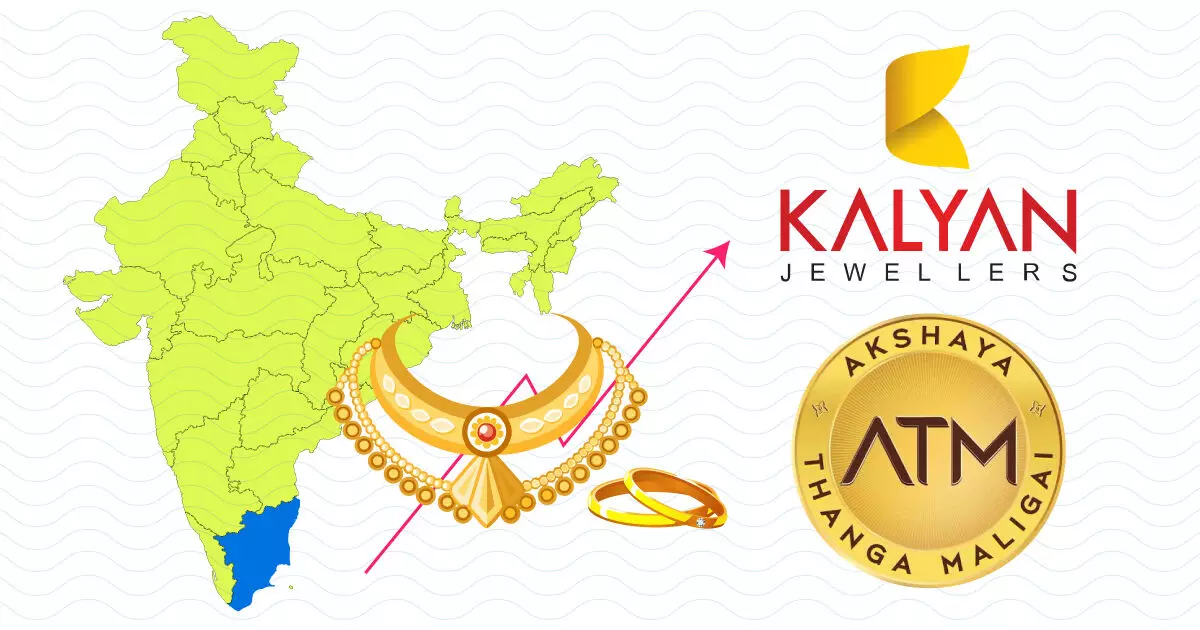
Kalyan Jewellers Bets On New Brand To Win Market Share. Will It Work?
- Business
- Published on 20 Aug 2026 6:00 AM IST

With Akshaya Thanga Maligai, Kalyan Jewellers is testing whether a national brand can also be a local one, even as margins take a hit.
The Gist
- The move aims to enhance local credibility and cater to Tamil Nadu shoppers who prefer regional jewellers.
- Kalyan's main business is growing rapidly but facing margin pressures, prompting this strategic shift to attract new customers and adapt to local buying preferences.
Kalyan Jewellers, one of India's largest jewellery retailers by revenue, is opening its first store under a new brand built only for Tamil Nadu. The store, called Akshaya Thanga Maligai, or ATM, opens in Chennai on August 21.
Four more stores will follow in the coming months.
The move comes at a time when Kalyan's main business is growing fast but earning less on each sale. The company's first-quarter results, released in the first week of August, showed strong revenue growth alongside falling margins, a pattern that has drawn attention from analysts tracking the stock.
ATM exists because Kalyan's national brand, however large, can't win the Tamil Nadu shopper who instinctively trusts local jewellers over an outside chain.
So rather than tweaking existing Kalyan stores, Kalyan built a separate brand from scratch, with a new name, a Tamil ambassador, and inventory (designs, weights, price points) tuned to local festivals and buying habits.
Experts believe it's not a replacement and is meant to attract customers who were never choosing Kalyan anyway. Through this new brand, Kalyan is buying local credibility it couldn't manufacture on its own.
The Core has reached out to Kalyan Jewellers for their response, and will update this report if and when they respond.
A Small Test, Not A New Direction
Kalyan plans to open 426 Kalyan-branded stores this year against just five ATM stores, according to Sandeep Abhange, research analyst for consumer & midcaps at LKP Securities.
While talking to The Core, he said this makes ATM a small test rather than a shift away from the company's national brand strategy.
Kalyan already runs 33 stores in Tamil Nadu, and ATM is not entirely new territory for the company. It already sells a regional line called Aishwaryam through its existing stores. Abhange said the real question is whether ATM’s individual stores can make as much money as a regular Kalyan store.
Manoj Menon, an analyst at ICICI Securities, offered The Core a longer view of the company's history to explain why this move makes sense.
Kalyan started as a regional brand roughly 15 years ago. Its first store opened in Thrissur, Kerala, in 1993, followed by a second store in Palakkad around seven years later, and only then did the company expand into Tamil Nadu through Coimbatore.
It was years later that Kalyan pushed into markets outside South India.
Menon said there was a distinction between having stores in a state and being perceived as a local brand.
Many jewellers may have a national footprint on paper, but remain associated with a particular community or region in the public’s mind.
He cited the example of a Bengali-focused eastern brand whose stores in Mumbai usually draw in customers primarily from the Bengali community, rather than the wider local population.
Kalyan, by contrast, has been tailoring its product mix by micro-market. In Mumbai alone, stores in different neighbourhoods carry different collections depending on which community dominates that area.
Menon said Tanishq is the only other jewellery brand with that kind of genuinely national reach and localised buying behaviour.
Why Margins Are Under Pressure?
Kalyan's consolidated revenue grew about 46% year-on-year in the April-June quarter to roughly Rs 105.9 billion, according to ICICI Securities' results note dated August 5.
The India business, which excludes West Asia operations, grew about 47% to around Rs 90 billion, helped by 28% same-store sales growth.
But profitability slipped. Consolidated gross margin fell to 11.9% from 13.9% a year earlier, a drop of 194 basis points, ICICI Securities noted.
On a standalone India basis, the decline was sharper; gross margin fell to 11.2% from 13.6%, according to the same report. Motilal Oswal's separate note, dated August 4, put the adjusted India gross margin at 10.8%, after stripping out a one-time gain.
Three factors explain most of the decline.
First, a higher share of gold coming from customer exchanges — old jewellery traded in for new — which Kalyan buys back at board rates rather than at the cheaper rates it can get for cash purchases. This recycled gold made up 46% of revenue in the quarter and crossed 55% in June alone, according to both broker reports, which cited company management.
Second, Kalyan ran promotional offers tied to its gold exchange campaign, called "Shine with India," launched in response to rising international gold prices.
Third, the same quarter last year had included one-off gains from selling platinum and silver, gains that did not repeat this year.
Partly offsetting this pressure was a one-time customs duty benefit of about Rs 410 million, after import duty on gold rose from 6% to 15%. Management told analysts on a call, as reported by Motilal Oswal, that it expects a further Rs 600 million of similar benefit in the current quarter.
Kalyan has also started a "Cash for Gold" scheme, buying old gold from customers below the prevailing market rate rather than through jewellery exchange.
Motilal Oswal's note said this business had grown from a single-digit share of transactions in June to double digits, and management expects it to gradually offset the margin drag from exchange-linked purchases.
Even with the margin pressure, both ICICI Securities and Motilal Oswal kept a "Buy" rating on the stock.
ICICI Securities raised its target price to Rs 680 from Rs 670, while Motilal Oswal kept its target at Rs 700, implying gains of 15% and 18% respectively from the stock's early-August price of around Rs 591.
What Localisation Means for the Market?
Abhange said the launch reflects how organised jewellery retailers may need to rethink competition.
He noted that branded jewellery's share of the overall Indian jewellery market rose from about 5% in 2000 to 32% in 2020, and to roughly 40% by 2025, a trend that makes it harder for large national chains to keep growing simply by opening more stores under one brand.
There’s also a change in how Indians are buying gold.
Gold jewellery volumes fell 15% in the April-June quarter even as the value of sales rose 50%, which he said reflects customers buying lighter, more affordable pieces as gold prices remain high.
Kalyan's own trade-in business grew accordingly: old-gold exchanges rose to 46% of revenue from 30% a year earlier.
Menon was more cautious about how far the localisation trend might spread. He said he could not speak for how other jewellers might respond, but noted that regional brands already have a foothold in several markets, citing PC Chandra in Kolkata, PN Gadgil in Maharashtra and Senco Gold in the east.
A national retailer creating a Tamil Nadu-specific brand, he suggested, is therefore less a new idea than an extension of a model that already exists in the industry. On whether Tanishq, the market leader owned by Titan, could take a similar route, Menon said he had no visibility into Titan’s plans but that the possibility exists, “logically speaking.”
ATM's rivals aren't named in Kalyan's own announcements; the company only refers to them as "entrenched regional jewellery chains" and "legacy jewellers."
In practice, that means Tamil Nadu's dominant homegrown players like GRT, NAC, Lalitha Jewellery, and Vummidi Bangaru, who've built deep local trust over decades.
Kalyan's stated edge isn't price; it's combining that same local, Tamil identity (via ATM's branding and Sivakarthikeyan) with things regional players usually lack: Kalyan's sourcing scale, hallmarking and quality standards, and capital, backed by a Rs 300 crore investment for rapid franchise-led expansion across the state.
Store Economics Will Decide The Outcome
Both analysts agreed that ATM's near-term impact on Kalyan's overall numbers will be limited, given it is starting with just five stores.
Kalyan management has said the new format will run on the same asset-light, franchise-led model the company uses for its main Kalyan stores, and that the pace of future expansion will depend on how the first few stores perform, according to Motilal Oswal's note.
Kalyan's broader India store network already leans heavily on this franchise model of the 354 Kalyan stores in India, 234 operate under a franchise-owned, company-operated structure, and franchised stores account for about 57% of India revenue, per ICICI Securities' data.
For now, the company's bigger financial story remains its debt reduction. Standalone gross debt stood at ₹16 billion as of June, with non-gold-linked debt at ₹3.2 billion, which management expects to clear entirely by the end of September.
Kalyan's Q1 FY27 margin pressure: gross margin fell to 11.9% from 13.9%, with the company attributing this to a higher proportion of exchanged gold, promotional offers under its gold-exchange campaign, and a one-off prior-year gain stemming from gold-recirculation and pricing dynamics, not from the ATM launch, which company statements never link to margins.
Experts say structurally ATM could help longer-term; ATM targets mass/regional demand with a franchise-led model, which typically carries lower capital intensity and could add volume without straining Kalyan's core margin mix, though this connection is inferred, not company-stated.
Whether ATM becomes a meaningful part of that growth story, or stays a five-store experiment, will depend on numbers investors won't see for a few more quarters.
Core.
Core.


