



 Newsletter
 Search
As Gold Stays Costly, Indians Are Rethinking What They Buy and How Much
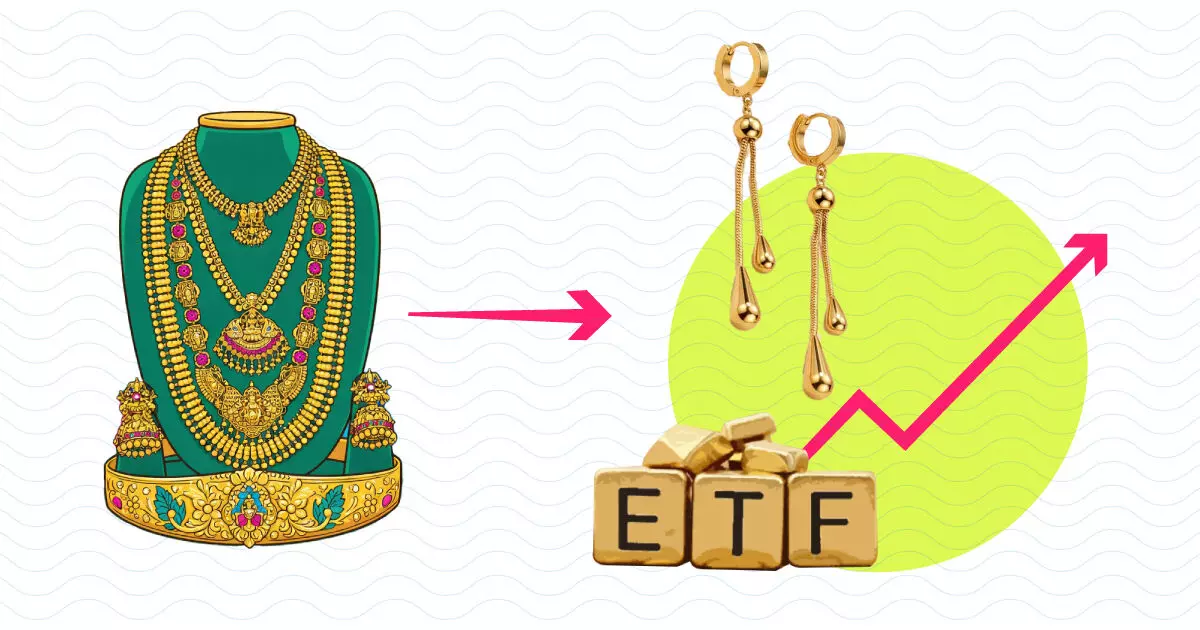
Jewellery volumes are falling, but spending is rising, as buyers trade down in weight and purity.
The Gist
Indian consumers are adapting to high gold prices by altering their purchasing habits, focusing on practicality over luxury.
- Couples like Shovik and Kritika prioritize versatile pieces for daily wear over traditional heavy sets.
- The share of gold jewellery demand is declining, with investment purchases rising.
- Buyers are increasingly utilizing old-gold exchanges and selecting lighter, lower-carat jewellery.
Shrusti Rane, a 29-year-old Mumbaikar, used to visit the jeweller several times a year. A new necklace, a pair of earrings, something for a cousin’s wedding — she would make several purchases a year.
But now, as gold prices have skyrocketed since 2025, she has reduced her gold buying.
“I used to frequently visit the jeweller's shop two to three years back. Now it's only on Dhanteras. The shops offer more discounts,” she said.
For many shoppers like Rane, Dhanteras, an auspicious day on the Hindu calendar to buy gold, is no longer one of many jewellery trips but the only one.
On Dhanteras day, the local jewellery shop that Rane visits was packed. She bought a pair of gold earrings this time and a diamond nose ring for her sister’s upcoming birthday.
Gold prices hit record highs in 2025 as geopolitical tensions rose in West Asia, with central banks across the world, including in India, diversifying their reserves away from the West.
While gold prices have eased from the record-breaking rally of 2025, they remain significantly higher than a year ago. This is changing how Indians buy gold.
From lighter jewellery and lower-carat pieces to fewer discretionary purchases and greater reliance on old-gold exchanges, consumers are finding ways to stretch their budgets even as the money they spend on gold continues to rise.
Wedding Gold Meets Rising Prices
Shovik and Kritika, also Mumbaikars, are getting married in January. Heavy gold sets, the kind families have long treated as the centre of a wedding, are not in their plan.
Dhanteras has become the one day many buyers like them wait for, because the brands’ offers make the purchase easier to justify.
“I want something I can wear every day. I believe it will be a waste if I can only wear it during a certain occasion,” Kritika said.
According to Shouvik, people his age care less about showing off with gold. He also says spending on things that aren’t essential is shrinking, so the couple would rather keep money for other priorities. They want to invest in a home 3 years down the line.
Their choices match a wider shift across India. Gold has become far costlier in a short time.
On Dhanteras 2024, Rs1 lakh bought about 13 grams of 24-carat gold.
On Dhanteras this year, 6 November, the same money bought about 7 grams, according to a Business Today calculation. In Delhi, 24-carat gold was about Rs1.46 lakh per 10 grams on Dhanteras, including taxes. A year earlier, it was about Rs1.32 lakh, Kotak Neo reported.
Prices are below the Rs1.83 lakh per 10 gram peak of 29 January 2026, but still high. On 10 November, Mumbai was at about Rs1.44 lakh.
Less Gold, More Rupees
World Gold Council (WGC) data shows the changing patterns of how Indians buy gold.
India’s gold demand in July-September fell 29% from a year earlier, to about 162.5 tonnes. But the value of that demand rose 3%, to Rs 2.42 lakh crore.
“High prices have not eliminated interest in gold jewellery. Rather, demand is adjusting,” said Kavita Chacko, research head, India, at the World Gold Council, told The Core.
Buyers are finding ways to cope.
Jewellery shows the same pattern. Volumes fell 20%, while spending rose 16% to Rs 1.49 lakh crore. The WGC said the rise in value was entirely price-led.
They are choosing lighter pieces and lower-carat gold, and they also swapping old jewellery for new. “Consumers have been buying lighter-weight and lower carat products, and there is greater use of old-gold exchange for new jewellery,” Chacko said.
Dhanteras followed the same script. Industry estimates put gold sales at about Rs 60,000 crore, up 15-20% from last year. The quantity sold was broadly unchanged, Kotak Neo reported.
Jewellery’s Shrinking Share
Jewellery remains the biggest share of India’s gold demand, but its share is falling. Chacko said it made up 72% of total net demand in 2021 and 56% in the third quarter of 2026. Investment, through bars, coins and gold ETFs, made up 42%.
Buying is also becoming more planned. “Purchases of jewellery are becoming more need-based, particularly around weddings and other important occasions, while discretionary purchases have softened,” Chacko said.
While weddings remain the backbone of India’s gold jewellery demand, rising prices are pushing families to stretch budgets and cut grams.
The World Gold Council puts bridal jewellery at 50 to 55% of the Indian gold jewellery market, and Motilal Oswal research estimates about 58% is wedding-driven. Rising prices are changing what families buy, though.
Jewellery demand fell 18% year on year to 241.1 tonnes in the first nine months of 2026, and consumers are choosing lighter-weight jewellery, lower-carat gold and stone-studded pieces. The World Gold Council expects wedding and festive buying to support demand for the rest of the year.
Investment buying has cooled from earlier in the year, though. In the same quarter, demand for bars and coins fell 40% from a year earlier to 55 tonnes, according to WGC data. Over the first nine months of 2026, investment demand fell only 4%, against an 18% fall in jewellery.
The World Gold Council blames a high comparative base, easing price momentum and May’s import duty increase. The Prime Minister’s appeal to curb gold purchases added pressure, and some investors are shifting to digital gold.
The World Gold Council blames a high comparative base, easing price momentum and May’s import duty increase. The Prime Minister’s appeal to curb gold purchases added pressure, and some investors are shifting to digital gold.
Chacko said the two kinds of buyers respond to different things. Jewellery buyers react mainly to income and price. Investors care more about inflation, taxes and uncertainty. “At present, high prices are the clearest pressure on jewellery demand, while uncertainty is supporting demand for gold as an investment,” she said.
Smaller Budget, Smarter Choices
Kinjal Shah, senior vice president and co-group head at rating agency ICRA, said the market has not stopped but has changed shape.
“While consumers are not deferring jewellery purchases altogether, elevated gold prices have led to a shift towards light weight purchases, lower gold-purity products and exchange of old gold,” Shah said.
ICRA’s numbers show the gap between value and volume, and how it is affecting the gold business.
Six listed jewellery companies grew value by 38% in April-June, even as volumes fell. For FY2027, ICRA expects the industry’s value to grow 14-16%, while jewellery volumes drop about 20%.
Jewellers are changing what they sell. Ramesh Kalyanaraman, Executive Director at Candere by Kalyan, said rising prices make buyers think harder about budget, design and weight.
“We see an opportunity to cater to evolving preferences through lightweight, contemporary fine jewellery that combines design with everyday wearability,” he said. The brand’s 14-carat and 18-carat collections target daily wear, festive occasions and gifting.
Neil Sonawala, Managing Director of Zen Diamond India, said buyers now want pieces they can wear on many occasions, not only at celebrations. “Consumers are increasingly looking for jewellery that offers versatility and can be worn across different occasions,” he said.
He said preferences depend on the purpose of the purchase. Higher-carat gold still matters for traditional occasions, while lower-carat gold suits modern diamond jewellery. His company sells 18-carat and 9-carat collections.
Sonawala also pointed to ways buyers manage costs. Zen Diamond India says it offers Rs 2,400 per gram above the market rate when customers trade in old gold, subject to terms. It also runs a gold accumulation scheme and zero-interest EMI options.
Can Big Brands Gain?
ICRA expects the high-price period to help organised retailers, especially in cities. Shah said they have strong brands, set exchange programmes and better access to gold. Hallmarking and compliance rules are also pushing buyers towards them.
Local jewellers still hold an edge in customer relationships and custom designs. But Shah warned that rules, inventory costs and limited access to formal finance and hedging could squeeze smaller players.
Smaller jewellers say they are making up for thinner margins by charging more for making.
Margins may tighten for everyone. Shah expects inventory gains to fade, while discounts and advertising spending rise. Higher prices also tie up more money in stock, so retailers are watching inventory and pushing old-gold exchange.
What Comes Next?
Chacko expects that weddings and festivals will support demand, and spending will be higher than in earlier periods. But the gap between value and volume will probably continue.
High prices are likely to reshape how India buys gold, not whether it does. Lighter, lower-carat and studded jewellery is gaining ground, and the organised sector’s share has nearly doubled since FY19.
“Consumers may continue to spend as much, or even more, on gold, but that spending will translate into lower quantity of gold given the elevated prices,” she said.
The WGC expects India’s full-year 2026 demand at 625-675 tonnes, among its lowest in years. ICRA expects overall gold demand to fall 9-11% in FY2027. Bars, coins and ETFs, which made up about 41% of India’s gold consumption by volume in FY2026, are expected to grow 4-6%.
Nobody on the jewellery shop floor says they’ve stopped buying. One small shop owner said that customers are not saying “I don’t want to buy”; they are saying “I’ll buy a little less.”
Shoppers made the same point from the other side of the counter. Even when buying less, they said, gold on Dhanteras is “a must”.
For most families, gold is still a gift, a saving and a mark of a good occasion. What has changed is how much of it they can carry home.
Core.
Core.


