



 Newsletter
 Search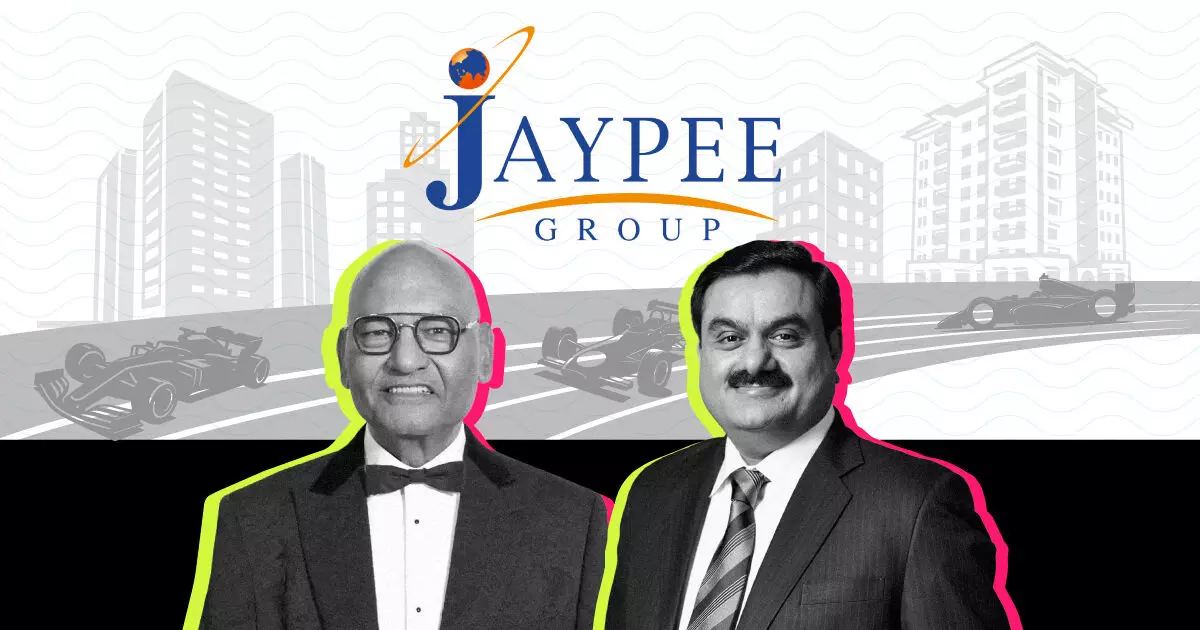
The Billionaires’ Battle For The Remnants Of Jaypee Group Inches To A Close
- Business
- Published on 12 May 2026 6:00 AM IST

A ruling in favour of Adani Enterprises could finally bring closure to the decade-long collapse of Jaypee Group and reshape the ownership of some of North India’s most strategic assets.
The decade-long disintegration of the Jaiprakash Group, or Jaypee Group, is at its tail end.
What remains of the once-mighty infrastructure empire is a "giant offering" of distressed assets that was, until last week, at the centre of a high-stakes battle between two of India’s most prominent billionaires: Gautam Adani and Anil Agarwal.
At stake is a diversified portfolio that includes critical limestone reserves, strategic land parcels, over two gigawatts of power capacity, and the Buddh International Circuit — India’s only Formula 1 track.
As the National Company Law Appellate Tribunal (NCLAT) gave its verdict, the resolution of these assets will mark the climax of one of India's most protracted corporate debt sagas.
For now, Gautam Adani appears to be the billionaire with the final laugh, and will have to plough in upwards of $1.5 billion and settle a group of aggrieved homebuyers in Noida. That is, if Anil Agarwal’s Vedanta group does not choose to pursue it further with an appeal at the apex court.
For the winner, the prize is a strategic foothold in North India; for the loser, it is a missed opportunity to consolidate a legacy in the country's core sectors.
“The underlying assets of Jaiprakash are valuable and that is the reason why big conglomerates are interested in buying the company. This will give them a wider presence in cement as well huge land parcels will come to their portfolios,” Ashish Pyasi, Partner at Aendri Legal, told The Core.
The National Company Law Appellate Tribunal (NLCAT) on May 4, 2026, dismissed Vedanta’s challenge and upheld the selection of Adani Enterprises' Rs 14,535 crore bid for the debt-laden Jaiprakash Associates.
This ruling can clear the final legal hurdle (if Vedanta does not appeal further) for Gautam Adani to absorb a sprawling portfolio of cement, power, and real estate assets, effectively bringing a close to one of the most protracted corporate insolvency sagas in Indian history.
From Liquidation To Legacy
Now, while the path appears clearer for the Adani Group, lawyers state Vedanta still has the recourse to appeal against the ruling in the Supreme Court. News reports said that the Adani Group has filed a caveat with the Supreme Court, anticipating an appeal from Vedanta.
For the Adani Group, many of Jaypee’s assets fit well into their group portfolios — primarily real estate, cement and power, where the group already has expansion plans. The F1 track would be a newer addition, and given it proved a challenge for Jaypee Group, how this augurs for the new buyers remains to be seen.
Vedanta’s plans for these assets are less clear. The company has mentioned it finds the power assets value-attractive and in line with its plans to expand capacity. However, what it plans to do with the remaining non-aligned assets is not clear. Vedanta has no presence in real estate or cement.
Those at Vedanta, in the past, informed analysts that their interest in Jaiprakash assets was largely the power capacity. “JP Group has a power portfolio of 2,200 MW, which is expandable to 4,000 Megawatts, given the availability of land ….. this acquisition is an important milestone, in our journey to increase our merchant power capacity by 20 Gigawatts, as we have guided previously by 2030,” an executive had said on a call, defending their bid decision with analysts in October 2025.
Adani group scion Karan Adani in past media interactions has expressed plans to revive the Formula 1 track in Noida. Besides the track, Adani’s wide presence across realty, power and cement offers a home for each of the assets in the bundle.
The group’s flagship company, Adani Enterprises, has also informed its debt raters that it would be funding and parking these assets across suitable group companies.
“Funds cannot be kept idle for a very long time over such procedural delays. Further, with delays, cost increases and sometimes, especially when the assets are smaller, the costs involved render the plan unviable for the applicant and in a few isolated cases even to the creditors. However, in the present case, considering the size of the asset involved, the plan will not become unviable,” Pyasi said.
Jaypee Groups Rise & Fall
The Jaypee Group was a cornerstone of India’s mid-2000s infrastructure boom.
At its peak, Jaypee Group was a significant player across multiple segments – infrastructure, power and cement.
While aggressively expanding their existing businesses, the Gaurs also added major real estate projects and the Formula 1 business to their kitty. From 2013 onwards, for the debt-laden Jaypee Group, all that could go wrong did go wrong.
Unfavourable policy changes over F1, slowdown in realty sales, increasing debt costs and fewer state buyers for electricity, all added to the group’s woes.
Starting 2014, Jaypee Group tried to deleverage its balance through sale of multiple assets. Two of these early, notable sales were a Rs 15,900 crore deal for cement units, sold to UltraTech Cement, and two hydro power units sold to JSW Energy for Rs 9700 crore.
Despite these promoter-level attempts to deleverage the group, lenders ultimately took Jaypee Group companies to the National Company Law Tribunal (NCLT), seeking a debt resolution plan.
The Giant Offering
Last summer, a pivotal decision by the NCLT changed the nature of the game. It was decided that the pending assets of the group should be clubbed and resolved as a single unit rather than being broken into multiple clusters.
This created a giant offering — a massive, diversified portfolio that forced bidders to look at assets ranging from 1,500 acres of land to more than two gigawatts of power capacity.
The competition for this bundle has been fierce. While at least four big conglomerates initially showed interest — including Aditya Birla Group’s UltraTech Cement and Dalmia Bharat Cement — the field has narrowed to a final duel.
Part of these assets on offer have seen intense interest from two other business groups – Aditya Birla Group’s UltraTech Cement and Dalmia Bharat Cement.
While UltraTech contested the resolution plan (which was later disposed of) over the cement assets, Dalmia was one of the five bidders who participated in the process, along with Vedanta and Adani Enterprises. Though united in interest in these assets, the reason for interest varies.
The cement companies UltraTech Cement and Dalmia have been vying for the cement assets, particularly the Dalla unit, as it offers strategic presence in the Uttar Pradesh market, and brings in limestone access, a prized raw material for the Indian cement industry.
Currently, the selected bid stands at Rs 14,500 crore from Adani Enterprises. This was being contested by Anil Agarwal’s Vedanta Group, which had placed a higher offer of Rs 17,900 crore on the table.
The Conflict
In November 2025, Adani Enterprises' resolution plan was cleared by lenders as the winning bid and the plan was approved by the NCLT in March.
This move then saw objection from the team of Anil Agarwal arguing their offer was of a higher value. According to news reports, the Adani offer was chosen for higher upfront payment and a shorter repayment period. In simpler words, the lenders chose a plan which combined to allow the maximum possible amount to be paid back in the earliest possible timeframe.
Vedanta argued the bid should be selected for overall bid value, and the bidding process did not disclose the value of the first payment instalment as part of the scoring mechanism. Last week’s NCLAT order was the latest in the battle between the two billionaires. The order establishes Adani’s as the new owners to take Jaypee’s residual assets ahead, unless Vedanta files a further appeal. So far, there is no word on the same.
Good Bet, Bad Bet
Adani Group’s approach to spread the funding needs of these assets across group companies and promoter entities, has put debt rating agencies at ease. The same may not have been the case, however, with Vedanta.
Those at Nuvama called Vedanta not being able to acquire Jaiprakash Associates a blessing in disguise.
“Going into unrelated businesses at this point of time when the priority should be deleveraging was a cause of concern. We believe not acquiring JP Associates is positive for Vedanta as it was not only contrary to its proposed demerger of different assets (pure play), it could also have led to an increase in debt without commensurate earnings,” the analyst noted in October.
It is unusual for a debt-laden entity to voice an opinion in NCLT matters, but this battle has also seen Jaypee Group’s founder, the nonagenarian Jaiprakash Gaur, extend his support in favour of the Adani bid. With the last word from the Appellate Tribunal now in, one could expect – unless Vedanta appeals again, a final closure to Jaypee’s decade-long debt saga and maybe a comeback for F1 in India.
Core.
Core.


