



 Newsletter
 Search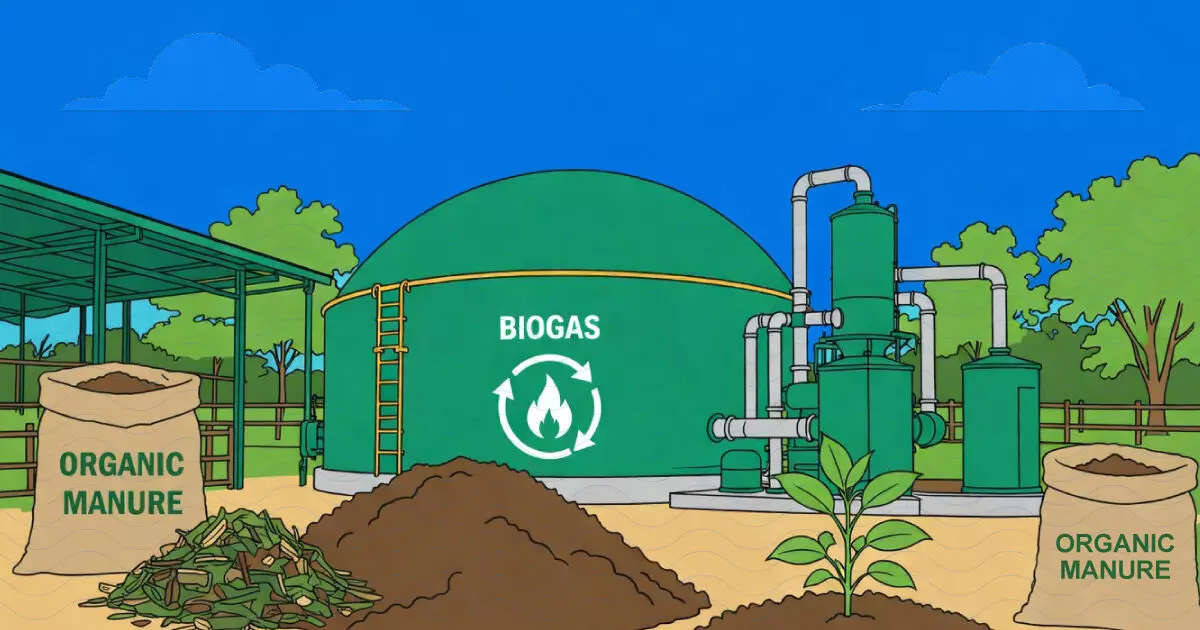
India's Biogas Bet Gets A Push, But Feedstock, State Policy Hurdles Remain
- Business
- Published on 8 Oct 2026 6:00 AM IST

After the weak run of a previous version, the Rs 23,731 crore GOBARdhan scheme sets CBG prices and buyer mandates. Feedstock, state policy, and execution still remain the hurdles.
Eight years after India first invited private investors to build compressed biogas (CBG) plants, the sector has plenty of registrations and very little gas produced.
The Rs 23,731 crore Galvanising Organic Bio-Agro Resources Dhan (GOBARdhan) scheme, which took effect on September 1 this year, is the government's attempt to change that.
It mandates buyers and sets a price for CBG, whereas the earlier policy offered purchase agreements that did not translate into steady offtake.
However, whether the government can achieve its target of a tenfold expansion in CBG production still depends on feedstock aggregation, state-level regulations, and on-ground execution, where the scheme helps only partially.
Why India Wants CBG
India imports about half of the natural gas it consumes, a dependence that raises energy security concerns, especially given the ongoing West Asia crisis. CBG offers a way to reduce that dependence.
Produced by the anaerobic digestion of organic materials such as cattle dung, agricultural residue, food waste and municipal waste, it has properties comparable to those of compressed natural gas (CNG) and can be used as its substitute.
CBG can be injected into city gas and natural gas pipelines. It also yields organic fertiliser, cuts methane emissions and has the potential to create rural jobs.
What The First Push Could Not Deliver
The first national push for CBG came in 2018 with the Sustainable Alternative Towards Affordable Transportation (SATAT) initiative, which invited private entrepreneurs to build CBG production plants and sell the gas to oil and gas marketing companies. It set a target of 5,000 plants for the production of 15 million metric tons (MMT) per annum of CBG by FY24.
However, the target fell short. As of August 6, 2026, government data shows 1,908 CBG plants registered across the country. Only 217 of them, about 11%, have been commissioned, and together they produce roughly 0.4 million standard cubic metres a day (MMSCMD).
And even the operating plants are struggling.
The Petroleum and Natural Gas Regulatory Board (PNGRB) has reported that several run at only 20% to 60% of rated capacity, leaving them with losses and maintenance costs they cannot sustain. Only 17 of the 207 plants were connected to a pipeline by April this year.
“There has been a significant gap with respect to the number of operational plants to registered plants,” Shobhit Srivastava, programme officer at the Centre for Science and Environment (CSE), told The Core.
Moreover, the operating failures were consistent across CBG projects. Developers had trouble securing feedstock, raising finance, finding assured buyers, meeting quality norms, moving the gas and keeping plants running near capacity.
SATAT laid the groundwork, but it left each of these risks with the developer. That is why the Union Cabinet approved the new scheme in August, folding SATAT and similar interventions into a single framework.
Dr KR Kaushik, former deputy director general of the Association of City Gas Distribution Entities, noted that going forward plants should be judged on how much gas they actually produce, not on installed capacity. A large plant on paper may deliver far less on ground because of downtime, feedstock shortages, seasonal swings and weak supply chains.
“Policy evaluation should incorporate such indicators,” he told The Core.
What GOBARdhan Aims To Change
Until now, the CBG ecosystem was spread across four ministries. GOBARdhan brings it under the Ministry of Petroleum and Natural Gas (MoPNG).
According to Srivastava, the new framework integrates different aspects of the sector, and a good number of registered plants can be expected to become operational.
However, he also cautioned that registration counts should no longer be the yardstick. The focus must be on quality implementation and actual production.
The GOBARdhan scheme aims to work on both supply and demand.
On supply, it offers capital assistance of up to Rs 2 crore per tonne per day (TPD) of installed capacity for greenfield projects, credit guarantee support and pipeline infrastructure. It also sets an administered price of Rs 2,110 per million British thermal unit, or about Rs 105 per kg of CBG.
Dr Kaushik noted that the capital subsidy alone will not draw private investors. “CBG projects need heavy upfront spending and take a long time to pay back, so policy stability matters just as much.”
He further pointed out that one financing model will not fit every plant. A small rural biogas unit, a medium-sized dairy-linked plant and a large commercial CBG project carry very different risks and need different amounts of capital.
Support, whether credit guarantees, blended finance, viability-gap funding, concessional loans or public-private partnerships, should be matched to a project's size and feedstock, he added.
On the demand side, city gas distributors (CGD) are now bound by a blending obligation that was voluntary until FY25. It became compulsory only in FY26.
In that first mandatory year, they met the 1% target for their CNG and household piped natural gas (PNG) sales. The obligation now rises to 3% in FY27, 4% in FY28 and 5% from FY29.
The 3% starting point reflects “a cautious step from the government’s side,” Gaurav Kedia, chairman of the Indian Biogas Association (IBA), told The Core.
A higher obligation would be welcome, but with offtake still low, it is being raised in a phased manner, he added.
Meanwhile, a district-level component in the scheme tries to address ground realities. Under the CBG Ecosystem Challenge Fund, district administrations are responsible for mapping feedstock and running awareness drives on collection and stubble burning, with cash rewards of Rs 5 crore and Rs 2 crore for the best performers.
The Feedstock Gap
A CBG plant needs a steady supply of biomass through the year, which makes aggregation one of the biggest factors in whether it survives. Where collection systems are weak, transport costs rise, plants run below capacity, and the economics fall apart.
“Right now, the CBG plants themselves bear this cost (of collection and transport of feedstock),” Srivastava said.
He added that the plant-level subsidy and district facilitation under GOBARdhan aim to soften the burden, but whether that moves the needle for scattered, low-value residue will depend largely on how seriously districts use the Challenge Fund. “Beyond the plant, aggregation logistics remain very much a local-level problem.”
Moreover, agricultural residue is available only for a short window after harvest and needs specialised machinery to collect, bale, shred, transport and store. Without that chain, it is usually burned in the field or left to decompose.
Vaibhav Dange, founder director of the Institute for Sustainable Energy (IFSE), expects a market for aggregation to emerge through farmer producer organisations, private companies or cooperatives, much as cooperatives operate in the sugar industry.
Because that market does not yet exist at scale, Dange cautioned that developers rushing in for the scheme's incentives could be caught out. CBG is capital-intensive, he said, so feedstock supply contracts, collection and aggregation should be planned at the Detailed Project Report (DPR) stage, not after commissioning.
Municipal waste is another potential source. However, mixed municipal solid waste cannot be digested efficiently without extensive preprocessing, because plastic, glass and metal damage equipment and lower the quality of the digestate. Where segregation is weak, plants end up with contaminated material and higher operating costs.
Dr Kaushik suggests the scheme should urge municipal corporations to collect waste at a single point and be paid for the service. This could be on contracts that set measurable quality standards and not just tonnage commitments.
Meanwhile, the by-product is an issue that still needs the most emphasis.
Along with the CBG, a plant produces fermented organic manure (FOM) every day, and the industry is "still not sure how we will take care of it,” Kedia said. Developers should assess demand for it at the feasibility stage, before choosing a site.
The government could bring in a SATAT-like scheme for fertiliser marketing companies, he suggested. Until then, plants near large cities could give it to farmers under contract farming and sell the organic crops instead. "This is where the real money lies, though it is a very local phenomenon."
From Plant To Buyer
A plant may produce good CBG and still struggle commercially if it cannot get the gas to the buyer. Where there is no pipeline over long distances, gas has to be carried hundreds of kilometres in mobile cascades (bundles of high-pressure gas cylinders), and the transport cost erodes margins.
Infrastructure planning should align plant locations with network expansion schedules, Dr Kaushik said.
PNGRB noted that pipelines can cut reliance on mobile cascades, bring down logistics costs, limit gas losses and enable continuous transfer of larger volumes. Cascades, however, may remain necessary for small and remote plants.
With only 17 of 207 commissioned plants connected as of April 2026, infrastructure readiness is a critical gap.
Srivastava said GAIL (Gas Authority of India Limited) needs to move faster on forming plant clusters and building trunk pipelines. Many producers will depend on them in places where city gas distributors cannot take their gas.
A Patchwork Of State Policy
Below the Centre, policy still remains fragmented.
Haryana, Uttar Pradesh, Bihar, Gujarat, Maharashtra, Chhattisgarh, Madhya Pradesh, Uttarakhand, among a few others, have framed CBG or bioenergy policy.
Many other states have yet to frame one, and those that have often offer no clear incentives and no simple approval process.
"Decentralisation is a problem because policy is fragmented and the regulatory landscape differs from state to state," Dr Kaushik noted, adding that state-wise targets for CBG plants lack transparency. And because land is a state subject, developers often struggle to secure land approvals, with the rules varying from one state to the next.
Some states may be waiting to see how others fare, Kedia suggested, but "sooner or later, this will come to all the states”.
Until that happens, there are other steps the government can take.
Srivastava suggests that states can set up single-window clearances to cut the time taken for consent to establish, consent to operate and land approvals.
They can make real use of Challenge Fund allocations to map feedstock and build collection infrastructure, rather than treat the money as a one-time compliance exercise. And they can build demand for the by-product FOM and its liquid form by using them in government departments and promoting them locally.
“Moreover, state nodal agencies need to handhold entrepreneurs in the CBG sector through consultation and discussion. It is also important for the state governments to clearly define the roles and responsibilities of different local authorities to support the upscaling of the sector within states,” he added.
With price and demand now locked in, the test for CBG has moved from the policy table to the on-ground execution. Meeting the ten-fold production target will need local administrations to support feedstock supply chains, all the states to spell out their regulatory framework, and the Centre to hold its policy steady long enough for projects to recover their investment.
Core.
Core.


