



 Newsletter
 Search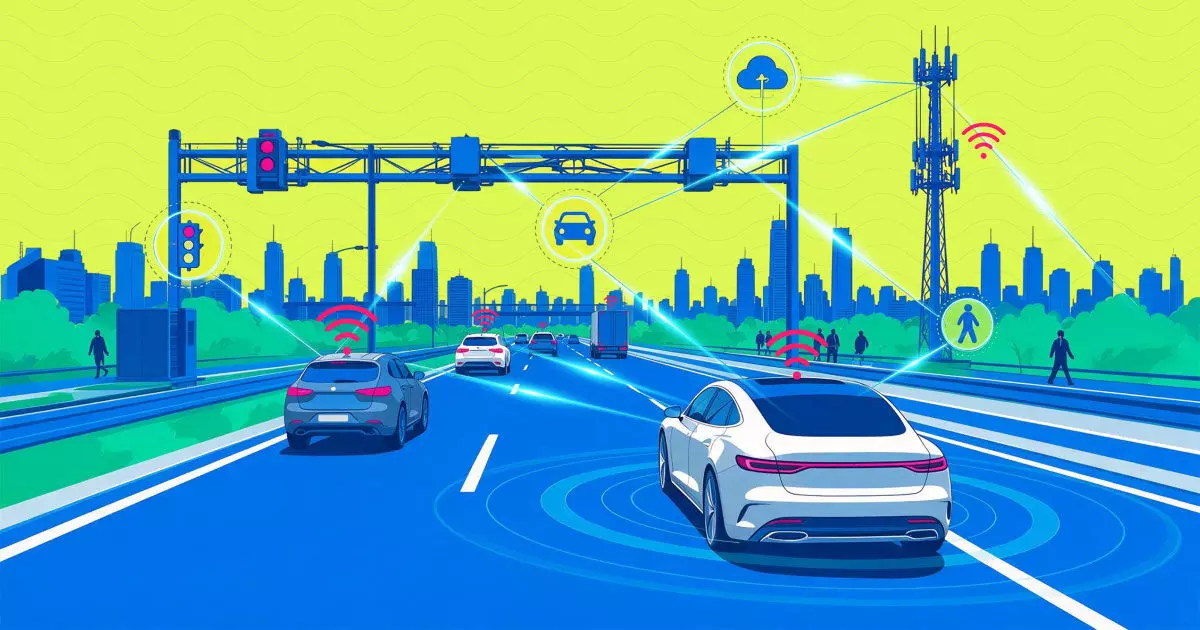
India Opens Doors To Connected Cars, But Its Biggest Challenge Is Beyond Technology
- Business
- Published on 4 Aug 2026 6:00 AM IST

India's vehicle-to-everything rollout now depends on shared standards, roadside units, cybersecurity and cross-sector collaboration.
Imagine driving on a busy Indian highway when your car senses, seconds before you can, that a truck two vehicles ahead has slammed on the brakes. Or riding a two-wheeler at dusk and getting a silent alert that a pedestrian is about to step out from an unlit corner just beyond your headlights.
That is the promise of vehicle-to-everything (V2X) technology, and India has now taken a concrete regulatory step, marking a real turning point for connected and autonomous mobility in India, with road safety at its core.
However, by every industry estimate, the mass deployment is still close to a decade from widespread use.
V2X enables vehicles to wirelessly exchange real-time information with everything around them. This includes other vehicles (V2V), road infrastructure such as traffic signals and toll booths (V2I), pedestrians and cyclists (V2P), and the wider cellular network (V2N). It is expected to complement the Advanced Driver Assistance Systems (ADAS), which are passive and active safety systems designed to remove the human error component to improve road safety, driving comfort and vehicle intelligence.
The Rules Are Changing
On August 3, the Ministry of Road Transport and Highways (MoRTH) issued a draft notification proposing a phased rollout of V2V communication systems. Under the proposed timeline, authorised vehicles will need to comply with the AIS-230 standard if fitted with V2V systems from October 2027, with mandatory fitment from October 2028.
These systems let nearby vehicles exchange real-time data on speed, position, direction and acceleration, giving drivers advance warnings.
This follows a series of steps already underway to build India's connected-vehicle framework. In June, India scrapped licensing requirements for two radio frequency bands used in advanced vehicle safety systems, by removing a regulatory hurdle that had made deploying V2X technologies slower and costlier than in the US or Europe, where the same bands are already unlicensed.
In April, the Telecom Regulatory Authority of India (TRAI) had released a consultation paper on the regulatory framework for V2X communication. Separately, the MoRTH proposed phased rollout of automotive cybersecurity rules in June.
Together, these developments could help move the technology closer to execution.
Why It Matters
V2X deployment could prove especially valuable on India's crowded, unpredictable roads, where pedestrians, cyclists, vehicles and stray animals share the same space, and where lane discipline and speed limits are often poorly enforced.
There is also a traffic management case. By allowing vehicles to communicate with signals, road infrastructure and each other, the technology has potential to reduce congestion and smooth traffic flow, with secondary effects on travel times and fuel consumption.
Beyond this, it could feed into two bigger shifts already taking shape. One is smarter, more efficient electric vehicles (EVs) that can perform better using data that goes beyond what cameras, radar and lidar alone can capture. The other is a faster path toward self-driving cars.
Building The Ecosystem
Praveen Sasidharan, partner and competency leader for Cyber Emerging Tech at PwC India, said the regulatory push changes what cybersecurity and software governance mean for the industry.
“It shifts connected mobility from optional innovation to a governed, safety-critical system of national importance,” he told The Core.
A functioning V2X network needs coordinated investment on four fronts, including automakers, road infrastructure, telecom operators and government initiative, he added.
Automakers need cybersecurity engineering that follows the ISO/SAE 21434 standard, plus the ability to update vehicle software remotely and safely. If an update fails, the vehicle should be able to revert to its last working version, and automakers must report this compliance to regulators every year.
Road infrastructure providers need roadside units (RSUs), edge computing, and secure back-end systems. Ideally, these should be built into new highways and smart-city projects from the start, rather than added later.
Telecom operators must provide fast, reliable connectivity in the 5.9 GHz band for V2X communication.
Sasidharan said that the government must build the underlying "trust infrastructure", which means a secure, future-proof system for issuing digital certificates to vehicles, along with agencies to test and certify this technology, and systems to catch and block any vehicle or device sending fake or harmful safety messages.
However, this will be an ongoing process in phases. Under the AIS 189/190 standards, companies will face annual security checks, production audits and market monitoring.
Why Interoperability Is Significant
A safety alert only works if a two-wheeler from one manufacturer, a truck from another, and an RSU from a third vendor can all understand and trust each other instantly.
Sasidharan warned that fragmented, proprietary systems would force the industry to spend a decade and significant capital retrofitting compatibility later. Interoperability, in his view, is the entire proposition.
His recommendation is to pick one cellular network technology (C-V2X) standard, agree on a common "language" called an intelligent transportation systems (ITS) message set that lets vehicles and road infrastructure describe hazards, locations and alerts the same way, and build a single, unified system for verifying trusted messages across the country.
C-V2X has gained momentum both in India and globally, thanks to its stronger network effects and its ability to leverage existing cellular infrastructure to cut deployment costs.
Get this right early, he said, and India ends up with one connected network, not dozens of systems that don't talk to each other. Crucially, he believes India has a rare opportunity to standardise before scaling up, something most countries never managed to do.
Commercial Fleets First
Dhruba Sarma, SVP and business leader for connected vehicles at KPIT, expects commercial vehicles (CVs) to be early adopters because fleet economics of CVs make the return on investment more evident.
KPIT's India R&D hubs develop safety-critical V2X communication stacks and E/E architectures for global automakers.
From the solutions standpoint, it is not difficult to bring the technology for passenger cars or two-wheelers, but the real determinant is whether a vehicle's underlying architecture is designed to move data efficiently from sensors to processing to action.
Automakers that have already invested in software-defined vehicle (SDV) architecture will find it comparatively easy to add V2X as another connectivity layer. The harder and costlier cases would be older vehicle architectures without a viable path to capture and route data, where V2X integration could require deeper rework.
A V2X unit, whether built into the car at the factory or added later as an aftermarket device, similar to India's earlier telematics mandates, is made up of a few core parts. This includes a processing unit, a chip set designed for the given communication band, and sensors that track the vehicle's position and movement, such as accelerometers, gyroscopes and GPS receivers.
In Sarma's words, it is essentially "a bigger telematics box", the kind of connectivity hardware industry already knows how to build.
India's Unique Opportunities And Challenges
India's roads are among the most heterogeneous in the world, with cars, two-wheelers, buses, trucks, autorickshaws and pedestrians sharing the same space. Sasidharan believes this is precisely where V2X can be transformative rather than incremental.
V2P and V2V alerts could directly help the two groups hit hardest by India's road deaths, two-wheeler riders and pedestrians. These alerts could flag a rider in a blind spot, or warn of a pedestrian stepping into a crossing without signals.
He stressed that the technology must be designed and built for everyone, not just those who can afford it. V2X in India, he said, cannot be a "car-to-car luxury." It needs to reach two-wheeler riders and pedestrians too, through low-cost devices and smartphone alerts, so its safety benefits aren't limited to owners of premium vehicles.
Now, once the regulations are in place, the toughest challenge is getting everyone to coordinate and trust one another. Sasidharan sees poor alignment across the industry and cybersecurity as the biggest risks.
“While all the risks are real, I would rank alignment across the ecosystem as the single biggest challenge because it influences how effectively all other elements come together,” he said.
Automakers will need certified Cybersecurity Management Systems (CSMS) and Software Update Management Systems (SUMS), which are internal frameworks that prove a vehicle's software is built and maintained securely throughout a vehicle's entire lifecycle, before it can even receive type approval.
Technology providers will have to build on PKI-based trust models, using signed digital messages that let vehicles verify an alert is genuine before acting on it. Roadside infrastructure, too, will need to be treated as a regulated, secure asset, not passive street hardware.
A connected-mobility network that people can't trust, he warned, is far worse than having no network at all. “A single spoofed safety message that causes a crash could set public confidence back by years.”
Sarma raised a similar concern. He said vehicle cybersecurity risks have grown sharply over the past decade, as connectivity has spread into nearly every part of the modern car. India, in his view, is still at an early stage on this front, depending mostly on individual efforts by telecom operators and automakers, rather than one coordinated national strategy.
However, India's new cybersecurity standards AIS 189 and AIS 190, which are currently in the draft phase, can be seen as a globally aligned starting point.
What's needed now is careful, consistent execution, as it requires joint inter-ministerial policy coordination, with two primary central ministries, including the MoRTH and the Ministry of Communications, involving the Department of Telecommunications (DoT).
Infrastructure Gap Is A Global Problem
Even countries seen as leading in V2X, namely China, parts of the United States, and pockets of Europe, haven't rolled the technology out nationwide. Instead, they've built corridors, which can be described as specific highways, smart cities and smart grids equipped with V2X, rather than covering entire countries.
Sarma pointed out that China has gone the furthest, backed by strong government support and large test zones where the technology can be proven before wider use.
India is likely to follow a similar path, he suggested, but not starting in Mumbai or Delhi, where heavy traffic makes rollout hardest. Smaller smart cities and towns are likely to come first instead, since infrastructure is easier to build and stakeholders are easier to align there.
According to an estimate by Mordor Intelligence, the global automotive V2X market is projected to grow from $2.87 billion in 2025 to $18.67 billion by 2030, a CAGR of 45.43%.
Even globally, the market remains fragmented, with chipmakers, Tier-1 suppliers, telecom operators, and niche software firms competing for share.
India’s Next Steps
Experts see the delicensing of the frequency band as a signal that the government is serious about deploying V2X, giving companies enough clarity to plan ahead and weigh their investments.
Once the rules are finalised and regulation is in place, global players that have already invested in V2X elsewhere and have a presence in India will be better positioned to commit investment here too.
Sasidharan predicted India's V2X rollout will happen in three phases. The first is the near term, over the next one to two years, following TRAI's consultation with industry stakeholders. During this phase, the focus will be on finalising rules and spectrum allocation, agreeing on technical standards, and running early pilot projects on select highways and in smart cities.
In the medium term, roughly three to five years out, V2X should start appearing on India's busiest highways and in major cities, as enough certified vehicles and RSUs are deployed and operational.
In the long term, five to eight years from now, broad commercial rollout should follow, as the network becomes valuable enough that its benefits multiply with each new user.
Sasidharan noted that the technology itself isn't holding up; what will determine the pace is how quickly infrastructure gets built, how many vehicles are equipped, and how well different stakeholders coordinate.
Sarma's estimates also lined up closely. He expects a formal government mandate particularly for V2V communications systems to be applicable from late 2027 or early 2028, as automakers typically need 12 to 18 months to take a V2X device from development to a fully tested and validated product.
The Long Road Ahead
Currently, Reliance Jio has committed to building a 5G Standalone (SA) network architecture optimised for C-V2X. Tata Elxsi is working on proprietary V2X software stacks, virtual validation frameworks and connected-car data platforms. Sasken, in partnership with Qualcomm, developed a platform to evaluate C-V2X modem performance for a Japanese automotive company. Other Indian firms are pursuing similar work.
While the work progresses, the bigger delay, as it seems, lies with finalising the regulation itself. For now, India still needs to carefully build shared technical standards, regulations that are well ahead of time, and the trust systems that let millions of elements on the road understand each other.
The silent alert that catches a braking truck, or a pedestrian stepping off an unlit curb, before a person ever could, is still, by every estimate, close to a decade away. But for the first time, the groundwork being laid suggests it is no longer a question of if, but when.
Core.
Core.


