



 Newsletter
 Search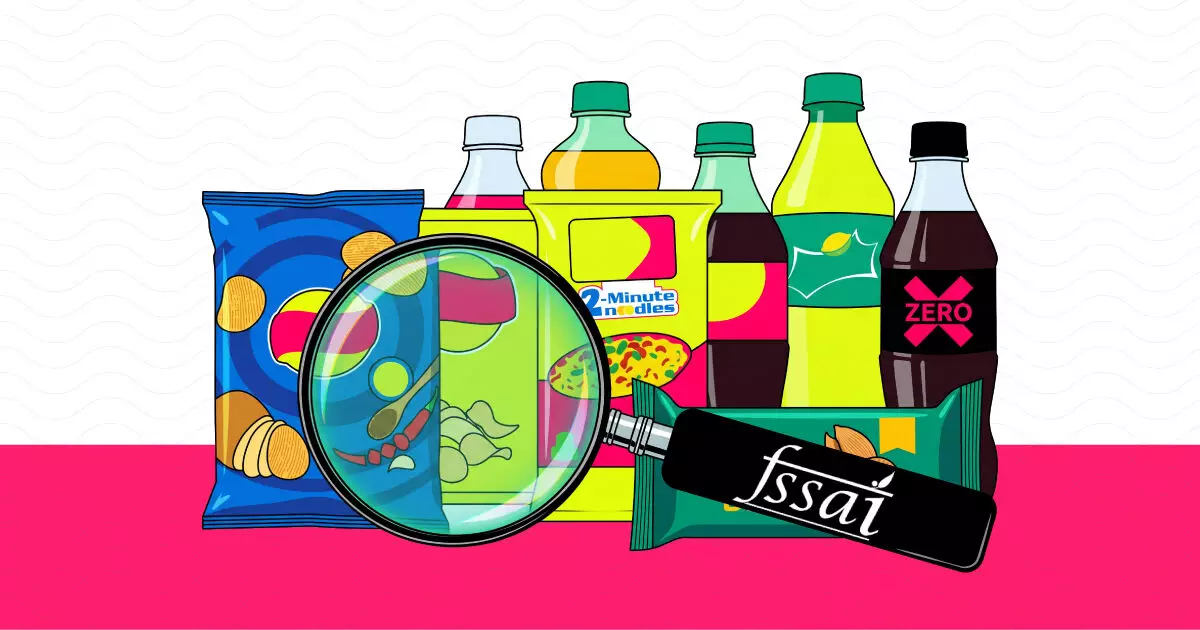
India’s Food Brands Face A Labelling Crisis That Hits Small Firms Harder

Chips, biscuits, snacks, instant noodles and cold drinks you buy will soon carry a bright red warning on the front of the pack if they have too much sugar, salt or fat.
The Gist
India's $100 billion packaged-food industry faces imminent regulatory changes with potential mandatory front-of-pack warning labels.
- The Supreme Court is questioning the Food Safety and Standards Authority of India's timeline for implementing new rules.
- Companies may need to redesign packaging and reformulate products, risking significant inventory losses.
- Pressure mounts as the industry navigates uncertainty over label formats and compliance deadlines.
India’s $100 billion packaged-food industry is bracing for sweeping regulatory changes that will lead to redesigned product packaging, recipes and most likely a write-off of existing inventory, with little certainty about how much time they will have to comply.
The Food Safety and Standards Authority of India (FSSAI) has sought about four months to finalise the rules, including a 60-day public consultation, followed by a final notification. It has also proposed giving companies a full year to comply voluntarily.
But the Supreme Court, which first heard the PIL in 2024, on September 28 asked the food regulator why it needs so much time.
The petition, filed in 2024 by the non-profit 3S and Our Health Society, asks the Supreme Court to make front-of-pack warning labels mandatory on packaged foods high in sugar, salt and saturated fat, citing rising diabetes, obesity and heart disease.
Manufacturers are in a tizzy.
The deadline will determine how much packaging they have to scrap, how quickly they can change production lines, and whether they have time to reformulate products before the rules take effect.
The Core has sought responses from Nestlé, Hindustan Unilever Ltd., `Marico and PepsiCo and will update this article if and when we receive a response.
The regulator’s current proposal proposes a red hexagon on the front of packs identifying added sugar, salt or saturated fat that exceeds thresholds based on the Indian Council of Medical Research–National Institute of Nutrition’s 2024 dietary guidelines. A separate warning would apply to non-caloric sweeteners.
The Supreme Court’s objections suggest the proposed timeline may face scrutiny, though the final order will determine what happens next.
A Fight That Has Dragged On
The push for warning labels on food packaging predates the Supreme Court’s latest intervention.
The Delhi High Court directed the FSSAI to frame rules on junk food as far back as 2013, and the regulator issued a draft front-of-pack labelling notification in September 2022, with voluntary compliance for 48 months.
In June 2021, BJP member and advocate Ashwini Kumar Upadhyay filed a PIL in the Supreme Court seeking guidelines for health star ratings and health warnings on the front of packaged foods and beverages.
It also asked the Court to direct the FSSAI to examine WHO recommendations on fat, salt, and sugar intake and report within three months, citing the Right to Health under Article 21.
The case now before the Supreme Court was filed in 2024. The petition asks the Supreme Court to direct the Centre to issue directions or regulations introducing mandatory front-of-pack warning labels on packaged foods, showing levels of sugar, salt and saturated fat.
The pressure intensified this year as the regulator reconsidered how consumers should be informed about the nutritional content of packaged foods.
On August 13, the court even asked whether FSSAI was bending to industry after it proposed showing recommended daily limits instead of warnings, and gave it two weeks to reconsider.
FSSAI then reversed course, proposing a red hexagon for products high in added sugar, salt or saturated fat, with thresholds drawn from ICMR-NIN's 2024 dietary guidelines.
Days later, the government appeared to have dropped a stricter proposal after Coca-Cola and industry bodies representing Nestle and PepsiCo lobbied against it in closed-door meetings, a Reuters report said.
That uncertainty about what these labels would actually look like and how soon it would need to be implemented leaves companies preparing for a rule whose final form and implementation schedule remain unresolved.
The Cost Of Packaging
Even after the rules are finalised, companies will need to translate them into packaging designs, obtain internal approvals, coordinate with printers and manage existing stocks.
"The 10-day period is really for the government to come up with a clear roadmap for implementation. It should not be construed as a 10-day compliance deadline for companies," said Ashwin Bhadri, founder and CEO of Equinox Labs, an FSSAI-approved, NABL-accredited food, water and air testing and auditing lab.
The real pressure, he believes, will come when the final thresholds, label format and compliance dates are notified.
“In food businesses, you cannot change a label the day a notification comes in.”
Companies may already have ordered or printed packaging in bulk. A shorter transition period could leave them with inventory that cannot be used under the new rules, forcing them to absorb the cost or find ways to manage the transition within the permitted period.
Changing the recipe is more complicated than changing the label. Manufacturers seeking to bring a product below a warning threshold would need to test alternative ingredients, assess shelf life and ensure the product retains its taste and texture.
“Reformulation is a much bigger exercise than changing a label,” Bhadri said. Such work can take several months or longer.
Inside The War Room
Rishi Agrawal, co-founder and CEO of TeamLease Regtech, told The Core that companies should not be wasting any time.
They should be on a front foot already by roping in finance, marketing, R&D, legal, production and government affairs, briefed upfront on one crucial distinction: these are proposed rules, not notified ones, he said, adding that companies should build optionality into every decision rather than lock in for a single final version of the rules.
Once the rules are notified, Agrawal expects every product head to run their SKUs through a severity-tiered checklist.
Products marginally over threshold might only need a recipe tweak; products well over the limit move straight into packaging-redesign territory, an entirely different cost and timeline.
For listed companies, he adds, the financial exposure isn't just an internal number; it may trigger shareholder disclosure obligations.
He also recommended a cross-functional task force reporting directly to the CEO or board risk committee, highlighting the severity of the changeover.
Big Company, Small Company: Not The Same Fight
Large FMCG firms have dedicated regulatory affairs teams, legal counsel, and balance sheets deep enough to write off a packaging run without blinking. Smaller and founder-led companies don't have that luxury; in many cases, the founder is also the head of marketing, sales and regulatory affairs.
For them, Agrawal points to very concrete exposure: printed packaging turning into stranded inventory overnight, contract manufacturers who can't be rushed, and no in-house team to chase the regulator for clarity when a rule is ambiguous.
Beyond Packaging
Charanya V, SVP for food safety and compliance at HungerBox, argued the label is only the visible part of the problem. HungerBox is a Bengaluru-based B2B foodtech company that manages and digitises corporate and institutional cafeterias across India.
Advertising aimed at children, in particular, will come under scrutiny. "Companies should review the use of health-oriented messaging, cartoon characters, influencers, games, giveaways and other promotional devices that could make a product appear healthier than it is," she said.
A "no added sugar" claim sitting next to a mandatory warning label, she notes, cannot be allowed to visually crowd out the warning.
India's packaged food industry is valued at over $100 billion, and this rule touches nearly all of it, from soft drinks to snacks to instant noodles. The question boards are asking has shifted. It is no longer whether the red hexagon will reach the pack, but how much time they will get before it does.
If the court accepts FSSAI's timetable, companies get a year to adjust once the rules are notified. If it cuts that short, packaging, stock and recipes will all have to change faster. The answer now rests with an order that could come any day.
Core.
Core.


