



 Newsletter
 Search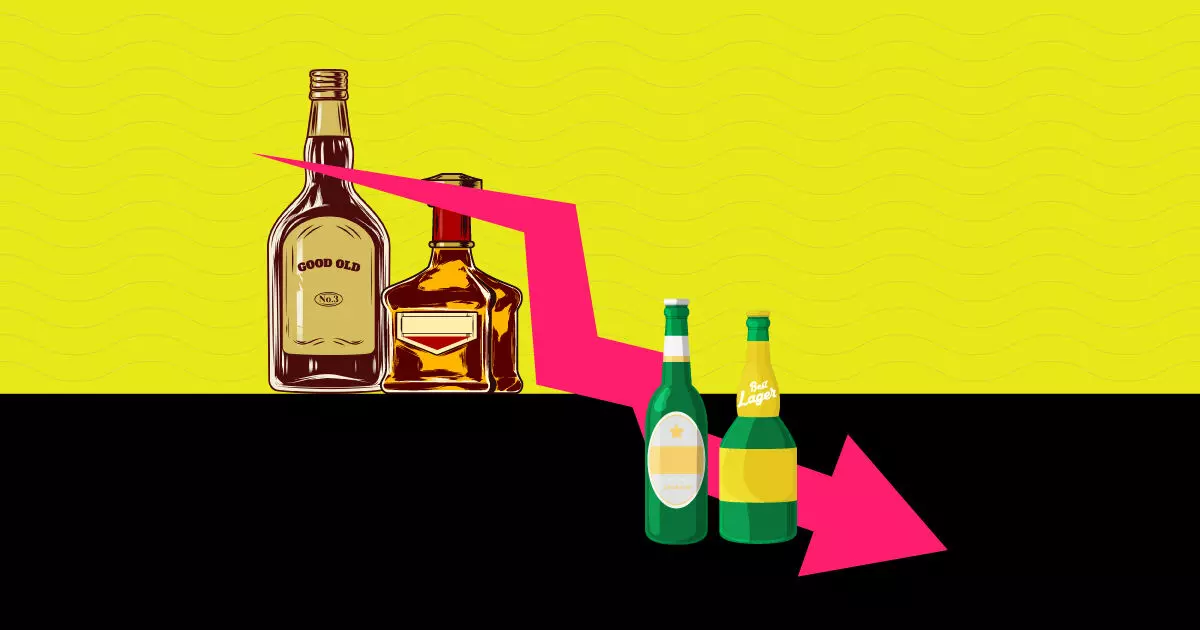
India's Liquor Companies Chase Premium As Mass Market Gets Squeezed Out
As alcobev giants chase margins at the top of the shelf, the regular segment is shrinking, squeezed by policy, economics and corporate indifference.
The Gist
The mass-market segment of India's alcohol industry is stagnating, as companies prioritize premium offerings amid rising costs.
- Regular segment sales are declining, with higher taxes and inflation impacting lower-income consumers.
- State policies promoting local spirits have diverted consumers away from traditional IMFL.
- While premiumisation grows, many consumers are left behind as companies retreat from the mass market due to profitability concerns.
India’s alcobev industry has spent the past few years celebrating the tred of premiumisation. Consumers are trading up. Premium whisky, vodka and gin are growing faster than the broader market.
From Diageo India to Radico Khaitan and Pernod Ricard, the industry's largest players are prioritising their top shelf labels in their strategy.
The data suggests that in India, premiumisation is not a story of consumers being priced out of cheaper options.
Quarterly results for the past couple of fiscals have largely support that view. According to the International Wine and Spirit Research (IWSR), India's total beverage alcohol volumes grew 7% in the first half of 2025, with premium-and-above price bands growing even faster at 8%, volume growth, not just value, which points to genuine demand rather than forced migration. Premium and super-premium spirits grew 9-12% in both volume and value through 2025, according to industry estimates.
At the same time, data from Investment Information and Credit Rating Agency of India (ICRA) shows overall spirits volumes declined around 2% in FY2025, following a 3% drop in FY2024, driven largely by higher state taxes and inflation. The picture that emerges is of two separate groups moving in opposite directions, one trading up by choice, the other dropping out entirely.
As the industry moves upmarket, the mass-market segment is stagnating or shrinking, squeezed by taxes, inflation and weakening corporate interest, leaving many lower-income consumers behind rather than bringing them along.
A Segment Under Pressure
Ajay Thakur, lead analyst for consumer staples at Anand Rathi Shares and Stock Brokers said, "The regular segment is more or less seeing flattish growth, or maybe to a certain extent a small decline."
The Andhra Pradesh market, which saw a policy-driven surge in regular segment sales at one point, has now become part of the problem. The base effect from that period is making current numbers look weaker, but even after adjusting for that distortion, the broader trend remains unchanged.
Diageo India's latest results illustrate the divide. The company's Prestige and Above portfolio, which accounted for 90.1% of net underlying sales in the quarter, grew 5% year-on-year. The Popular segment, which contributed just 8.9% of sales, declined 13.2%.
This is not merely a Diageo story. It is becoming the defining feature of India's alcohol industry.
Diageo, which operates in India through United Spirits and makes brands including McDowell's No.1, Royal Challenge, Signature, Johnnie Walker and Smirnoff, has been the most aggressive practitioner of the strategy. In 2022 it sold 32 mass-market brands, including Haywards and Honey Bee, to focus almost entirely on Prestige and Above products, which now account for more than 90% of net sales.
Its competitors are moving in the same direction.
Radico Khaitan, maker of Rampur Indian Whisky, After Dark and Magic Moments vodka, reported a 24.7% rise in net revenue to Rs 6,050 crore in FY26. Prestige and Above volumes grew 28.5%, with the segment contributing more than 70% of IMFL revenue.
Allied Blenders, maker of Officer's Choice, increased the share of Prestige and Above products from 37% of volumes in FY24 to more than 46% in the first half of FY26. Pernod Ricard, which sells Royal Stag, Blenders Pride and Chivas Regal, reported 11% growth in the January-March 2026 quarter, with premium brands outpacing the broader portfolio.
Even Tilaknagar Industries, best known for Mansion House brandy, which sold 10 million cases in FY26, has entered the premium whisky market with a pure malt priced at Rs 5,200 a bottle.
Across the industry, companies are maintaining their regular portfolios where margins remain viable and retreating where they do not. What was once considered mid-market, such as McDowell's No.1, increasingly functions as the entry point to organised spirits. The floor of the market has moved higher and much of the traditional mass market is being left behind
Policy Shift
Two state-level policy shifts have contributed significantly to this. In Maharashtra, the government introduced the Maharashtra Made Liquor (MML) category in mid-2025, a grain-based spirit produced exclusively by local manufacturers, priced below mainstream IMFL and designed to promote domestic distilleries.
By making locally made liquor cheaper and more accessible, MML has pulled consumers away from the regular IMFL segment.
Karnataka, in its 2026-27 budget, announced the removal of government-controlled retail pricing for alcohol, a major structural shift, and introduced an Alcohol-in-Beverage (AIB) based taxation system that ties excise duty to alcohol content rather than product category.
The reform has been widely welcomed by premium brands and seen as a positive step for premiumisation. But industry bodies have flagged that for lower IMFL slabs, which account for over 85 per cent of monthly volumes, the duty increases that followed have already caused a degrowth of around 6 per cent.
In both cases, the mass market consumer ends up squeezed, and companies are not in a position to absorb those costs.
According to Euromonitor International, India's overall alcoholic drinks market touched 7,355.8 million litres in 2025, up from 7,033.3 million litres in 2024. Spirits alone crossed 3.74 billion litres.
Step Back From Mass Market?
Analysts believe that a significant part of what is pushing companies away from the regular segment is the lack of profit.
In September 2022, Diageo's United Spirits sold 32 Popular segment brands, including Haywards, White Mischief, and Honey Bee, to Inbrew Beverages for Rs 828 crore, explicitly calling it a sharpening of focus on Prestige and Above.
Pernod Ricard followed in December 2025, selling Imperial Blue — India's third-largest whisky by volume, with 22.4 million cases sold in FY25 — to Tilaknagar Industries for Rs 4,150 crore. Pernod's CEO called it a move to focus on more profitable and faster-growing brands, while its India CEO said exiting the mass segment would free up resources for Royal Stag, Blenders Pride, Chivas Regal, and Jameson. Within three years, the two largest global spirits companies in India had voluntarily sold off their biggest mass-market whisky brands.
India has 28 states, each with its own excise policy. And most state governments have historically been reluctant to let companies raise prices in the regular segment. The result, as Thakur explains, is that profitability in the lower segment erodes over time. Companies are essentially selling cheaper drinks in a more expensive environment, with no room to pass on cost increases.
"With time, the other segment becomes less feasible for companies to focus on because the profitability in that segment keeps going down," he says. "That has eroded a whole lot of the feasibility of those markets, and hence players have exited those segments and started introducing more of the mid and premium variants."
The response to a policy environment makes the mass market increasingly difficult to sustain. The very regulations meant to keep alcohol affordable for lower-income consumers may be contributing to those companies reducing their presence in that space altogether.
Filling The Gap
There is another dynamic worth noting. Governments in several states have introduced premium country liquor as a category. This is cheaper than IMFL (Indian Made Foreign Liquor) but positions itself above the roughest end of the market. For a consumer at the bottom of the IMFL ladder, this creates a pincer effect.
"The segment which is the regular segment or the mass market segment is actually coming incrementally under more and less stress," Thakur said.
"Because there, the excise rates have already gone up, it is actually getting more expensive, while there are cheaper options available on the premium country liquor side. Or if the consumer wants to spend a little extra, there are better premium products also available."
The mass market IMFL consumer is, in other words, being squeezed from both sides. Go down, and you get premium country liquor. Go up slightly, and entry-level prestige brands are waiting. The middle ground — the traditional popular IMFL segment — is shrinking.
Premiumisation Isn’t The Whole Story
Per capita alcohol consumption in India jumped from 2.4 litres in 2005 to 5.7 litres in 2016, with consumption forecast to reach 6.7 litres by 2030. More recently, per capita consumption is projected to increase by just 0.1 litres between 2024 and 2029, reaching 5.06 litres by 2029, a 2% increase over five years, a modest volume trajectory.
Amardeep Singh, Executive Director at Medusa Beverages, said, "The mass market is not disappearing, it is changing its expectations."
He argued that across income levels, consumers are becoming more selective, drinking less often but with more intention. "This is not a temporary behaviour, it is a value reset that has been building for a few years now."
What is growing much faster is value; industry revenues are projected to grow at 10-12% even as volumes inch up, which confirms that the story is about what people are spending, not how much they are drinking. India remains well below global averages. Overall alcohol consumption stands at 4.9 litres per capita, with male consumption at 8.1 litres, and only 18.8% of men and 1.3% of women consume alcohol.
Singh pushes back on the idea that growth is being driven purely by the affluent. He points to markets like Ranchi, Bokaro, Ambala, and Panipat showing consumption behaviour that would have been considered metro-exclusive five years ago. At Medusa, he said, a growing and consistent proportion of volumes is now coming from non-metro markets.
Premiumisation is not only a story of rich city consumers drinking expensive whisky. It is also a story of a small-town consumer who occasionally reaches for something better, or who is choosing quality over quantity in a way that even he may not have expected to.
"It is not just the affluent customers. The youth coming into play, their preferences are more towards the premium segment. Gen Z and millennials want to drink less but drink more expensively,” Thakur said.
Euromonitor data showed that premium beverages are growing through a combination of exclusivity, craftsmanship, and wellness positioning.
Indian single malts like Godawan and Longitude 77 are gaining traction alongside international names. The craft and artisanal segment is drawing in younger, more discerning consumers who are actively seeking something beyond the standard shelf.
But all of that growth is happening in a segment that covers a relatively small share of total volumes. The bulk of India's drinking population is not there yet.
Growth At The Top, Silence At The Bottom
India's alcobev market is projected to grow at a CAGR of 7.2% through 2026, according to industry estimates. A significant portion of that momentum is coming from consumers making quality-led choices. That is a healthy trend for the industry's margins and for the brands that have invested in building premium portfolios.
What is less visible in numbers is what happens to the consumer who cannot afford to trade up, and is not being served by a mass market that is quietly retreating. "The feasibility of this segment over the medium term is going down," said Thakur.
"Many of these players are not interested in focusing too much on this and rather would focus more on the mid and premium segment to make sure that the profitability is maintained."
From a pure business standpoint, that makes sense. Diageo India's Q4 performance, net profit up 28% year-on-year to Rs 539 crore, illustrates how well the premium strategy can work when executed well. CEO Praveen Someshwar called the results resilient, noting that the core national portfolio excluding impacted states delivered broad-based double-digit growth.
What Next For The Mass Market?
Analysts’ outlook for the mass market over the next one to two years is cautious. State governments are unlikely to suddenly allow meaningful price hikes in the popular segment. Excise pressures are not going away.
Premium country liquor will keep eating into the customer base from below. And companies will continue directing investment and brand-building energy toward the segments that make financial sense for them.
The premium story will keep running. India's urban population is expected to cross 40% of the total population by 2036, and rising incomes, particularly among younger consumers, will sustain demand at the upper end. Medusa's draught beer launch in Delhi, Singh notes, is built on exactly this logic: that people are seeking elevated occasions, not retreating from them.
But for now, the mass market is not growing nor collapsing. It is just being slowly deprioritised, and companies have found a better return elsewhere.
Core.
Core.


