



 Newsletter
 Search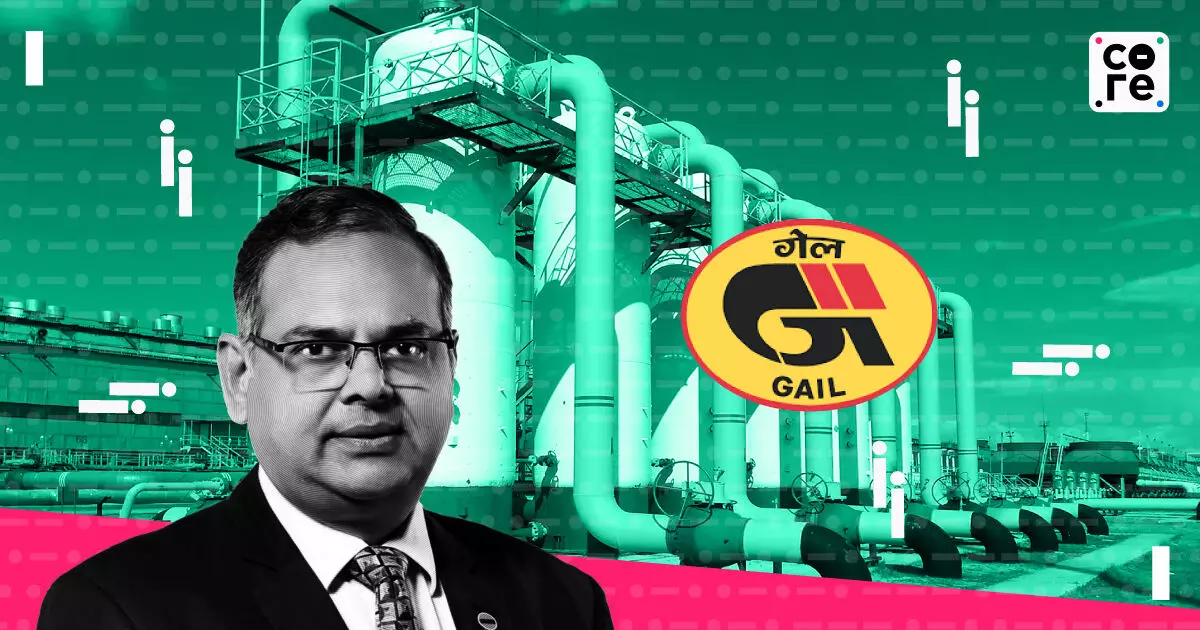
GAIL Bets Big On Pipelines And AI To Power India’s Gas Push
- Business
- Published on 23 Jan 2026 5:36 PM IST

A nationwide pipeline push, coupled with AI-led efficiencies, reflects an effort to future-proof assets in a shifting energy mix.
The Gist
GAIL (India) Ltd is in an accelerated growth phase, having commissioned nearly 3,000 km of new natural gas pipelines, expanding its national grid by about 20%.
- Chairman Sandeep Gupta highlighted the completion of the Mumbai-Nagpur-Jharsuguda Pipeline.
- The expansion connects energy-rich western India with underserved industrial hubs in the east.
- GAIL is also leveraging AI to enhance operational efficiencies and has trained over 3,700 employees in AI fundamentals.
State-run energy major GAIL (India) Ltd has moved into an accelerated growth phase, commissioning nearly 3,000 kilometres of new natural gas pipelines over the past year to expand its national grid by roughly 20%, chairman and managing director Sandeep Gupta said.
“GAIL is expanding its network on a pan-India basis. And many new pipelines have been laid and have already been commissioned, gasified or are likely to be gasified very shortly.
So a great part of the country is now covered with our natural gas network,” Gupta told The Core during an interview as part of the India Energy Week.
The infrastructure surge is headlined by the strategic Mumbai-Nagpur-Jharsuguda Pipeline (MNJPL), which has achieved full operational status on its critical 694-km Mumbai-Nagpur stretch. The project integrates a high-capacity gas corridor within the utility space of Maharashtra’s Samruddhi Mahamarg Expressway—a first-of-its-kind engineering feat in India under the PM GatiShakti framework.
Bridging the National Grid
The massive expansion, which brings GAIL’s total network to approximately 17,000 km, is designed to link the energy-rich western coast to underserved industrial hubs in central and eastern India.
Significant project updates for 2026 include:
Eastern Corridor Expansion: The 422-km mainline of the Srikakulam-Angul Pipeline is now operational, connecting Andhra Pradesh and Odisha. While the mainline reached gasification in late 2025, work on associated spur lines is slated for completion by June 2026.
Southern Reach: The Kochi-Mangalore-Bangalore pipeline is entering its final stages, with the remaining sections in Tamil Nadu expected to be commissioned by March 2026, ending years of land-acquisition delays.
Petrochemical Integration: Beyond transmission, the company is nearing the launch of its USAR petrochemical project in Maharashtra and a PTA plant in Mangalore, both expected to commission within the current calendar year.
The AI Dividend: Project Sanchay
Parallel to its physical expansion, GAIL is betting on Artificial Intelligence to wring efficiencies from its new assets. Through Project Sanchay, the company is targeting a net present value benefit of 600 crore ($72 million) by 2028.
"We are using AI to manage hydraulics and line pack in our pipelines and advanced process controls in our petrochemical units," Gupta said. To support this, GAIL has launched a massive upskilling initiative, training over 3,700 of its 5,000 employees in AI fundamentals. The goal is to identify "AI champions" who can automate high-risk tasks, such as predictive maintenance at "vulnerable spots" identified through intelligent pipeline pigging data.
Resilient Logistics And Financial Strength
Despite the effective closure of the Suez Canal due to regional conflict, GAIL has maintained its supply chain through a "swap" strategy. By selling U.S.-sourced LNG to Europe and sourcing equivalent volumes from the Middle East for India, the company has successfully bypassed the longer Cape of Good Hope route for a significant portion of its portfolio.
Financially, the company remains in a "hyper-growth" position. With a debt-to-equity ratio below 0.25:1, GAIL is aggressively lobbying regulators to de-authorise stalled projects from other entities and hand them to GAIL for completion.
"Infrastructure must precede consumption," Gupta said. "We are providing the network first, and we are seeing city gas distribution and fertiliser sectors follow at a phenomenal speed."
Core.
Core.


