



 Newsletter
 Search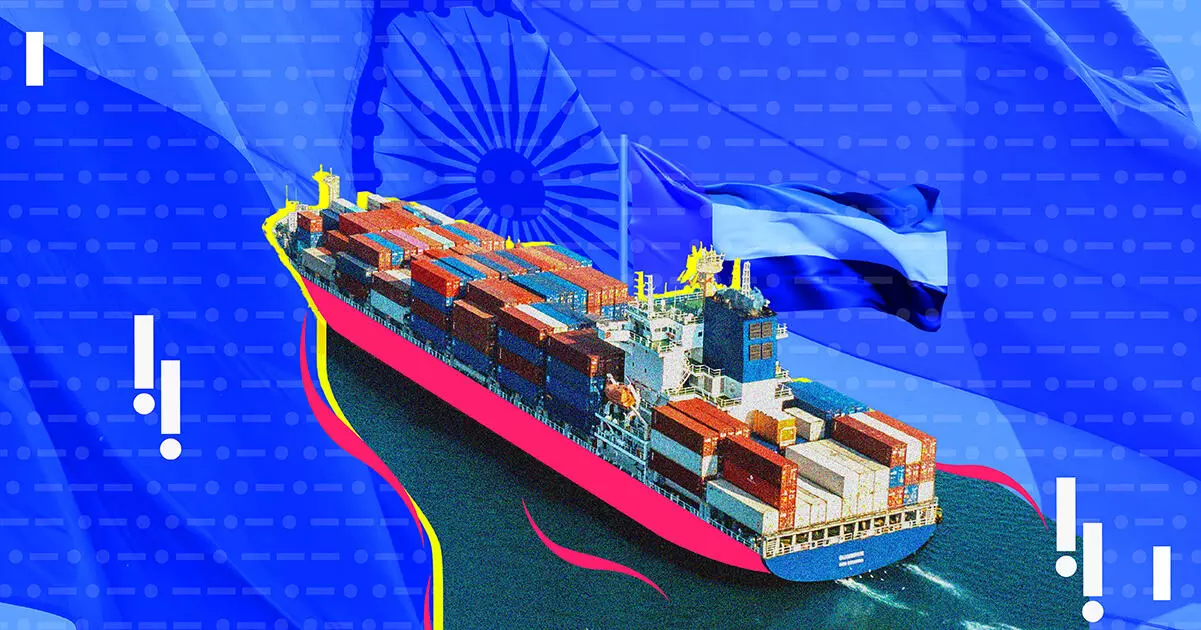
From Aluminium To Alphonso Mangoes: West Asia Tensions Are Paralysing India’s Export Engines
 By Zinal Dedhia
- Business
- Published on 17 March 2026 6:00 AM IST

West Asia tensions disrupt India’s exports to the Gulf, delaying shipments, raising freight costs and forcing exporters to reroute cargo, cancel orders and explore domestic markets.
The Gist
India's export sector faces challenges as shipping routes are altered due to tensions in West Asia, affecting trade with the UAE.
- Exporters are experiencing delays and increased costs, leading to a reevaluation of their strategies.
- Perishable goods are particularly hard hit, with some exporters abandoning shipments due to high freight costs.
- Industry experts suggest that exporters may shift focus to the domestic market as a response to ongoing uncertainties.
For years, the Gulf has been a steady market for Anirudha Agrawal. From his base in Kolkata, the director of Manaksia Aluminium Company regularly shipped aluminium products to the UAE, building a business that clocked annual exports worth millions of dollars. But the current tensions in West Asia have suddenly thrown that trade into uncertainty.
The disruption comes at a time when the United Arab Emirates has emerged as one of India’s most important export destinations. India’s exports to the UAE were worth about $36–37 billion in 2024, making it the country’s second-largest export market and third-largest trading partner overall.
“Fifteen to 20 million dollars annually was my export to the UAE,” Agrawal told The Core, describing how the Gulf market had become a key destination for his company’s products.
Now, even shipments that have already left Indian ports are caught in the disruption. According to Agrawal, aluminium coils and sheets worth about $2 million are currently in transit, but their journey has become far more complicated.
“We have received feedback from the shipping line DP World that they will take the goods via Khor Fakkan or Fujairah, the port before the Strait of Hormuz. Since they are focusing on essentials first, our products will reach with a delay of 15–20 days,” he said.
The uncertainty does not end there.
Not only have new orders not come in, but banks are also sceptical about financing new orders. As a result, exporters like Agrawal are facing a situation where both current and future trade flows are under strain.
Even when shipments eventually arrive, the costs will likely be higher.
“Right now, the product is shipped at the old value, but shipping lines will charge extra for rerouting and extra transportation cost, and this will be passed on to the customers,” Agrawal explained.
The disruption is already pushing exporters to reconsider their strategy.
“Managing this situation in exports will be to target other markets, because there is not much clarity,” he said.
The broader logistics costs are also climbing.
“The freight costs to India have increased by almost $2000–$2500 per container. We import from Europe and are affected by this price rise,” Agrawal added.
According to Ajay Srivastava, founder of Global Trade Research Initiative (GTRI), several sectors in India could be hit if disruptions in West Asia persist, with energy facing the highest exposure. India imported about $70 billion worth of petroleum crude and products from the region in 2025, including $50.8 billion in crude oil, nearly half of its total imports.
The country also relies on West Asia for 68.4% of its LNG and nearly half of its LPG supplies. The fertiliser sector is also vulnerable, with $3.7 billion worth of imports covering about a third of India’s needs. Key industrial inputs such as limestone, sulphur and polyethylene, along with rough diamonds for the export sector, could also face disruptions.
Shipping Delays Ripple Across Export Sectors
Industry bodies said Agrawal’s experience reflects a wider disruption unfolding across India’s export sector as shipping routes and schedules are altered due to tensions in West Asia.
“The export has definitely been impacted. We are seeing a challenge not only for export to the Middle East, but even export to other destinations is facing a challenge because if the ship has to go through a longer route, it entails a cost and the frequency of sailing is likely to be impacted,” Ajay Sahai, director general of the Federation of Indian Export Organisations (FIEO) told The Core.
For shipments headed specifically to West Asia, exporters are increasingly relying on indirect routes. Some cargo is now being transported only to intermediary ports before being moved further through other modes.
“For Middle East, some sailing has started more so by the NVOCC, and they are moving particularly the cargo up to Khor Fakkan port and from there it is either moving by road or the shipping lines are abandoning that or handing out those consignment to Khor Fakkan and then exporters are arranging from there by road to other Middle Eastern countries,” Sahai said.
These longer routes are also affecting payment cycles, which are typically tied to the delivery of goods.
“The longer duration has also started, but that has impacted the delivery of the container and since payment is generally related to the delivery, the payments are getting impacted, which is affecting the liquidity at the end of the exporters,” he said.
The slowdown in shipping has created another problem closer to home: containers are piling up at factories as exporters struggle to move their cargo.
“With not many containers moving, there are compilations of the containers at the factories, which is also posing a problem,” Sahai said.
That, in turn, is beginning to affect production itself.
“So if I am not able to send the container to the Middle East and there is no available sailing, I have to keep the container filled with the goods at my factory, and I have to run the factory also. So if I have a number of containers stacked at my factory, it is affecting the manufacturing in the factory also,” he added.
The disruption is being felt across sectors, reflecting the diversified nature of India’s exports to the Gulf region, which include engineering goods, automobiles, chemicals, food products and plastics.
India exports a wide range of goods to the Gulf region, reflecting strong trade ties with countries such as the UAE, Saudi Arabia, Qatar, Kuwait and Oman. Key exports include petroleum products, engineering goods, machinery, automobiles and auto components, gems and jewellery, chemicals, plastics and pharmaceuticals. The region is also a major destination for agricultural and food products, including rice, sugar, meat, fruits and vegetables.
In addition, textiles, ready-made garments and leather products form an important share of India’s exports to Gulf markets, with hubs like Dubai also serving as re-export centres for goods destined for Africa and other regions.
Perishable Exports Face the Sharpest Impact
Perishable products are among the worst hit, largely because of their limited shelf life and the additional cost of refrigerated shipping.
India exports large volumes of fruits and agricultural products to the Gulf. Bananas, in particular, form a significant portion of shipments from southern states, with tens of thousands of tonnes exported every month to Gulf markets during peak seasons.
“Referred container charges have an additional levy of $4,000, which is making it extremely difficult because in many of the cases, the cost of freight itself is much more than the cost of the product,” Sahai said.
For example, a referred container, a special container used for temperature sensitive products like perishables, to West Asia may have $1,000 to $1,200 per container. Now your surcharge itself is $4,000.
Faced with such steep costs, some exporters have chosen to abandon shipments altogether and sell the goods in the domestic market instead.
“That is why you must have seen that in perishables we have seen many cases of back-to-town containers also because exporters thought that they would not be able to pay that much of high freight and therefore they have offloaded in the domestic market,” he said.
When export-bound goods flood the local market, the ripple effects extend beyond traders and exporters to farmers as well.
“That’s true because if the prices are suppressed, then the farmers will also not be getting a good price. Because if we let us say a banana comes to the domestic market, what happens to the further bananas being produced? So that price also comes down,” Sahai said.
“It is not just confined to the export-related consignment. If the export-related consignment brings down the price, it impacts all the supplies of the product,” he added.
Dubai’s Role
For sectors like garments and textiles, the Gulf — and especially Dubai — serves not only as a consumer market but also as a trading hub connecting exporters to buyers from Africa, Russia and other regions.
India’s textile and apparel exports exceed $35 billion annually, with ready-made garments forming a major share and the Gulf region accounting for a significant market for trading and re-exports.
“See, the fact is that there is uncertainty in the Middle East region, and it is not just the exports to the UAE consumers, but Dubai, particularly, is also a transhipment point for many other markets,” Rahul Mehta, chief mentor of the Clothing Manufacturers Association of India (CMAI) told The Core.
Dubai’s wholesale markets often act as meeting points for international buyers who source goods from Indian exporters.
“It is a kind of wholesale market where buyers from the whole of Africa, even Russia and all, they come to Dubai to place their, make their purchases. So in that sense, definitely it will be an impact if it continues,” Mehta said.
Exporters Eye Domestic Market
While the current disruption is largely being seen as a short-term shock, exporters are also reassessing their longer-term strategies.
“There are two ways of looking at it. One is in the very long term. In the very long term, I don't think people are changing their plans, you know, thinking of moving out of the industry or whatever,” Mehta said.
However, many exporters — particularly those with large manufacturing capacities — may begin shifting a greater share of their output to India’s domestic retail market.
“But they will, I think most exporters today, especially those with large production capacities, I think will be looking at the alternative of getting to the domestic market,” he said.
Large apparel exporters have already started moving in that direction.
“I think that is a strategic… many of the exporters thinking, as it is, all the big players like Shahi, Pearl Global, etc., they’re all already having started to work with domestic retailers,” Mehta said.
India’s rapidly expanding organised retail sector is also making the shift more feasible.
“Till now, the domestic market was not big enough for us. But now with the big retailers like Reliance, Aditya Birla, the Lifestyle Group, etc., the orders, the quantities are good enough, the prices are good enough,” he said.
Uncertainty Ahead
Industry leaders say the situation could worsen if freight rates remain elevated and shipping disruptions continue.
“Since lot of containers have to come back because exporters are finding it very difficult to pay that much of a freight or buyers are backing out to pay that kind of freight, I’m pretty sure that in times to come we will see many containers coming back also because probably for large volume, low value products, the freight itself will be quite huge,” Sahai said.
“So, it may not be possible to bear the cost of the freight. Let us see how it spans out in the next 15 days or so,” he added.
Core.
Core.


