



 Newsletter
 Search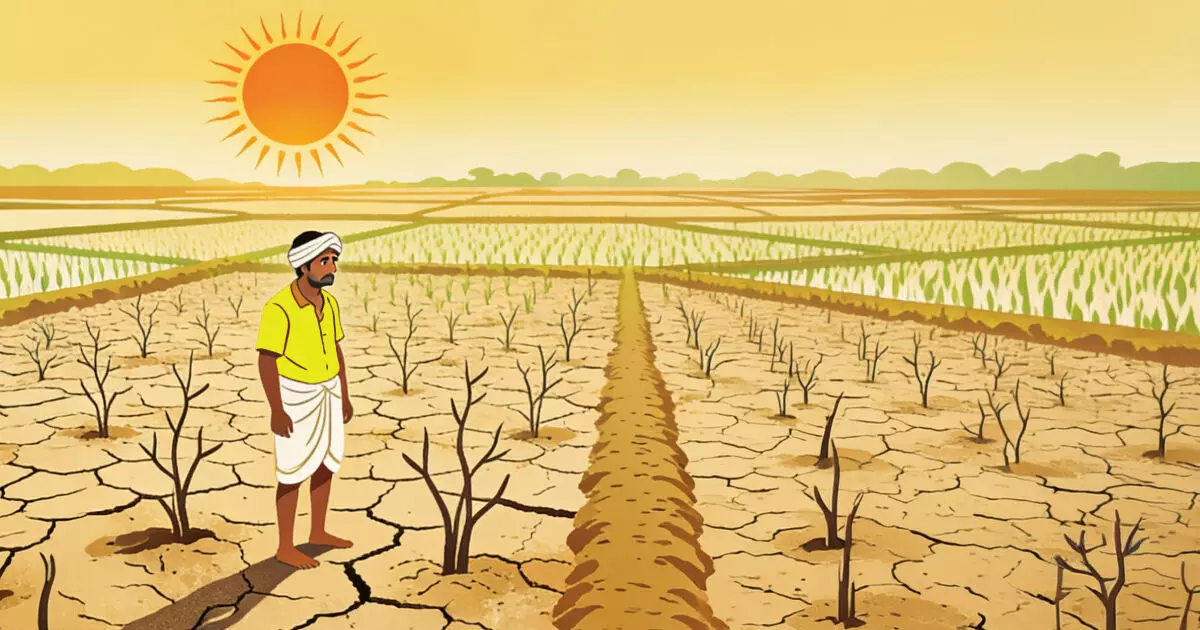
El Niño Threatens Farms And Rural Economy, But India Isn’t Prepared
- Business
- Published on 18 Jun 2026 6:00 AM IST

Not just fall in crop yield or farmers’ income, delayed VB-G RAM G and inflation could lead to rural distress for months.
The Gist
- El Niño alters global weather patterns, affecting rainfall and temperatures.
- India may face a weak to strong El Niño, impacting agricultural yields and rural incomes.
- Preparations by the Indian government appear insufficient, raising concerns over food security and farmer distress.
On June 11, the US National Oceanic and Atmospheric Administration (NOAA) confirmed that El Niño had developed in the tropical Pacific and warned that it could strengthen into a “very strong” event this year. Global forecasters expect it to increase through the year, when India experiences its crucial monsoon season.
El Niño is a climate pattern in which sea surface temperatures in the tropical Pacific Ocean become unusually warm, altering rainfall patterns and weather systems across large parts of the world, including India.
A strong El Niño is typically associated with ocean temperatures at least 1.5°C above average, while a very strong event exceeds 2°C. The WMO has already confirmed that 2025 was among the warmest years on record and that the past 11 years have been the warmest recorded period globally, with ocean heat continuing to rise.
A very strong El Niño in 2026 could further elevate global temperatures, raising the possibility that 2027 becomes another record-breaking year.
While there is much chatter about how it could affect India, Mrutyunjay Mohapatra, Director General of the Indian Meteorological Department, told The Core that India was expected to experience a “weak” El Niño in June, and a “moderate” version in July-August and a “strong” one in September — the last month of the south-west monsoon.
The IMD predicts that rainfall will be at an 11-year low of 90% of long period average (LPA); it has also predicted heatwave conditions in several parts of the country, particularly in the east, central, north, northwest and southwest peninsula.
A strengthening El Niño threatens to hit India's farm output and rural incomes, with experts warning that delayed preparations and rising input costs could deepen distress across rural India.
India Isn’t Prepared
Though warnings of El Niño and heatwaves surfaced months earlier, turning more definitive since April, the Ministry of Agriculture and Farmers Welfare launched its “Khet Bachao Abhiyan” on June 1.
The ministry has proposed that agricultural scientists, experts and public representatives spread out and create awareness among farmers. At a review meeting the next day, the ministry identified 197 districts as most vulnerable and talked about “focusing on seeds, moisture conservation, water management and alternative crop planning” for kharif.
Rabi didn’t find a mention except that enough seeds will be available, as also for kharif. At the June 16 review, the number of most vulnerable districts was increased to 326, spanning 12 states.
GV Ramanjaneyulu, executive director of the Centre for Sustainable Agriculture, said that the preparations should have begun in May, not June. “Farmers across the country started sowing in May with pre-monsoon showers. The plants will dry if there is no rain for another week”, he told The Core, adding that farmers should have been asked to delay sowing, avoid water guzzling paddy and sugarcane and be provided with drought-resistant seeds.
The impact of El Niño this year could be worse than earlier ones, not only because it may raise the temperature by over 1.5°C, but also because it follows 2025, one of the warmest years on record.
“Farmers may now need second sowing, which will require more fertilisers; yields may be impacted, and farmers’ income may dwindle if they opt out of paddy and sugarcane, which are procured, providing assured income. They can’t switch to organic farming overnight as the government is asking them to because that will cut yield by 50% as the soil is used to chemical fertilisers for years,” Ramanjaneyulu said.
While the government may have launched an initiative, it seems to have not yet reached the farmers. Farmer leader Balbir Singh Rajewal of the Bharat Kisan Union told The Core that he had neither heard nor read about the “Kheti Bachao Abhiyan”, hence there was no question of farmers being aware or being prepared.
“It is only a rhetoric, not a practical solution. Farmers have already started transplanting paddy. They are not getting adequate urea and DAP; the diesel prices are up, and drought-resistant seeds can’t be provided overnight. They are facing a crisis now, and what we are staring at is a fall in crop yields and risks to food security”, he said.
In winter, Ramanjaneyulu believes there could be a competing demand for drinking water and industrial use during winter, which will put more pressure on irrigating rabi crops.
He said the kharif crop loss could be as high as 30-40%. Since kharif contributes 60-70% total crop output and is rain-fed, he said, “If kharif goes, everything goes.”
One comforting factor is the relatively healthy level of water stored in reservoirs. As of June 11, reservoirs held water equivalent to 28.28% of their live storage capacity, around 16% higher than the 10-year average, although 8% lower than the level recorded a year earlier. The higher-than-normal storage should provide a buffer against a weak monsoon and help support irrigation needs during the rabi season.
The Long Term Effect
Already by the end of May, there was a massive shortfall in pre-monsoon showers. The south-west monsoon arrived four days late in Kerala, and around 18 states in India received “largely deficient” rainfall between June 1 and 16.
These weather conditions damage not just kharif crops but livestock, fisheries and forests, threatening livelihoods and the health of agricultural workers.
Low monsoon rainfall also means weaker replenishment of reservoirs, rivers and groundwater, forcing greater dependence on existing water stocks. Along with lower soil moisture, this can leave less water available for the rabi crop season, which is sown between October and November.
As a result, the impact of El Niño is unlikely to be confined to the kharif season and could extend well into the rabi season. The extent of the damage, however, will only become clear over time, given the inherent uncertainty surrounding weather events and their interaction with local conditions.
El Niño Impacts Agriculture In Many Ways
Past El Niño episodes offer a glimpse into what may lie ahead.
A 2023 study by the ICAR-Indian Institute of Farming Systems Research found that yields of major kharif crops, including paddy, maize, pearl millet and sorghum, fell by more than 10% during previous El Niño years such as 2002, 2004 and 2009.
The risks are compounded by extreme heat. A 2025 analysis found that rising temperatures can sharply reduce crop yields, while climate scientist Joy Merwin Monteiro of the Indian Institute of Science Education and Research said labour productivity during the heat spells can fall by as much as 50%.
The impact matters because farming and livestock remain central to rural incomes.
According to NABARD's All India Rural Financial Inclusion Survey, cultivation and livestock account for about 45% of agricultural household income and 27% of all rural household income. With rural India contributing nearly 48% of the country's net value added, a severe El Niño could ripple far beyond farms, affecting consumption, wages and economic growth.
Resilience Given A Go By
The risks posed by El Niño and heatwaves are compounded by the limited resilience of India’s agricultural system.
Ramanjaneyulu said, “Resilience comes from local conditions, but we don’t plan agricultural output based on soil, water and environmental conditions. Our policy is what the government thinks is right. Half of Punjab is not suitable for paddy, and except for basmati, most of the paddy produced is not locally consumed either, but it is grown because the central government procures it.”
Another factor that has emerged as a major setback to crop yields is the lack of quality seeds. The NITI Aayog’s reports have identified it as one of the factors for India’s growing import dependency in oilseeds and pulses.
The Economic Survey of 2025-26 found that, barring maize, yields of soybeans, sunflower seeds, rapeseed, peanuts, millet and many other crops have “either stagnated or declined” in recent years, and the ethanol blending has pushed away farmers from edible oil, pulses and some cereals like millets – critical for food security – to maize due to price signalling.
Soumya Dutta, co-convenor of South Asian People’s Action on Climate Crisis, said that India was not prepared because there was no immediate threat due to sufficient food stocks, and the ascent is on corporatisation of farming, rather than empowering farmers or raising their incomes.
No Income Back Up
Unlike in previous years, there is no fallback option for farmers either. The job guarantee scheme MGNREGS has been replaced with VB-G RAM G, which is no longer a demand-driven scheme and is scheduled to start only in July, entirely bypassing the peak demand quarter of April-June (which accounted for 40% in FY25).
The operational changes introduced in the VG-G RAM G means, farmers and farm labourers (accounting for 55% of the total agricultural workforce, as per the 2011 Census) sitting idle due to lack of rain (drought) and lack of work after the sowing is over can no longer demand work but will have to rely on what the Indian government offers (which will be known only after July).
Given that an average of 61 million households and 86 million individuals availed MGNREGS work in five years between FY22-FY26 (their numbers are 20 million and 26 million, respectively, during April 1-June 16 of FY27), the income loss will be huge.
The changeover to the VB-G RAM G also comes with another setback: The average wage of these workers has actually fallen to Rs 266.83 in FY27, from Rs 267.08 in FY26, as per the MGNREGS records.
The yearly revision has been kept at abeyance because of the switch to the new rural job regime.
Ramanjaneyulu said the last time India was hit with a “strong El Niño” was in 2015-2016, which caused drought in 266 districts across 11 states.
“India was caught unprepared since there was no advance warning then. A massive crop failure led to a large number of suicides by farmers in those years,” he said.
So far, the Indian government has not said a word about a possible drought.
Core.
Core.


