



 Newsletter
 Search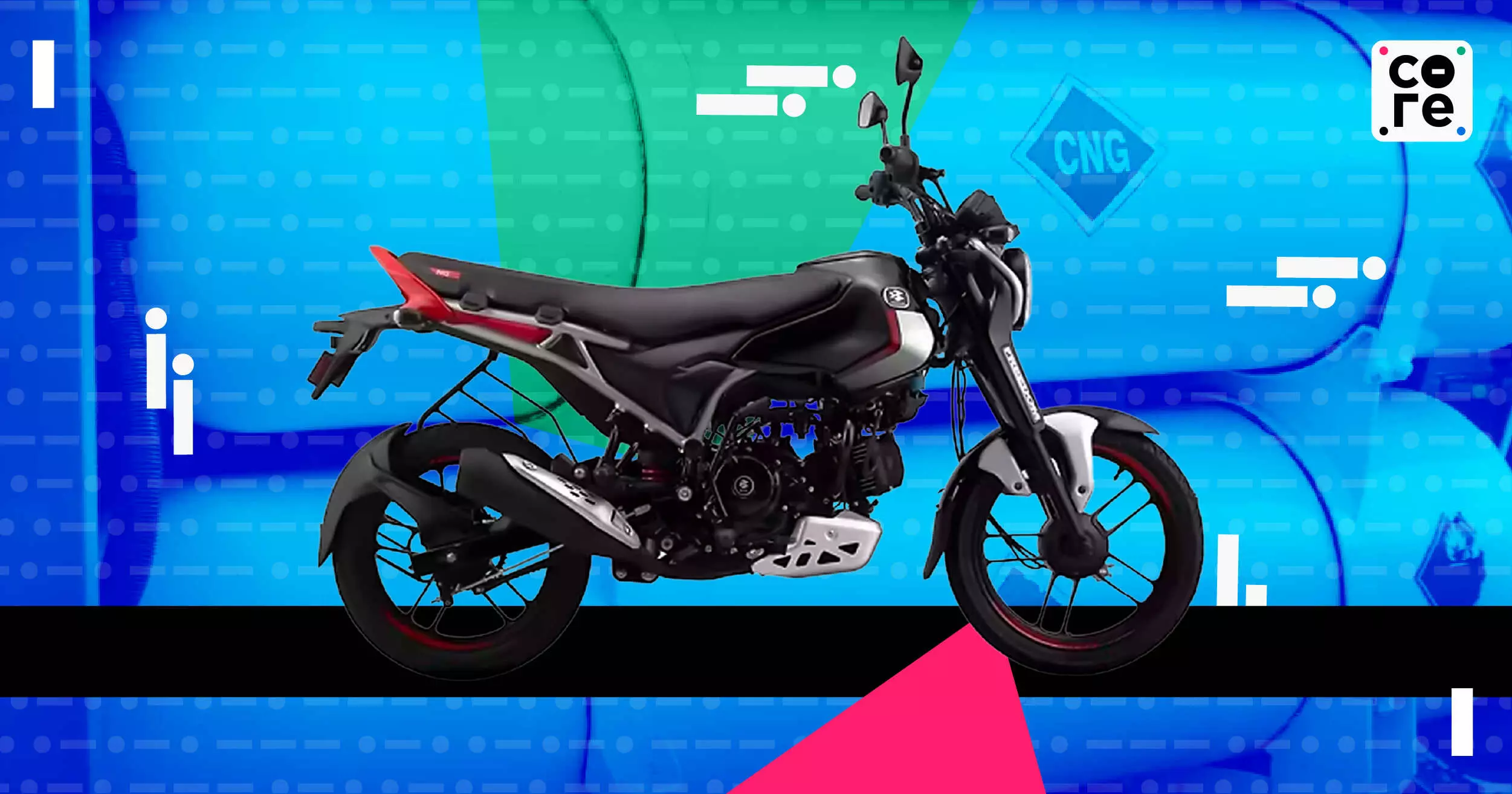
CNG Motorcycle Didn’t Click. Can Scooters Change The Story?
- Business
- Published on 19 Nov 2025 6:00 AM IST

Bajaj’s CNG motorcycle bet hasn’t ignited the market, but scooter makers are circling the opportunity. Now the real question is whether CNG can find its niche before EVs run away with the show.
If you’ve ever been stuck in a CNG refill line long enough to reconsider your life choices, here’s the plot twist: India’s fuel landscape is evolving, with the CNG network expanding more than tenfold, soaring from 738 in 2014 to more than 8,000 today.
The appeal is evident— lower running costs, cleaner emissions, and a decade-long track record powering autos and city cabs. CNG has long been the workhorse fuel for three-wheelers and budget-conscious customers.
But its real turning point only started to emerge last year. For the first time, CNG made inroads into India’s most dominant vehicle category, the two-wheeler market, where the country leads the world.
However, about 69% of respondents in The Core’s online survey said they weren’t even aware that a production-ready CNG two-wheeler is available in India. That’s surprising at first glance. After all, Pune-based Bajaj Auto, one of the country’s most recognisable two-wheeler makers, launched the Freedom CNG motorcycle over a year ago, which also holds the title of being the world’s first commercially produced CNG-powered bike.
But that surprise fades quickly when you look at the market reality — there’s only one CNG motorcycle on sale.
“CNG adoption in two-wheelers has lagged far behind other segments largely because of inherent design limitations. Unlike cars or three-wheelers, two-wheelers simply don’t have the space for a CNG cylinder without affecting weight balance, performance, and overall rider comfort,” said Rohan Kanwar Gupta, Vice President & Sector Head- Corporate Ratings at ICRA, in a conversation with The Core.
Interestingly, Chennai-based TVS Motor Company has also stepped into the space, showcasing a Jupiter CNG scooter at the Auto Expo earlier this year. And it isn’t alone, Suzuki Motorcycle recently showcased a CNG-powered Access prototype at the Japan Mobility Show. However, neither company has gone on record with a clear product launch timeline yet.
According to Hemal N Thakkar, Senior Practice Leader & Director at research and consulting firm Crisil Intelligence, the recent push toward CNG models is also an industry response to rising affordability pressures in the entry-level motorcycle market.
“Since the rollout of BS-VI norms, prices of entry-level two-wheelers have risen 35- 40%, while petrol has stayed expensive. OEMs are exploring CNG variants as a more cost-effective alternative for price-sensitive consumers,” Thakkar told The Core.
Even though sales have picked up, India’s two-wheeler market is still below its FY2019 peak of 21.2 million units. Vehicle prices had jumped in recent years because of stricter emission norms, added safety features, and rising input costs. The recent GST cut now offers a much-needed breather.
Where’s the Customer Interest?
CNG started gaining traction in India in the early 2000s as government mandates pushed public transport toward cleaner fuels and private vehicles embraced retrofitted kits. For cars, the real momentum arrived in the 2010s, when OEMs began rolling out factory-fitted CNG models. Leading the charge was Maruti Suzuki, which kicked off its CNG lineup with the Alto.
India has also tested CNG two-wheelers earlier, albeit with little success. A 2016 Delhi pilot programme retrofitting scooters with CNG kits, followed by similar trials in certain states, ran into performance issues, infrastructure gaps and high costs.
When Bajaj Auto launched its CNG motorcycle in July 2024, the company earned widespread applause for its bold first-mover bet. It was a high-stakes experiment, one that could have reshaped the category or fallen flat. Both Bajaj and the industry were watching closely to see how Indian consumers would respond. But the reception has been far more modest than expected.
In its first year, Bajaj dispatched 74,730 units of the Freedom 125, with retail demand holding steady at around 5,000 units a month through 2024, and peaking during October-November accounting for the festive-season surge. Initially launched in Maharashtra and Gujarat, markets with strong CNG networks, the motorcycle's availability has since expanded to over 350 towns.
But momentum has cooled sharply. Less than five months after launch, Bajaj cut Rs 5,000 from the entry variant to stay competitive, and another round of discounts followed in 2025.
Now, monthly dispatches have slipped below 2,000 units, indicating that the Bajaj Freedom has yet to gain the sustained traction the industry once anticipated.
The Core reached out to Bajaj Auto with a detailed questionnaire on November 10, but is yet to receive a response. At the company’s Q2 earnings media call this month, CFO Dinesh Thapar affirmed that despite the drag in consumer demand and sales, Bajaj is not considering pulling the plug on the Freedom motorcycle. “There is some work in the product funnel as well that will play out in due course,” he said.
“The bike has received a decent response and appeals to ‘value-for-money’ customers. But Bajaj needs to step up its marketing efforts, especially in the northern region,” said a Delhi-based dealer who requested anonymity.
Another Bajaj dealer described the motorcycle as a “common man’s bike” aimed squarely at the gig economy. According to him, it barely attracts family commuters and primarily goes to daily users who clock close to 100 km a day, including coaches, delivery workers, and small business owners. Additionally, some dealers are offering "exclusive discounts for Rapido riders."
Insiders tracking the industry suggest that Bajaj introduced the model at a time when its entry-level portfolio (100cc-125cc) was under strain. The Platina, for instance, had seen sales drop sharply as the company shifted its focus toward the Pulsar range. In an attempt to regain ground against segment leaders like the Honda Shine, Hero Splendor, and HF series, Bajaj explored a CNG variant as a potential differentiator, an idea that ultimately took shape as the Freedom 125.
“When the motorcycle failed to deliver the volumes needed to revive the segment, Bajaj moved swiftly to recalibrate its strategy. The company redirected its efforts toward the Chetak electric lineup, where it has since seen far stronger traction,” said one of the persons cited above.
The renewed CNG push also comes as EV adoption accelerates. India crossed 20 lakh EV sales last fiscal, led by electric two-wheelers, followed by passenger e-rickshaws. But with electric motorcycle options still limited, CNG offers a viable opportunity. And for Bajaj, already a leader in CNG three-wheelers where the tech is well proven, the Freedom 125 seems less a risk and more a calculated bet.
Ashim Sharma, Senior Partner & Group Head Business Performance Improvement Consulting (Auto, Engg. & Logistics) at Nomura Research Institute (NRI) said, “Automakers view CNG motorcycles as a strategic addition to their portfolios, particularly in the absence of electric alternatives at similar price points in this category. The proposition is aimed at customers looking to lower running costs, while the technology itself is proven and requires minimal incremental investment. For manufacturers, CNG offers an additional revenue stream with limited financial risk.”
Is It A Product Flop?
Bajaj CNG motorcycle features dual fuel tanks (2kg CNG and 2L petrol) and the company claimed it can cut fuel expenses by nearly half compared to a petrol motorcycle.
A recent internal study by Crisil Intelligence found that the total cost of ownership (TCO) over a five-year period shows only a marginal difference between CNG and petrol motorcycles. For a daily commuter riding 30–35 km a day, a comparable petrol bike still edges out the CNG option at roughly Rs 3.2 per km, versus Rs 3.3 per km for a CNG bike. However, for heavy users such as gig workers, who average 100–120 km of riding per day, the economics flip in favour of CNG. The Crisil study shows that a CNG bike delivers a promising ownership proposition here at roughly Rs 1.7 per km, compared with about Rs 1.9 per km for a petrol motorcycle.
For personal use, the Freedom CNG certainly doesn’t quite click. Nobody wants to bake in a CNG line behind autos and cabs, most of which are also covered, while you sit exposed on a motorcycle in peak summer. And beyond the heat, an industry veteran summed up the feeling- the bike just doesn’t deliver the comfort or pride of ownership to earn a “national bike” status.
According to Anurag Singh, advisor at management consulting firm Primus Partners, fleet operators, in particular, can benefit from centralised refueling and predictable usage patterns, making CNG a cost-effective option.
Looking at the long-term perspective, Thakkar of Crisil said, “The maintenance cost of a CNG motorcycle is likely to be higher than that of a petrol bike, due to the specialised components, fuel system, and safety checks required for CNG operation.”
“And no one can predict it with certainty, but petrol vehicles, being time-tested and long established, are likely to retain a higher resale value compared to newer CNG models,” he added.
Experts also suggest that expanding the CNG refuelling network remains critical. According to Singh, adoption of CNG two-wheelers faces structural barriers that don’t affect other vehicle categories as strongly. “They require compact, lightweight systems, and integrating CNG kits compromises space and performance. The cost of retrofitting and the limited availability of refuelling infrastructure in smaller towns remain major deterrents,” he said.
An industry veteran also pointed out that entry-level motorcycles are predominantly a rural-market product, and with CNG infrastructure still majorly concentrated in urban towns, the fuel simply isn’t accessible where much of the demand exists. That mismatch, he noted, could be a key factor holding back adoption.
Setting up compact CNG dispensing units, mobile refueling stations, and integrating with city gas networks can make CNG viable.
As per the latest data sourced from PNGRB, Uttar Pradesh, Maharashtra and Gujarat, followed by Haryana and Delhi, are the top 5 states with the widest CNG network in the country.
Are Scooters The Better Bet?
Experts believe that while CNG two-wheelers may carve out a niche in the near term, the likelihood of widespread, mass-market adoption is very slim.
“Within this segment, scooters are likely to see stronger traction than motorcycles, given their urban-focused usage and appeal among delivery fleets and cost-conscious riders,” Kunwar said.
Sharma also noted that in the case of scooters, the opportunity appears promising to replace some of the ICE demand, which EVs cannot satisfy due to charging issues. As predominantly urban vehicles, scooters can leverage the relatively well-developed CNG infrastructure in major cities. This could appeal to urban consumers who face challenges with EV charging.
“Given that two-wheelers account for the bulk of India’s vehicle market, even a niche uptake of CNG scooters and motorcycles could translate into meaningful sales volumes,” he said.
However, Thakkar pointed out that in scooters, boot space is a key selling point, especially for family or women-centric rides. If a CNG cylinder eats into that space, it limits the scooter’s practicality, and compromising storage can make it challenging to sell a vehicle effectively.
While the industry still has no production-ready CNG scooters on the road, Suzuki hasn’t confirmed whether its Access CNG concept will make it to the Indian market.
And TVS? That launch looks like a long shot. Three people close to the development told The Core that the company is in a wait-and-watch mode on introducing its CNG scooter to the market, especially after the response to the Freedom motorcycle. The Auto Expo showcase, they said, was more about signalling capability than an imminent rollout.
Singh of Primus Partners said that while CNG has potential as an alternative fuel for two-wheelers, its ceiling is fairly clear. “In the medium term, CNG will find its own level of acceptable success, but it cannot become a mainstream option like petrol or EVs,” he said.
The limited success will ultimately hinge on policy support, infrastructure expansion, and overall consumer economics.
Core.
Core.


