



 Newsletter
 Search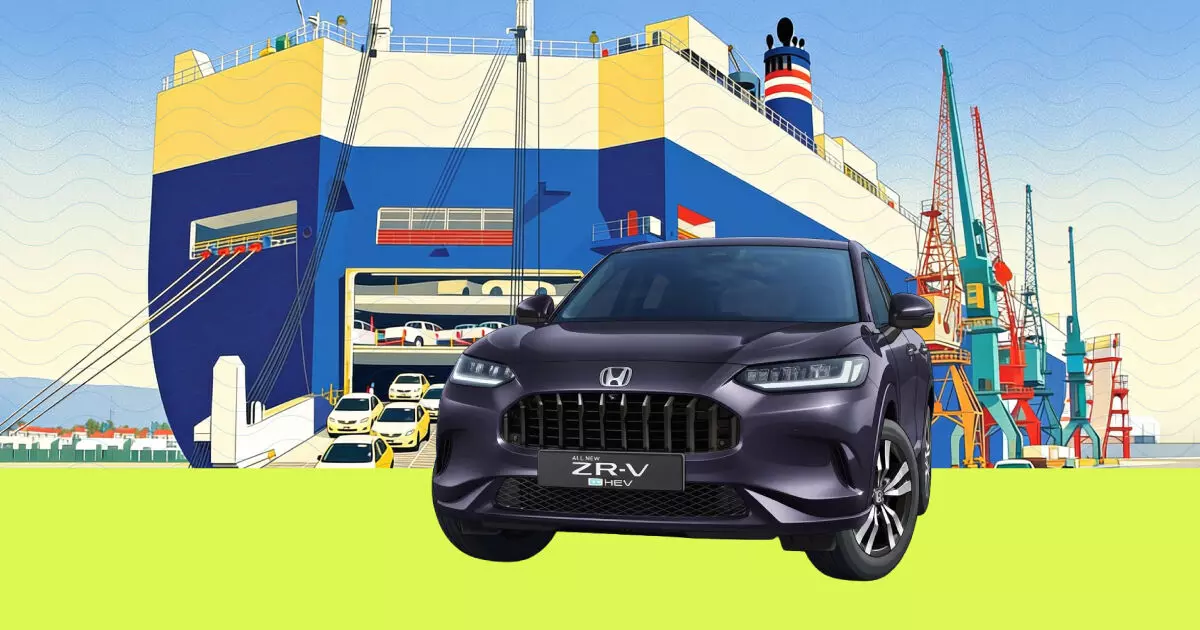
Honda Bets On Imports And SUVs To Rebuild Its India Presence

The move reflects Honda’s broader push to revive its position in India through a two-pronged strategy of bringing back premium global models while building a pipeline of mass-market SUVs and electric vehicles for the domestic market.
The Gist
Honda Cars India is shifting its strategy to revive its market presence.
- After nearly 25 years, Honda's portfolio in India was limited to three models until the recent launch of the ZR-V hybrid SUV and an updated City sedan.
- The company plans to introduce over 10 models by 2030, focusing on premium global models and mass-market SUVs.
- Despite challenges, Honda aims to tap into its loyal customer base and the growing demand for premium vehicles in India.
Clearly, Honda Cars India is at a crossroads. After nearly two and a half decades in the country, the Japanese carmaker’s portfolio had shrunk to just three models until a few months ago. But in May, Honda signalled a shift in strategy, unveiling the premium hybrid SUV ZR-V for the Indian market alongside a refreshed version of its long-serving City sedan.
The move reflects Honda’s broader push to revive its position in India through a two-pronged strategy of bringing back premium global models while building a pipeline of mass-market SUVs and electric vehicles for the domestic market.
Honda had also announced more launches during the Japan Mobility Show 2025.
President and CEO Toshihiro Mibe had said during the event that the company had an aggressive growth map for India. “We are planning to launch 10 or more models by 2030.”
For the SUVs, which have become mainstream in India, “our plan is for seven models by 2030,” he elaborated. Mass-market SUVs and mid-size cars customised for the Indian market will start launching from 2028 onwards.
The ZR-V hybrid, which will compete with models such as the Skoda Kodiaq, Jeep Meridian and Volkswagen Tiguan R-Line, is set to begin deliveries from July after its launch.
The India Reset
Despite its limited offerings, Honda has retained a loyal customer base in India, helped by its product quality and service network.
The company is also looking at tapping into its annual six-million two-wheeler customer base in the country, with customers expected to graduate to entry-level models such as the Amaze and future mass-market SUVs.
However, Honda’s strategy also marks a shift as the company plans to bring back select models through imports as completely built units (CBUs).
The ZR-V hybrid, among the first of these, will be imported from Japan and is expected to attract import duties of more than 110%.
Powered by a 2-litre gasoline engine, the vehicle is also likely to attract higher taxation applicable to premium cars with engine capacities above 1,500cc, pushing its expected ex-showroom price to above Rs 40 lakh and potentially limiting volumes.
Honda, in fact, was among the first automakers to introduce SUVs in India when it brought the second-generation CR-V as a fully imported model in 2001. The model later transitioned to local assembly, but was eventually phased out along with the Accord hybrid sedan. The Civic, another locally assembled model, was also discontinued in 2020 after BS-VI emission norms took effect.
The move raises questions over why Honda is bringing imported models back to India, a market known for its price sensitivity.
The company is considering a return to larger and more premium vehicle categories with models such as the Civic, Accord hybrid and CR-V, according to industry reports. The CR-V has also been spotted undergoing road tests in India.
Honda has traditionally positioned itself as a premium brand. An industry expert said the company could be looking to tap growing demand for higher-priced vehicles, driven by rising disposable incomes and a gradual shift toward premium products as upper market segments expanded.
Kunal Behl, vice-president, marketing and sales at Honda Cars India, told The Core that India has a very diversified market with varied customer tastes.
Honda has some very popular models globally that it wants to leverage for those aspirational customers who travel overseas and have a predilection for certain Honda products.
The ZR-V is believed to have sold 800,000 cars globally since it was introduced in 2022. “We don’t have any plans of manufacturing these cars in India at present,” Behl added.
The Enigma Of Imported Cars
Honda Cars has never chased market share in India and has instead focused on quality products to improve its brand recall in the country, a strategy that has worked.
The market share of Honda Cars has slid from 2% in FY24 to 1.3% in FY26 in the passenger vehicle market, with sales down 6% to 61,943 units YoY in FY26. This has dropped its ranking to the eighth slot in the pecking order from the seventh position in FY25.
Now, with its new game plan of maintaining a mix of both mass and premium, it has even floated its in-house captive financing arm to provide liquidity to customers.
Puneet Gupta, director-automotive at Mobility Global, said that since Honda’s sales and market share are under pressure, the automaker has to create some excitement in the market with new product launches.
It will be difficult to manufacture new models in India that cannot be localised if economies of scale don’t justify that kind of volume.
“Completely built units won't transform Honda's market share in India, but they can elevate the brand, attract enthusiasts and reinforce Honda's premium and technology credentials,” said Vivek Sharma, director, India -automotive, GlobalData.
The Indian market has evolved significantly over the past few years, with a growing base of affluent consumers willing to pay a premium for differentiated products and global nameplates.
The premium imported models will also allow the company to test consumer response to niche segments without committing to large-scale localisation investments.
Therefore, importing a limited number of larger and premium models with newer engine options and technologies could help Honda remain relatively competitive on pricing while targeting niche demand.
The carmaker, however, wants to maintain its predominant play in petrol and strong hybrids, where its City sedan is a frontrunner in addition to battery electric vehicles (BEVs).
Globally, Honda plans to launch 13 next-generation hybrid models between 2027 and 2031 and is targeting annual hybrid sales of 2.2-2.3 million units by 2030, underlining the strategic importance of the technology.
It is working to reduce the cost of its next-generation hybrid system by more than 30% compared to the hybrid system introduced in 2023.
By combining its next-generation hybrid system with the next-generation platform and newly developed electric AWD unit, Honda is looking to improve the fuel economy of the next-generation hybrid models by more than 10%. This will make hybrid vehicles more competitive.
Sharma felt India would likely receive a select portfolio rather than a large influx of global products. “The real test will be whether Indian consumers are willing to pay a premium for that technology proposition.”
Brand Makeover
The kind of cars Indians buy has also changed significantly. The share of petrol cars has gone down from 70% to 40% over the last 4-5 years. CNG has doubled to 60% and is popular in the hatchback segment where Honda is not present.
Honda's dealer-fitted CNG strategy suggests it recognises the commercial importance of the fuel in India, but its long-term conviction clearly lies with hybrids.
Prajyot Sathe, research manager-mobility at Frost and Sullivan India, believes Honda is repositioning itself in India from a mass-market player to a premium brand based on the adoption of advanced technology like Toyota has done with hybrids.
Honda’s limited product portfolio in India, now largely centred on the Amaze and City sedans and the Elevate SUV, has diluted the premium positioning the company built during the years when models such as the City, Accord, Civic and CR-V formed the core of its lineup. “Honda will use imports to rebuild its weakened brand equity; it can compete on advanced technology by leveraging its full hybrid electric vehicle technology for the Indian model lineup by treating India as a priority market,” said Sathe.
Plugging The Loopholes
Honda’s planned mass-market SUV launches over the next few years could help address gaps in its presence in India’s rapidly expanding sports utility vehicle market, which accounted for 66% of total passenger vehicle sales in FY26.
Behl said the company is targeting around six product launches during the current financial year, including the O Series Alpha electric SUV, which has been spotted undergoing road tests in India. The model is expected to be priced at around Rs 20 lakh.
Honda, however, enters an increasingly crowded electric vehicle market, where companies such as Tata Motors, Mahindra & Mahindra, Hyundai, Maruti Suzuki, VinFast, MG Motor and BYD have already established a presence.
Honda has historically drawn its strength from sedans, with the City e:HEV emerging as a leader in the mid-hybrid sedan segment. But as SUVs continue to account for a growing share of industry sales, the company has been expanding its focus beyond sedans. Industry executives say developing India-specific SUVs and battery electric vehicles requires substantial investments, while Honda’s scale in the country may not currently support multiple model rollouts.
Although Honda does not view itself as late to the electric vehicle market, pointing to EV penetration of around 4% of India’s passenger vehicle industry in calendar year 2025, Gupta said the company could potentially position India as an export base for electric vehicles, similar to the approach adopted by Maruti Suzuki and Toyota.
“They have a big fixed cost in India with a large plant and many employees, and India is a growing market, so they cannot exit it,” he added.
What’s Next?
Honda has so far utilised slightly more than half of the annual production capacity of 180,000 units at its Tapukara plant in Rajasthan.
During the pandemic, exports became a key focus area as domestic demand weakened. In FY26, however, exports fell 56% from a year earlier to 26,485 units.
The company has nevertheless maintained that India will remain a key export base for vehicles manufactured locally.
Honda has already announced an investment of Rs 1,200 crore to manufacture its O Series Alpha electric vehicle and build the supporting ecosystem at its Tapukara facility, which is also expected to serve as an export hub for the company’s electric vehicles.
Sharma said Honda has identified India as one of its priority growth markets while increasingly viewing the country as a globally competitive manufacturing and sourcing base to support its wider operations.
In the near term, exports could assume greater importance as they improve plant utilisation, create scale benefits and support localisation of components, Sharma said. However, Honda is unlikely to prioritise exports at the expense of its domestic business.
As a relatively late entrant to the electric vehicle market, Honda could benefit from industry learnings and launch products developed on dedicated EV platforms rather than modified internal combustion engine architectures. But analysts say its success will likely depend on pricing, localisation and product positioning.
Core.
Core.


