



 Newsletter
 Search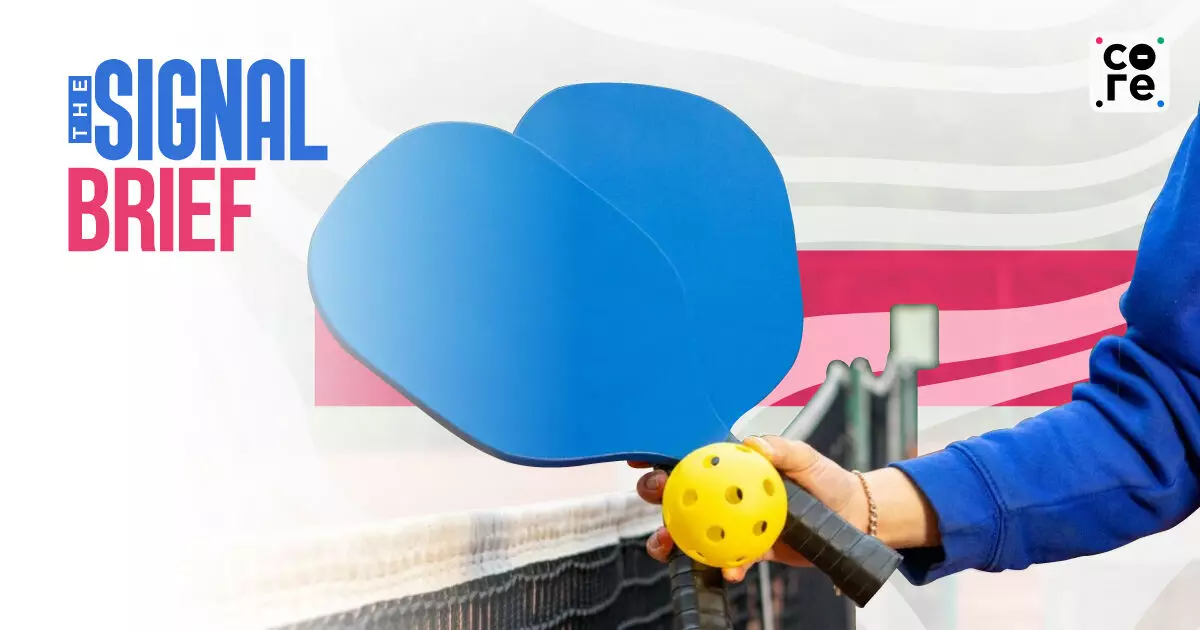
Why Is Everyone Playing Pickleball?
- Podcasts
- Published on 2 Jan 2026 6:00 AM IST
Pickleball is everywhere. On Instagram. In private clubs. In neighbourhood courts across Indian cities.
Industry and association estimates suggest the number of players has grown by around 275% since 2021, and could cross one million by 2028.
Supporters say pickleball could become India’s next cricket.
But, critics see it as an elite South Delhi, South Bombay sport.
So who’s right? And how accessible is pickleball, really?
Hear from players and proponents in the latest episode of The Signal Brief.
The Core produces The Signal Brief. Follow us wherever you get your favourite podcasts. To check out the rest of our work, go to www.thecore.in
NOTE: A machine transcribed this episode. A human has looked at this text but there might still be errors. Please refer to the audio above, if you need to clarify something. If you want to give us feedback, please write to us at feedback@thecore.in.
—
TRANSCRIPT
Kudrat (Host): India has a problem: we don’t move enough. A 2024 study by medical journal The Lancet shows that 50% of Indians are physically inactive, meaning they do not get at least 150 minutes of moderate-intensity activity per week.
Indian women are especially inactive. Specifically, 57% of women and 42% of men in this country do not get enough exercise, according to the same study.
Enter pickleball. Industry and association estimates suggest pickleball players in India have grown by around 275% since 2021. By 2028, the number could exceed 1 million. The sport’s proponents say that pickleball is perfect for Indians–it’s a low-impact sport that everyone in the family can participate in.
Kudrat (Host): My name is Kudrat Wadhwa and you’re listening to The Signal Brief. We don’t do hot takes. Instead, we bring you deep dives into the how and why of consumer trends.
Pickleball’s supporters think it could be the next cricket. In this episode, we question if that’s true. We also ask, what actually makes a sport take off in India.
Pradnya: I used to fight to win and I get that same feeling again on the court. It keeps you mentally very young. Physically, it can be hard sometimes. But mentally, it puts you in the right frame of mind.
Kudrat (Host): Pradnya, who’s 52 and runs a school for special-needs children, says she played badminton competitively when she was younger. She tried to stay fit as she got older too, by going to the gym and walking.
Pradnya: Then, during the lockdown, everything stopped. And once that lethargy sets in, it’s very hard to start again.
I found it difficult to motivate myself to go back to the gym. I wanted something more interactive, something competitive, that would keep me going.
Kudrat (Host): Then, Pradnya found pickleball.
Pradnya: The main motivation for me was my husband is also a pickle ball player. He has been playing for past about eight or nine years and was pushed. He said, uh, need to get out, do something.
The first time I played, it felt easier. The court was smaller. The running wasn’t too much.
There were only two or three women that day. They were starting a new academy and invited us to try. I liked it immediately. I joined the very next day.
Kudrat (Host): Pickleball’s supporters say it’s the perfect game for older people and for those who are new to activity. It’s low impact, and you don’t have to run around too much, if you’re playing for leisure. In fact, the sport’s early players were older Americans.
Here’s Sunil Walavalkar, of All India Pickleball Association, talking more about the game’s origins.
Sunil: To give you a little background on the history of pickleball, the sport started in the United States near Seattle in 1965. So it is not something new.
It has a nearly 60 year history in the US. For a long time, especially through the 2000s, it was seen and marketed largely as a senior citizens’ game. That perception stayed for quite a while.
But the sport has changed significantly since then.
In the Indian context, I believe pickleball is particularly well suited. Traditionally, we are more a country of spectators than players. That is something I often say.
And if you want to convert spectators into players, pickleball is one of the best options.
Everyone is trying pickleball in India. And I genuinely believe it is well suited to Indian conditions. That is my view.
Kudrat (Host): Sunil is deeply optimistic about pickleball’s future in India. The numbers support his positive attitude. For a sport that barely existed a few years ago, the scale-up has been striking–the number of pickleball players and courts has grown several-fold in just a few years.
But, though pickleball says it’s for everyone, the internet is not convinced.
CLIP: Instagram reel of Shiv Verma
Kudrat (Host): So is pickleball an elite, SoBo/South Delhi sport? As content creator Shiv Verma, who we just heard from, described it.
I posed that question to Sunil.
Sunil: Absolutely, that’s not true. The original intent of pickleball was always to be a common person’s game. I believe that very strongly.
I started playing and promoting the sport, and it gained traction for that reason alone. Because I firmly believe that many other sports are costly, aristocratic, and often gender specific.
Pickleball is different. It is very economical. When I started playing, I used a wooden paddle that cost 300 rupees. The ball cost 50 rupees at the time.
That cost effectiveness is the reason pickleball began to grow.
Kudrat (Host): We wanted to find out the cost of playing pickleball for ourselves too. So, we checked.
Kudrat (Host): Okay, so I’m looking up pickleball courts near me and how much they cost.
I can see at least 20 courts across Delhi. Some listings say prices start at 25 or 50 rupees, but when I click through, most bookings are closer to 400 or 500 rupees.
I try booking one nearby. There are no slots today. Tomorrow morning at 7 am, it costs 999 rupees.
So that’s about a thousand rupees for a private pickleball court in a neighbourhood club.
Equipment rental is cheap. A pickleball paddle costs 50 rupees.
Buying one is a different story. On speciality sites, paddles start around 8,000 rupees and go up to 30,000 or more.
On Amazon, they’re much cheaper. I see options for 800 to 2,000 rupees, sometimes including two paddles and balls.
So it’s easy to start. Staying in the sport can be more expensive.
Kudrat (Host): That was Delhi, but what about other parts of the country? Here’s Anirban, an engineer who now plays pickleball competitively.
Anirban: When I started, I bought a simple paddle for around 1,200 rupees. After a couple of months, I upgraded to one that cost about 5,000.
Now I’m thinking about an even better one. At that point, you start asking — do I buy imported gear, or something Indian?
Kudrat (Host): So, entry level racquets are cheap. As are basic, no-frills courts. But, as you advance, costs add up. Pickleball isn’t inaccessible, but it isn’t frictionless either.
Still, even if pickleball isn’t prohibitively expensive, that hasn’t erased its image as an elite, Instagrammy sport. But, Sunil claims that maybe, that’s not such a problem after all.
Sunil: But as you rightly pointed out, at the moment the sport is being seen that way. It has been labelled as a rich man’s sport because of celebrity endorsements. And there is nothing wrong with that.
When wealthy or well-known people play a sport, others naturally feel encouraged to try it as well. That is how visibility works.
Cricket was also once played by kings and maharajas. Over time, it reached the grassroots level. I believe a similar thing will happen with pickleball.
But as a sport, pickleball itself is not a rich people’s game.
Kudrat (Host): Sunil is making a familiar argument. Historian Ramachandran Guha, who has written two books on cricket, argues that
CLIP: Why is cricket so famous in India? Listen in to Ramachandra Guha 🏏
Guha adds that cricket didn’t spread in India because of organisations or state support.
It spread when ordinary people began playing it badly and often, in gallis, with homemade bats, arguing about rules.
Long before cricket became organised, it had already become a habit.
Kudrat (Host): Meanwhile, in Delhi, the state government backed the recently concluded Indian Pickleball League, or the IPBL, inspired by, of course, the IPL. It featured six teams: the Bengaluru Blasters, the Chennai Super Warriors, Capital Warriors Gurgaon, the Hyderabad Royals, the Lucknow Leopards and the Mumbai Smashes.
CLIP: Live: IPBL 2025 Final | Hyderabad vs Mumbai Battle for the Maiden Indian Pickleball League Trophy
Kudrat (Host): Pickleball has a lot going for it. It doesn’t require athletic levels of stamina, meaning the whole family can participate. At the same time, many Indians still see it as a rich people’s game.
Pickleball’s players, though, can’t stop booking courts. For starters, it’s fun. And also, and maybe more importantly, it helps them feel like a part of a larger community.
Pradnya: I’ve also made a lot of friends there. That’s a big motivation to go back — to meet people and spend time with them. That’s really why I go. When I joined, there were just two or three groups in Mumbai. Today, there must be at least fifteen or twenty.
Anirban: Obviously, uh, the fun and enjoyment is obviously on one side and other than the, uh, how the community is building. I’m connected to about fifteen or twenty different communities. Each one has over a hundred players. That’s more than 2,000 people playing regularly in Mumbai alone.
Outro: That's all for today. You just heard The Signal Brief. We don't do hot takes. Instead, we bring you deep dives into the how and why of consumer trends. The Core produces The Signal Brief. Follow us wherever you get your favourite podcasts.
To check out the rest of our work, go to www.thecore.in.
If you have feedback, we'd love to hear from you. Write to us at feedback@thecore.in or you can write to me personally at kudrat@thecore.in.
Thank you for listening.


