



 Newsletter
 Search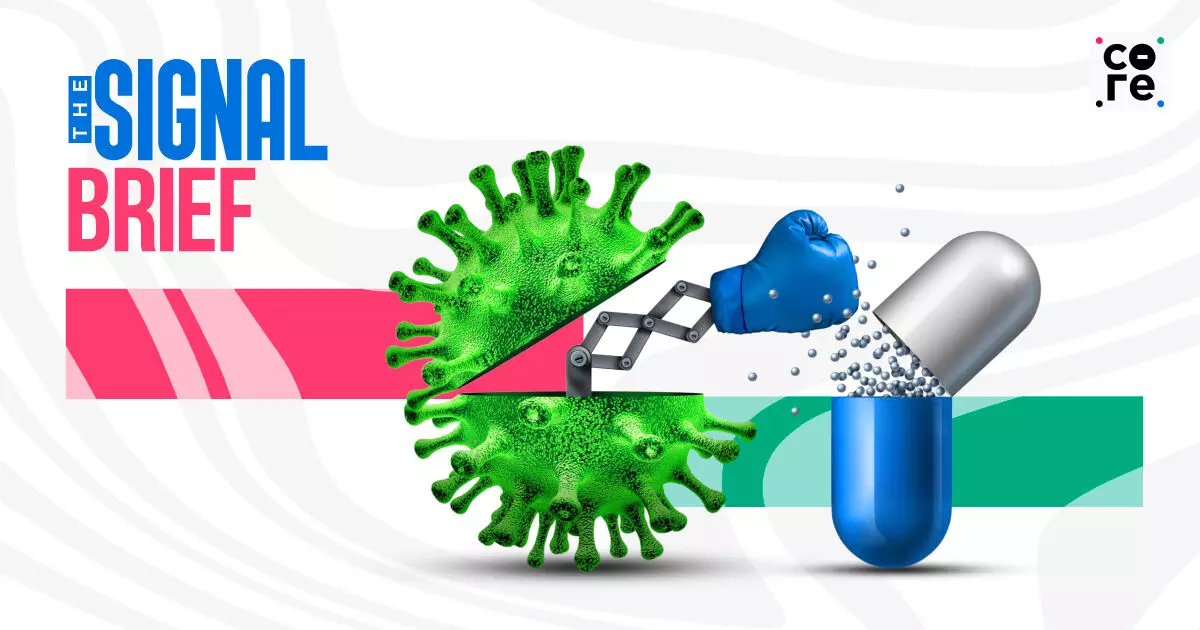
Why Are Antibiotics Failing In India?
- Podcasts
- Published on 20 Feb 2026 8:00 AM IST

I rarely fall sick. But when I do, it lasts for weeks.
And when I was a kid, doctors used to prescribe me antibiotics for everything. Including for viral illnesses.
I’m not alone either.
Experts say that one in two antibiotic prescriptions in India might be useless. Potentially even dangerous.
India ranks one of the highest in the world for antibiotic resistance.
And, modern medicine depends heavily on antibiotics.
Doctors use them to cure everything from UTIs to even more serious illnesses like pneumonia.
When antibiotics stop working, modern medicine regresses.
So what exactly is antibiotic resistance? Why is this problem severe in India? And what does all this mean for you as a consumer?
To learn more and to hear from experts directly, check out the latest episode of The Signal Brief.
The Core produces The Signal Brief. Follow us wherever you get your podcasts.
Register for India Finance and Innovation Forum 2026
NOTE: A machine transcribed this episode. A human has looked at this text but there might still be errors. Please refer to the audio above, if you need to clarify something. If you want to give us feedback, please write to us at feedback@thecore.in.
—
TRANSCRIPT
Kudrat (Host): Pneumonia once killed millions of people. Then scientists discovered antibiotics, and almost overnight, the illness stopped carrying the same dread.
For decades, we’ve treated bacterial infections as manageable. Serious, yes. But solvable.
That confidence is beginning to crack.
Kudrat (Host): In recent years, doctors across India have seen bacteria cause pneumonia, bloodstream infections, and sepsis that no longer respond even to the strongest antibiotics available. In some hospital settings, particularly drug-resistant Acinetobacter and similar pathogens carried mortality rates approaching 30% because treatment options ran out.
When bacteria outsmart the drugs designed to kill them, even the best doctors cannot help.
Experts call this antibiotic resistance.
It’s a global issue, but it’s especially prevalent in India. A 2025 Lancet study reported that a vast majority of samples from India (83%, to be specific) showed antibiotic-resistant bacteria: that’s the highest among all surveyed countries.
This is a serious issue–the medical system extensively relies on antibiotics to cure everything from UTIs to more serious illnesses like pneumonia.
If antibiotics stop working, medicine comes to a standstill.
Kudrat (Host): My name is Kudrat Wadhwa and you’re listening to The Signal Brief. We don’t do hot takes. Instead, we bring you deep dives into the how and why of consumer trends.
Today, we’re examining antibiotic resistance: what it is, why it’s a particular issue in India and what it means for you.
Kudrat (Host): The phrase “antibiotic resistance” sometimes misleads people. It suggests that medicines get weaker.
That’s not what happens. Rather, bacteria adapt.
Every time you take an antibiotic, you don’t just kill the bad bacteria causing your infection. You’re also wiping out a huge chunk of the good and harmless bacteria living inside you, which fight the bad bacteria.
And, often, a few of the bad bacteria survive. They might have a random mutation that makes them slightly less vulnerable to the drug.
Those survivors then multiply.
The next time you take the same antibiotic, it kills fewer bacteria than before. A few more survive. They multiply again. Over time, you’re left with a population of bacteria that the drug cannot touch.
This process is called selection pressure. It’s essentially the evolutionary process; it’s how organisms survive and evolve. But among bacteria, selection pressure is also what creates the infamous “superbugs.”
And, these superbugs are proliferating among Indians.
Kudrat (Host): I spoke to Dr Ranga Reddy, president of a non-profit called the Infection Control Academy of India. He told me that antibiotic resistance has massive costs.
Dr Ranga Reddy: So globally, you know, when we talk about antimicrobial resistance, a few million people are already dying due to the situation when none of the antibiotics currently we have in the arsenal are working. In India, we don't have hard and fast data, but rising antimicrobial resistance is definitely causing at least a few lakh deaths every year due to, again, the failure of the treatments because of the resistance.
Kudrat (Host): Experts use the broader term antimicrobial resistance. That includes resistance to antibiotics, antivirals and antifungals. But in everyday healthcare, what drives most of the crisis is antibiotic resistance — bacteria that no longer respond to treatment.
Now, antibiotics are not unique to India. And neither is antibiotic resistance.
But, as The Lancet study found, the magnitude of this problem in India is huge.
So, how did we get here?
You see, in the West, it’s virtually impossible to procure medication without prescription.
We have similar restrictions in India too. But, state capacity to enforce them is limited.
Dr Ranga Reddy: A red line is actually put on every antibiotic strip. The enforcement is quite weak, and hence people have access to these antibiotics without restrictions. That is one major problem.
The second major issue is that healthcare access in India is poor. The poor people, especially in rural and semi-urban settings, when they don’t have access to qualified medical care or healthcare, often actually go to quacks who try and give them the most advanced antibiotics, making them redundant or, over a period of time, not useful when they are really required.
Kudrat (Host): Dr. Ranga said that doctors sometimes overprescribe antibiotics too.
Dr Ranga Reddy: Let me give a couple of statistics to strengthen what I said. Right now, in countries like the United States, about one third of all antibiotic prescriptions are considered to be either inappropriate or not useful. In countries like India and other developing countries, we don’t have hard and fast data, but easily we can assume that every second prescription for antibiotics may be not needed, not necessary, or inappropriate.
Kudrat (Host): That could be due to lack of experience. Sometimes that happens also because patients ask for antibiotics and then pressurise their physicians to give those to them. Other times, it’s because accurately diagnosing someone’s illness is actually more expensive and time-consuming than doling out antibiotics.
Dr. Ranga Reddy: Today, antibiotics in India are much, much cheaper than going for diagnostic microbiological testing. The culture — whether it is urine culture or blood culture or any other — would cost probably anything between thousand to 4,000, depending on the complexity of that. Whereas antibiotics, as you know, cost like nothing. Probably for a few hundred rupees, you will be able to buy a strip or an equivalent of one quarter of five days of antibiotics.
So that is one reason. Second is when you do the culture tests, which are currently the legacy tests, they take anything upwards of 48 hours to get the results. That means till such time the results are going to come, the doctor has to just wait in order to prescribe the antibiotics. And most patients, they don’t have the patience to adhere to the doctor’s advice to wait a couple of days before he prescribes the most appropriate antibiotic.
Kudrat (Host): A key component of this chain are pharmacies; since that’s where people buy meds.
I wanted to understand what chemists had to say about this issue.
So, I visited some pharmacies in Central Mumbai.
Chemist:
पहले प्रिस्क्रिप्शन बोलते हैं उनको हम डॉ. का प्रिस्क्रिप्शन के हिसाब से क्या प्रॉब्लम है, वो हिसाब से हम प्रिस्क्रिप्शन बोलते हैं उनको। ठीक है। और नहीं प्रिस्क्रिप्शन है उनके पास, रेगुलर कस्टमर है, तो कोई सामने से मांगता है तो हम लोग दे देते हैं। रेगुलर कस्टमर है, और सामने से अगर मांगता है, “मेरे को मैंने ये लिया है,” तो प्रिस्क्रिप्शन की जरूरत नहीं है। मेरे को पता है उसके बारे में, तो हम लोग वो ये कर लेते हैं।
Kudrat (from clip):
कभी ऐसे भी होता है कि आप कहें कि प्रिस्क्रिप्शन चाहिए और लोग कहते हैं कि नहीं, मेरे पास नहीं है, मुझे दे दो।
Chemist:
तो ऐसा नॉर्मली, कोई अगर बोलते सर्दी-खाँसी है, कोई एंटीबायोटिक तो नहीं है, हम लोग प्रिस्क्राइब करते हैं नॉर्मल मेडिसिन और एंटी-एलर्जी वगैरह हम लोग दे देते हैं। देते हैं। बट रेगुलर तो आप कह रहे हैं एंटीबायोटिक्स दे देते हैं। एंटीबायोटिक्स अगर कोई मांग रहा है सामने से, वो देंगे। नहीं तो ऐसे नहीं देते।
Kudrat (Host): Another chemist I spoke to, also in Central Mumbai, said the same. That they only ask for prescriptions from new customers. But they trust their usual customers.
Also, if someone comes in with an old, used packet of tablets, they usually oblige too.
Both the chemists also said that people don’t generally finish the entire course of antibiotics.
The first chemist said it’s because once people feel better, they stop taking the medicine. The second pointed to affordability. That sometimes, people can’t afford to buy the entire course. So they make do with half of it, for instance.
Kudrat (Host): Popping antibiotics carelessly or only pursuing half of the treatment explains the consumer part of the problem. But, resistance also builds in places that patients don’t have direct control over.
I spoke to Sheetal Sapale, VP Commercial of PharmaRack, a company that audits pharma businesses, to learn more.
Sheetal Sapale: The third important reason is poor hygiene seen in hospitals. So if there are microbes which have already become resistant to certain antibiotics, and the areas in the hospitals or certain places where it is too crowded, then the spread of these bacteria happens faster. Many people start getting affected by these microbes, which are already resistant.
One more important reason is the disposal of sewage by pharma companies. Of course, when a pharma company is producing an antibacterial product, there will be some sewage that has some products which have to be disposed via other water flow. This water has diluted concentrations of antibiotics. These diluted concentrations are not strong enough to kill the bacteria, but they are so weak that they can act as a vaccine to the bacteria, and the bacteria then develops resistance against these medicines.
Kudrat (Host): All of these forces — overprescription, incomplete courses, weak enforcement, hospital hygiene, pharmaceutical waste — converge long before a patient reaches an ICU.
The Indian govt says it recognizes this problem of antibiotic resistance.
In fact, in late December last year, PM Modi talked about it on his monthly radio address, Mann Ki Baat.
Clip: Mann Ki Baat Dec 28th, 2025
Kudrat (Host): Dr Reddy told me that India has been trying to fight this problem for several years now.
Dr Ranga Reddy: Globally, there is a global action plan to contain antimicrobial resistance on similar lines. India, in 2017, started its National Action Plan to contain antimicrobial resistance. It has many pillars. One of the main pillars is to create awareness and also to ensure that there is stewardship among doctors.
But one pillar that we all really have to ensure is going to work is that we become aware that antibiotics are not casual medicines or something like popcorn. We have to use them responsibly. The National Action Plan also stipulates that, apart from stewardship, there has to be innovation. It also stipulates that we are going to collaborate between doctors working in the human segment, animal segment, environment segment, and also agri segment, so that misuse does not happen in any of these verticals.
Kudrat (Host): That last pillar matters.
Antibiotics also enter livestock and poultry farming. Farmers use them to treat infections, and in some cases, to promote faster growth. Resistant bacteria do not remain confined to farms. They travel through food supply chains and water systems and reach humans.
This is what experts call a “One Health” problem: one that connects human health, animal, and environmental health in a single chain.
So where does all of this leave you as a consumer?
Dr Reddy offers straightforward advice.
Dr Ranga Reddy: My call to the people is: please, please, please don’t misuse antibiotics. When antibiotics fail, small infections become serious, hospital stays become longer, and healthcare becomes more expensive.
So let’s remember three very simple rules:
Take antibiotics only when prescribed.
Complete the full course.
Never share or reuse them.
Protecting antibiotics today means protecting our children’s health tomorrow, the future of our nation, and the future of modern medicine.
Outro: That's all for today. You just heard The Signal Brief. We don't do hot takes. Instead, we bring you deep dives into the how and why of consumer trends. The Core produces The Signal Brief. Follow us wherever you get your favourite podcasts.
To check out the rest of our work, go to www.thecore.in.
If you have feedback, we'd love to hear from you. Write to us at feedback@thecore.in or you can write to me personally at kudrat@thecore.in.
Thank you for listening.


