



 Newsletter
 Search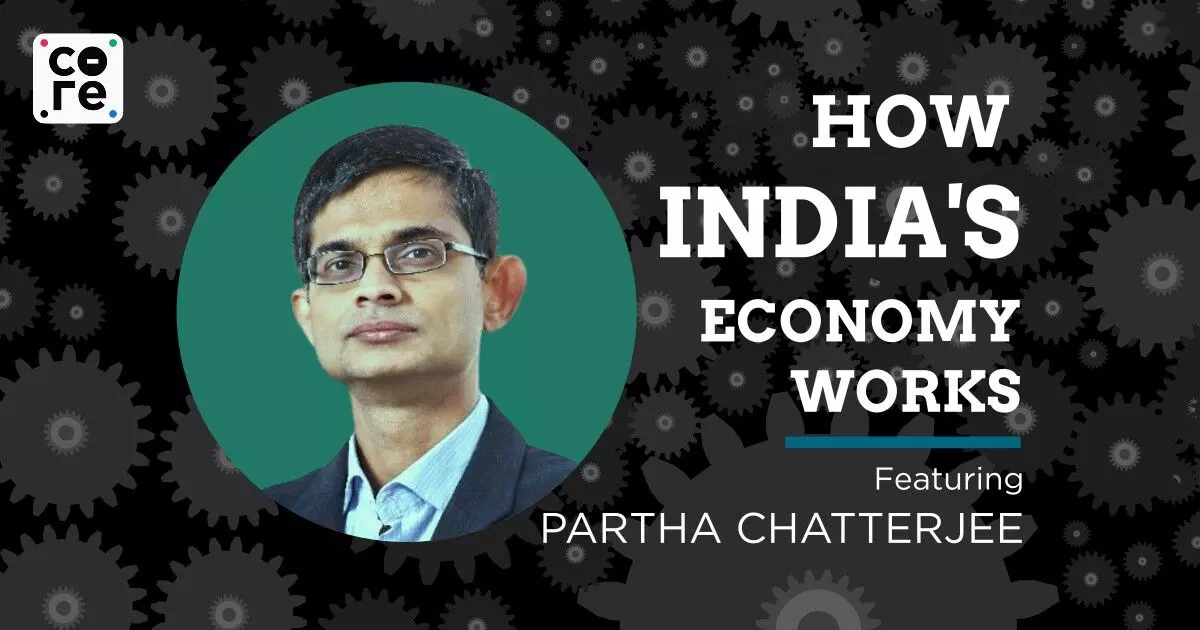
What India’s Impressive GDP Growth Numbers Are Hiding
- Podcasts
- Published on 14 Jan 2026 5:00 PM IST

Insights on what India’s growth numbers reveal—and conceal—about jobs, incomes, fiscal space, and economic resilience
In this episode, journalist and author Puja Mehra speaks with economist Partha Chatterjee and Dean of Academics at Shiv Nadar University. They talk about how the Indian economy is really performing beneath the headline numbers and what recent data signals about growth prospects through 2026. Drawing on the latest GDP estimates, inflation readings, labour market indicators, and credit trends, Chatterjee explains why strong real GDP growth and low inflation—hailed by the Reserve Bank of India as a “Goldilocks” phase—mask growing imbalances across sectors. He unpacks the widening gap between real and nominal GDP growth, the emergence of deflationary pressures in agriculture and parts of manufacturing, and why subdued price growth has serious implications for incomes, profitability, and government finances. The conversation examines the sources of current demand, including public capital expenditure, rising household credit, and the expanding role of cash transfers, and questions how sustainable this mix is over the medium term. Chatterjee also assesses the limits of industrial policy tools such as PLI schemes, their weak employment impact, and the risks posed by slowing job creation, stagnant rural wages, and rising import dependence. The discussion concludes with reflections on the policy trade-offs facing the government and the RBI, and why characterising the economy as “Goldilocks” risks complacency at a time of heightened global volatility. Tune in for insights on what India’s growth numbers reveal—and conceal—about jobs, incomes, fiscal space, and economic resilience.
NOTE: This transcript is done by a machine. Human eyes have gone through the script but there might still be errors in some of the text, so please refer to the audio in case you need to clarify any part. If you want to get in touch regarding any feedback, you can drop us a message on feedback@thecore.in.
—
TRANSCRIPT
Puja Mehra: Professor Chatterjee, thank you for coming to the show. This is the first show of the year.
Partha Chatterjee: Thank you, Puja, for having me.
Puja Mehra: Professor Chatterjee, I was wanting for you to help us understand how is the economy doing right now and how it's likely to do through the year 2026. The Reserve Bank governor said just a few days ago that the Indian economy is in a Goldilocks phase with low inflation and high growth. But there are many commentators, economists, who have some reservations over how strong the economy is performing.
So what are your views? How do you analyse the Indian economy at the moment?
Partha Chatterjee: Well, let's start by looking at the numbers that we recently got from the advanced estimates of the GDP, right? And there we've seen that the GDP is expected to do very well. The economy is doing very well.
It's expected to grow at about 7.4%. So that's very commendable. The CPI inflation has been very low, around 2% or so, right? So on that front also, there's not much to worry about.
If you look at that aggregate numbers as such, and the interest rate is being low in the economy at this point, it does seem that the economy is doing very well, right? And there's a little bit of worry in terms of it's not meeting the 8% benchmark that it's needed to ensure that India becomes an advanced economy by 2047. But still 7.4% is pretty good. But then when we start looking at the details, there are some questions that come up, right? And let's try and look at some of these. Let's start with, for example, if we start at the demand side things, right?
And there we find that much of the growth has come from two sources as such. Capital formation by both government and private, which has grown at 7.8%. And in fact, that's the only thing in the demand side that has grown above 7.4%. And while decomposition between private and public is not there, but it's mostly public in what I understand, right? And the second thing that has done well has been the private consumption.
The private consumption has grown at 7%. And this is important because in Indian economy, the share of private consumption in GDP is about 56%, right? So that has to do very well.
And it has done reasonably well, though it's still less than 7.4%, which is the GDP growth rate. So it does seem that there are sectoral imbalances as such. Investment in particular, there's still concerns.
We have seen the PMI, the HSBC, India Services Purchasing Manager Index, which has dropped to among the lowest in November. I've recently looked at a CEIC leading indicator. CEIC is a company which compiles data and it creates an index from many fast-moving indicators like manufacturing PMI and services PMI, electricity generation, farm tractor sales, registered motor vehicles sales, exports, imports, transactions through cards, UPI, et cetera, passenger traffic, cargo traffic.
All of them is compiled into one indicator, right? And that's called a CEIC leading indicator. And that has fallen over the year, right?
So that's something again, that raises a little bit of questions of sorts. Similarly, on the job posting, there are variety of indexes, indices to look at. In particular, if you look at three, which are most commonly used, one is the NOCRE, the other is the REVALUE, and the third one is the FOUNDED, right?
So NOCRE and the REVALUE indices are flat over the year. The FOUNDED index has increased over the year, but it's moderated over the second half. So these are obviously smaller samples in the sense that these are post-trade job, but this does give an indication that in the formal sector, job formation has not been very high.
In fact, in the PMI report that I talked about, all the managers have mentioned that in December, the businesses have grown, but they're marginally cut down on hiring. So there are many such indicators, which are even electricity consumption, which has not grown over the year. Rural wages, except for casual workers, has been absolutely stagnant.
So while the economy growing at 7.4% is very good, and it does give us some confidence that the economy is in the right path, but there are questions about where is this growth coming from, and is it really benefiting the population, right? Because at the end of the day, we need this growth to matter in making differences in people's lives, right? So that's, I think, where we still have to dig a little more, understand what's happening, and going forward in this year, we need to think about what can be done.
So I think that's, in a sense, where the economy is right now.
Puja Mehra: Professor Chatterjee, you said that there are imbalances which are coming through in the GDP estimates that you have seen, and there are some parts of the economy that are not performing as rapaciously as the rest, and the overall growth rate is sort of masking that imbalance. I've read commentary on the economy where it has been said that substantial segments of the economy, at least where high proportion of the population is, could be entering into deflationary zones, such as the agriculture economy, the rural economy. How much is that an area of concern, and is that reflecting in the official GDP estimates?
Partha Chatterjee: Well, what we have seen in the numbers, in the advance estimate, is that the real GDP growth has been about 7.4 percent, right? But the nominal GDP growth has been about 8 percent, which is lower than earlier estimates, let's say last year's budget estimates, which has estimated it to be at about 10 percent. And this is because, or at least that implies, is that the GDP deflator is at about 0.6 percent, which is very low, right?
I mean, I told you that CPI is at about 2 percent, but the GDP deflator is a different index. It includes some other things other than only consumption goods. So, it's a different index, and this is the price that impacts production of many things.
So, that being 0.6 percent is something that we have to at least be concerned about, if not completely worry about. In particular, as you mentioned, there are certain sectors like agriculture, and agricultural prices seem to be not only not growing, but it seems to be falling in many of the crops and things like that, right? So, because we have seen reports where the commodities are trading at 5 to 20 percent lower than MSPs even, right?
So, this is something that's probably happening right now in the agricultural sector, and that's a bit of worry because agricultural income depends on not only how much has been produced, but at what value is it being sold, right? So, if the prices are low, it's not increasing or even decreasing, then even with good output of crops, the farmers and the farm economy may not be earning as early, right? So, this is definitely a matter of concern.
And remember, in the Indian economy, agriculture supports out about 45 percent of the population. So, that's a really, really large number, and if the income of that population is going to fall, then it will have repercussions throughout the economy. But it's not only the agriculture, possibly parts of domestic manufacturing is also experiencing, if not a deflationary pressure, but at least their inability to price things at a higher rate.
That's also a little bit of concern, and one is maybe there is more increased competition, and we have been hearing that India is also going to open up to China even more. So, that makes it even more difficult for these manufacturing firms in India to price things at a higher rate, at a higher level. But also, what's happening is that the imports have been increasing, right?
So, there's been a substantial increase in imports. In the rest of the world, particularly US and others, the inflation is still relatively higher, and the Indian rupee has been falling. So, the cost of intermediate goods is probably increasing for many of these firms.
Yet, if they are unable to pass that cost in the final good, then they may actually not be able to make much of a profit. And that's also a concern, because we have been trying very hard to increase the manufacturing sector. If profitability is hit in the manufacturing sector, then clearly, more investment in manufacturing is not going to happen, and particularly at a stage where the share of manufacturing in GDP has, over time, fallen a little bit, right?
So, their ability to profit from their activities is impacted because of these kinds of price pressures, and maybe a little more competition from external. While this is not necessarily bad overall for the consumers, but this may have a long-term implication in terms of where we are getting investment from, particularly in looking into the manufacturing sector, or the overall demand in the economy, looking at the rural sector, and even, you know, given that the rural income has been low anyway, it can impact the well-being of people adversely. So, I think there is a little bit of, I wouldn't say a big worry yet, but definitely something that we need to keep an eye over the next year to see how this shapes up.
Puja Mehra: Professor Chatterjee, I think because politicians tend to keep their ear to the ground, we are already seeing them respond to this economic situation with a lot of spending on schemes like cash transfers for women and farmers, perhaps because they do have the information about low incomes in those parts of the population. Similarly, if profitability of manufacturing, there's a question mark over that. We also see a lot of schemes where government supports with subsidies, etc., manufacturing. But, is that the right policy response to this situation? Because if demand incomes remain constrained in such large parts of the population, can this growth, which we are seeing primarily coming from private consumption, can it be sustained and maintained? Because it is, after all, coming out of a large government spending.
So, how long can this cycle of maintaining growth carry on?
Partha Chatterjee: Let's go back to the aggregate numbers and look at where growth is coming from, what are the different sources. So, one, as we talked about, has been capital expenditure by the government. That, to a certain extent, is visible through the infrastructure and other expenses that the government is doing in building up different kinds of fixed assets in the country.
So, that's one part that we can expect to continue. And, in fact, when we talked about the nominal income not rising as fast as it was estimated at about 10% in the budget, so there is a little bit of worry that tax revenues might not be as expected, because tax revenues depend on the nominal income. And, therefore, the government might have to cut down on some expenditures.
So, in terms of policies, that's one area I think we have to keep an eye on, but I would hope that the government does not ramp down expenditure very quickly in the next quarter or so before this financial year ends, right? So, because that might have an impact. The other thing that you mentioned is that a large part of the economy is about private consumption, right?
And that's something that has to do well, but let's look at what's also driving the private consumption. And if you look at what's been two primary reasons why private consumption has been doing well, relatively speaking, one has been, particularly in the urban areas, it's about the credit growth, right? So, we have seen that household liabilities have actually increased faster than financial assets.
And the RBI had put out a financial stability report earlier in 2025, and they have flagged the growth of unsecured personal loans, gold loans, and credit card debt expenses. So, clearly, there has been a shift in how consumers, particularly in the urban areas, are funding this consumption. It seems that more than this being funded by income growth, it's being funded by loans and credits.
And that is, again, something that we have to worry about because then that can kind of lead to a bubble of sorts. And if there is a failure in credit repayments and things like that, then that can impact the economy adversely, right? So, that is one thing that's happening in terms of what's driving private consumption.
But the other big story is, of course, the transfers that the governments have. When I say governments, it's both the central government as well as the state governments. And clearly, the fiscal policy has shifted decisively towards supporting the mass consumption through direct benefits, right?
Direct benefit payout. I think at least about 14 or 15 states now have a monthly income transfer scheme to some group or the other. And it's a huge, huge payout, right?
By some estimates, it's about 1.6 trillion rupees, which is about 11-12 percent of the state's expenditures. So, that's money that's going directly to the consumers or households, mostly in the rural sector. And again, on top of that, there are also where the government is subsidising grains and other kinds of food products and things like that.
So, there is a little bit more disposable income with the rural population purely because of these transfers, right? And that's also kind of driving the consumption. So, on both counts, where it's either driven by growth in personal credits and loans and things like that, or it's because of the government transfers, the question remains is how long can this be sustained, right?
For the government, of course, this is a big question because government is transferring all of these resources in contrast to doing something else, which could have been productive and increasing productivity for long-run growth, right? So, direct transfers, while it can increase consumption at that moment, it's not really building capacity for growth for the future. So, again, something that the government has to think hard that maybe it has to find a balance where it can create a minimum social insurance, yet it can keep funding activities that will generate future growth, right?
In terms of the other thing that you mentioned, which is government policies like PLIs and things like that, right? So, we really need to evaluate those very closely. While PLI has had some success in generating maybe electronic manufacturing and things like that, it clearly did not generate more employment.
And one might argue that there is a strategic angle to building that bit of capacity, given that we live in a very fractured world today, maybe there is some substance to that. Yet, we really need to think about generating employment, not only generating production. And having said that, while I'm saying that there has been maybe some success in electronic production and things like that, but if you look at overall share of manufacturing in GDP, it has not gone up, right?
So, at best, it's questionable what the PLIs have done. If we just want to think about manufacturing as such, we need to think about how to create an ecosystem of manufacturing, which is not only supporting big manufacturers. And today, manufacturing, particularly big manufacturing, is much, much more capital intensive.
It absorbs labour very little. So, the question is, how can we create an ecosystem, maybe bringing in a lot more of MSMEs into manufacturing and figuring out how to allow them to benefit from these PLIs and things like that, right? So, that is something that I think the government has to think harder, that what is the PLI doing?
What is kind of a policy that the government has taken? Is it delivering what's desirable or does it need some change, right? So, I think in all of these issues that I've talked about, the credit growth, personal credit growth, the transfers, as well as trying to incentivise manufacturing in India, there is room to think harder in terms of where we can change the policies.
I'm not saying that all of these policies has to be completely scrapped, but maybe we need to think how to balance things out, right?
Puja Mehra: In fact, for all the hype around electronic goods PLI scheme and its success, the net exports continue to remain a drag on GDP growth. So, sometimes when we get very excited headlines about how well that sector is performing, we also need to see it in the context of the overall macroeconomy. I want to also ask you that when we see a relatively low single-digit nominal GDP growth figure, what does that tell us about the economy, especially for those listeners who don't understand economics that well?
What does a low nominal GDP growth at this point tell us about the state of the economy?
Partha Chatterjee: So, one thing is when the real growth is strong, right, but the nominal growth is weak, that means that there hasn't been an increase in the prices that much, right? Or in some cases, the prices might actually be falling because the real growth tries to capture the total amount of output in the economy, both in terms of goods as well as services, whereas the nominal tries to capture the value of all of that is produced, that's produced in the economy, right? And the value depends on both the actual value, actual quantity of stuff as well as the prices.
So, if the nominal is not increasing as much, then prices haven't increased a lot, right? And that is something that's probably going on right now in the Indian economy. Remember, Indian economy is still an emerging economy, it's growing at a fast rate, and it's somewhat unusual to have very low increase in prices for such an economy.
As we already talked about, one of the sectors where this is impacting a lot is the agricultural sector, right? And as we talked about, that agriculture in particular is so critical because it supports about 45 percent of the population. And if the income is not going to go up, because suppose in some firm you are producing 100 tonnes of wheat or something like that, and if the price is not increasing, then even if your production is doing well, your income from that, by selling that, you're not getting that much income, right?
So, your income increases lower. So, that's a big, big concern. Second, as we'd also talked about earlier again, that means in production, particularly in manufacturing, but also maybe in services, the firms are not able to price things which will allow them to increase their margin or even sometimes pass on the increased cost in the intermediate goods, as we talked about again, because there is higher inflation in the U.S. compared to what U.S. inflation is generally, and our exchange rates are falling, so the intermediate cost might actually be going up, so this is not being reflected.
Also, from the government finances, this becomes a challenge because all of these calculations in terms of GST, income tax, corporate tax, these are based on nominal activities. So, if nominal growth is not going to go up, then tax collections will fall or may not increase that much, and if that happens, then the government finances will be under pressure. The government might either increase their debt or cut down on expenditure in the coming budget, and if they do increase budget or increase debt, or even otherwise, right, there is also an implication on the debt servicing, because essentially what happens is, what we want is that the R, which is the interest rate in the economy, and the G, the gap should be reasonably high so that the government can finance their debt very easily, because R minus G, or the difference between the growth rate and the difference between the interest rate, is what allows government to keep the borrowing costs low.
And now, with nominal growth at around 8%, and I think the borrowing cost is at around 7%, this gap has reduced very much. That's a risk that's there, that if the growth rate falls by any chance, then the interest payments will actually be higher than the rate at which the economy is growing. So, the future generations will be burdened even more.
So, I think nominal growth rate increase, if it is too low, then it's not only going to impact our current generation, but it might actually impact the future generation if we get into a situation where the nominal growth rate is not keeping up with the debt servicing. So, I think from what we are seeing now, it's still alright, but it's something that we have to be carefully noticing and carefully understanding what's happening in the coming year, and to see that it does not fall even further.
Puja Mehra: So, the room for the government is actually very, very small to wiggle around this In the end, just to circle back to Sanjay Malhotra's characterisation of the economy as being in the Goldilocks phase, data-wise, we do seem to be in a Goldilocks phase, and that is his mandate as a technocrat to keep inflation low to ensure that growth doesn't stumble. But from your discussion, it seems to me that that is not translating necessarily into incomes and jobs for large sections of the economy. So, is there something you'd like to say about the RBI's policy also?
You've already said what the government needs to think about, but is there something that the Reserve Bank of India needs to keep in mind?
Partha Chatterjee: Look, the Indian economy is not in crisis by any means, right? I mean, it's actually doing alright, and 7.4 percent, if you look at cross-sections across countries, it's actually very good, right? It's still short of the 8 percent that we want if we are targeting 2047 as the timeline for India becoming Vixit Bharat, but it's close enough.
So, India is doing alright in that aggregate sense. But as we said that, you know, there are certain areas of concern. So, I think characterising this as the Goldilocks moment is fine, but if that leads us or the government to become complacent, to not critically think, then that is the danger there, that by characterising this economy as Goldilocks thing, right?
In particular for RBI, I think right now it's in actually a comfortable zone because the inflation is low, the growth rates are high. So, monetary policy, remember those are the two objectives of the monetary policy as such, that how can we reduce inflation and how can we increase growth. On an aggregate sense, it's doing the job, but I think there are a few things that it can think about.
One is that, and that's something that we have been talking for years now, that, well, what's about the transmission mechanism? Is it cut in interest rates, for example? Is it really reaching the people who need it and so on?
So, that's one thing that obviously is still valid, that whether the transmission is happening or not. But also, I think there's another aspect that maybe RBI can think about, which is how to mitigate risk, right? Because we are in a time when the volatility is as high as it can get.
We live in a world that's completely fragmented and unpredictable, and that also translates to different kinds of risks, both exporters as well as domestic producers, agricultural farms, and all kinds of consumers, and definitely also MSMEs. So, there can be ways to maybe deal with that. Standard things have been done earlier is to give some concessions for MSMEs and things like that.
Well, that essentially, if the cost of borrowing goes down, then the expected return goes up, right? So, that's one way to tackle that. But also, in terms of thinking about some kind of insurance of sorts, right, how that can be implemented.
So, this is a little more complicated and a little more difficult, nuanced policy, and maybe it will require non-conventional policies, right? It may not be possible only through changing of the interest rates and things like that, right? Because earlier, during the crisis, for example, we have had central banks taking equity positions and things like that, and that allowed mostly big firms to reduce risks.
And so, those kinds of policies at this stage have to be there in their armour, even if they're not implemented as aggressively, but at least it should be thought about and it should be part of their whole set of policies that they are talking about, they are communicating to the rest of the world.
Puja Mehra: Especially if the threat of 500% tariffs from the Trump administration comes through because one never knows what gets implemented, then what you're saying surely should be thought about. Thank you. Thank you, Professor Chatterjee.
Thank you so much.
Partha Chatterjee: Thank you, Puja. It was a pleasure. Thank you.


