

Cabin Upgrades Drive A New Phase Of Competition In Indian Aviation
Cabins are now the battleground where airlines win or lose passengers, where comfort, design, and technology matter as much as price.
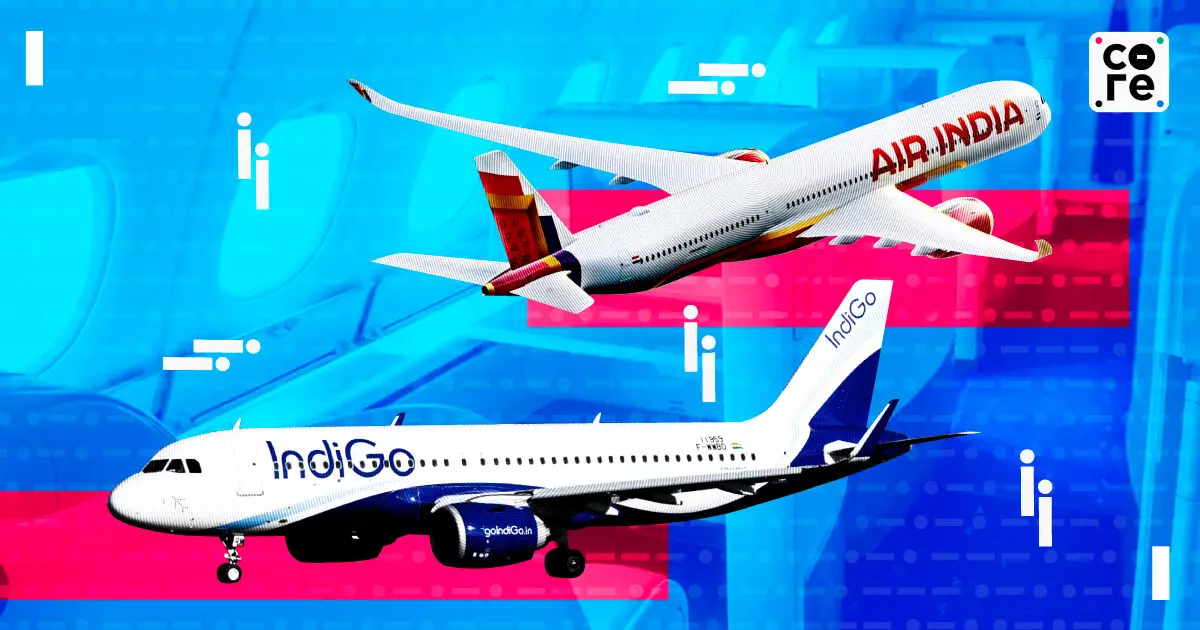
The Gist
- Passenger videos highlighted poor conditions in Air India's business class, prompting modernization efforts.
- IndiGo's new A321XLR and Air India's 787-9 feature upgraded cabins and amenities.
- Both airlines are focused on enhancing passenger comfort and loyalty, with Air India investing $400 million in retrofitting its fleet.
Multiple times last year, passenger videos of the poor conditions of Air India’s business class cabins went viral on social media. There was widespread criticism that for the airline to truly be the national carrier, it had to rehaul its ageing aircraft.
Cut to today, in-flight experience is finally taking centre stage for India’s airlines. IndiGo has taken delivery of India’s first A321XLR. Air India followed days later with its first 787‑9, both bringing refreshed cabins, upgraded seats, and a long‑haul product reset.
Air India’s partnership with Singapore Airlines, with a 21% share, deepens as the two align products, routes, and schedules, edging toward a unified long‑haul network with expanded loyalty benefits. A new Saudia codeshare, effective February, further widens Air India’s international reach.
Indian aviation is finally shedding its legacy of dated cabins, key to passenger experience and business for the airlines.
No More Intertia
Air India, long trapped in government‑era inertia, is now racing to modernise under private ownership, treating cabin upgrades as central to its brand revival. IndiGo, meanwhile, is using its new‑generation fleet to sharpen its onboard experience — cleaner, brighter, more ergonomic interiors that lift comfort without abandoning its low‑cost discipline.
Together, they signal a market where modern cabins are no longer optional but the new baseline for competitiveness.
Indian airlines typically refresh soft cabin elements every four to six years and undertake major seat or in-flight entertainment overhauls every eight to 12 years, though financial constraints often push these timelines far beyond plan. The outlook is improving: more capital, new aircraft deliveries, and expanding MRO capacity should finally allow carriers to refurbish cabins closer to schedule. But supply‑chain delays, certification hurdles, and thin margins will keep the pace slower than the industry would like.
Air India will take delivery of six new A350‑1000s and 787‑9s this year, each featuring redesigned cabins that will set the template for its entire 787 fleet. Air India’s retrofit commitment is $400 million, aimed at modernising 43 widebodies and standardising interiors across the fleet.
A nose‑to‑tail retrofit of 26 legacy 787‑8s in new livery begins in 2026. By year‑end, nearly 60% of Air India’s widebodies will sport modern, upgraded interiors, a transformation the airline has never attempted at this scale.
Cabins Are More Important Than We Think
Cabin interiors matter far more than most people realise — they shape perception, comfort, loyalty, and even airline economics. Ageing cabins instantly erode trust, especially on long‑haul routes. When an airline upgrades its cabins, it isn’t just refreshing the look; it’s rewriting the passenger experience and its competitive position.
In a global market where travellers compare India’s airlines to their international counterparts, refreshed cabins aren’t cosmetic; they’re competitive survival. This is because passengers judge an airline by the seat they sit in, the space they get, the lighting they see, and the overall sense of modernity the moment they step onboard. If an Indian carrier’s cabin feels dated while a rival’s feels premium, the decision is made before take-off.
An EgyptAir cabin study found passengers increasingly expect modern, tech‑enabled interiors, with smart features boosting satisfaction and discomfort driven mainly by seat pitch, noise, temperature, and in-flight Entertainment quality.
Now, with Indian carriers pushing deeper into international markets and a backlog of at least 130 confirmed wide‑body orders-70 for Air India and 60 for IndiGo-pressure to elevate cabin comfort is only going to intensify. Competing against Etihad, Qatar Airways, and Emirates, US and some European carriers, all of whom have substantial wide‑body pipelines and consistently premium interiors, Indian airlines have little choice but to upgrade if they want to win long‑haul passengers.
What Indian Passengers Want
Indian travellers don’t fit the mould of a “global average flyer.” Their expectations are shaped by culture, family dynamics, and a more demanding value instinct. Indian passengers prioritise crew responsiveness, food, cultural familiarity, along with price and a sense of hospitality that feels personal rather than procedural, as well as multilingual support, creating a distinctly different set of needs for airlines.
International passengers tend to prioritise consistency and standardisation, and product quality. As expectations rise, cabin experience has become one of the strongest decision drivers for Indian passengers. This becomes a true make‑or‑break factor.
European and US carriers deliver efficient, process‑driven service—but it often feels impersonal. Air India has a different advantage: hospitality that’s culturally intuitive, warm, and naturally personal. Its legacy of genuine care and high‑quality Indian cuisine isn’t just branding; it’s a built‑in differentiator. If Air India leans into this DNA, it won’t just earn compliments — it will win loyalty quickly to win loyalty fast.
Do Indian Meet International Standards
Passengers have started to measure Indian carriers against international giants that have spent years defining what “good” looks like in long‑haul flying. For many Indians, especially the diaspora, Emirates, Qatar Airways, and Singapore Airlines have set the standard for warm hospitality, polished cabin crews, consistent food quality, and spotless cabins. These experiences have shaped expectations, and Indian carriers are now judged against that benchmark on every flight taken.
An upgraded Air India sits in an interesting middle ground: no longer the tired legacy product it once was, but not yet at the uniform polish of the best carriers. The gap, however, is narrowing fast. Air India is beginning to look competitive in ways that would have been unthinkable even three years ago.
Campbell Wilson, CEO, Air India, has been consistent in his core message: “Air India’s cabins must move from ‘acceptable’ to ‘world‑class,’ and the airline is investing at a scale never attempted before to make that shift real.”
Air India’s new A-350-1000s and 787‑9s finally deliver a cabin that can stand alongside the world’s leading products. The business‑class suites with doors, modern IFE, cleaner aesthetics, and a significantly upgraded premium‑economy cabin now outperform what Lufthansa, Austrian, Turkish, Swiss, and most US majors offer on comparable aircraft -many of which still rely on older widebodies with dated 2‑2‑2 layouts. The true peers in long‑haul cabin quality remain the Gulf and Southeast Asian carriers, which continue to set the global benchmark. Unlike most of these carriers, Air India offers free Wi-Fi for every class!
“If Air India sustains its current training push, it can carve out a distinctive service identity that blends Indian warmth with global professionalism,” Kiran Koteshwar, CFO at Air One with long stints at IndiGo and SpiceJet, told The Core. The challenge is execution at scale: international carriers benefit from decades of standardised service protocols, while Air India is rebuilding its culture after years of inconsistency.
Indian airlines are slowly realising consistency builds trust. Passengers know exactly what to expect on Emirates or Singapore Airlines, and they now want that same reliability at home. Air India has one natural edge: food. Authentic Indian cuisine is hard for global carriers to deliver, but when Air India gets it right, it becomes a real differentiator - especially for diaspora travellers on long‑haul routes. Frequent travellers, however, do expect a change in menu regularly, yet to be implemented.
IndiGo, which has expanded its international network to more than 40 destinations in just over a year, now matches the world’s best low‑cost carriers on core fundamentals: a young and uniform fleet, strong on‑time performance, quick turnarounds, and consistently clean cabins. But when stacked against global leaders such as AirAsia, Scoot, Jetstar, Peach, Cebu Pacific, VietJet, easyJet, Wizz Air, flydubai, and even JetBlue’s hybrid model, the gaps become visible. IndiGo’s standard seats are tighter, the cabin ambience remains basic, and its buy‑on‑board offering is functional rather than distinctive. The upcoming A321XLRs, with a less dense cabin and the introduction of streaming IFE-may help the airline inch closer to international benchmarks.
Pieter Elbers, CEO, IndiGo, has consistently framed the international push as an evolution of its product, saying “the airline will adapt its cabin experience in line with longer routes while staying true to its core strengths of simplicity, reliability, and value.”
Indian Carriers- Credible Alternatives?
An upgraded Air India is no longer the industry underdog. Its new aircraft already match—and in some cases exceed—many international products. Its hospitality and food give it a genuine opportunity to stand apart. The real work now lies in delivering consistency and building a loyalty experience that feels modern and reliable.
As Koteshwar put it, “The direction is unmistakable: Air India is moving from ‘catching up’ to ‘competing,’ and soon, on certain routes, it may even be ‘leading.’ By the end of the year, most of the widebody fleet will reflect this new standard—marking the first time in decades that Air India’s cabins tell a coherent, modern story.”
ndiGo’s greatest strength is its discipline. It runs a ruthlessly efficient operation, turns aircraft quickly, keeps costs low, and delivers a level of reliability that many long‑haul low‑cost carriers struggle to match. Its real competitive edge lies in network logic.
The question is whether this model can hold on routes where full‑service, home‑grown Air India—with its upgraded cabins and full‑service proposition—also operates. Price may not be IndiGo’s natural advantage either; in one instance reviewed by the author, IndiGo’s fare on a direct European sector was Rs 10,000 higher than Air India’s.
Koteshwar argues that the A321XLR will shift the equation by opening destinations Air India doesn’t serve—such as Athens and Copenhagen—and by connecting Indian cities directly to Central Asia and Southeast Asia without routing passengers through hubs. “That point‑to‑point convenience is something long‑haul LCCs like AirAsia X or Scoot cannot replicate for Indian travellers,” he said.
But where it risks losing is in comfort perception. Its success will depend on whether passengers prioritise price and direct connectivity over the comfort gap that becomes more visible the longer the flight stretches.