



 Newsletter
 Search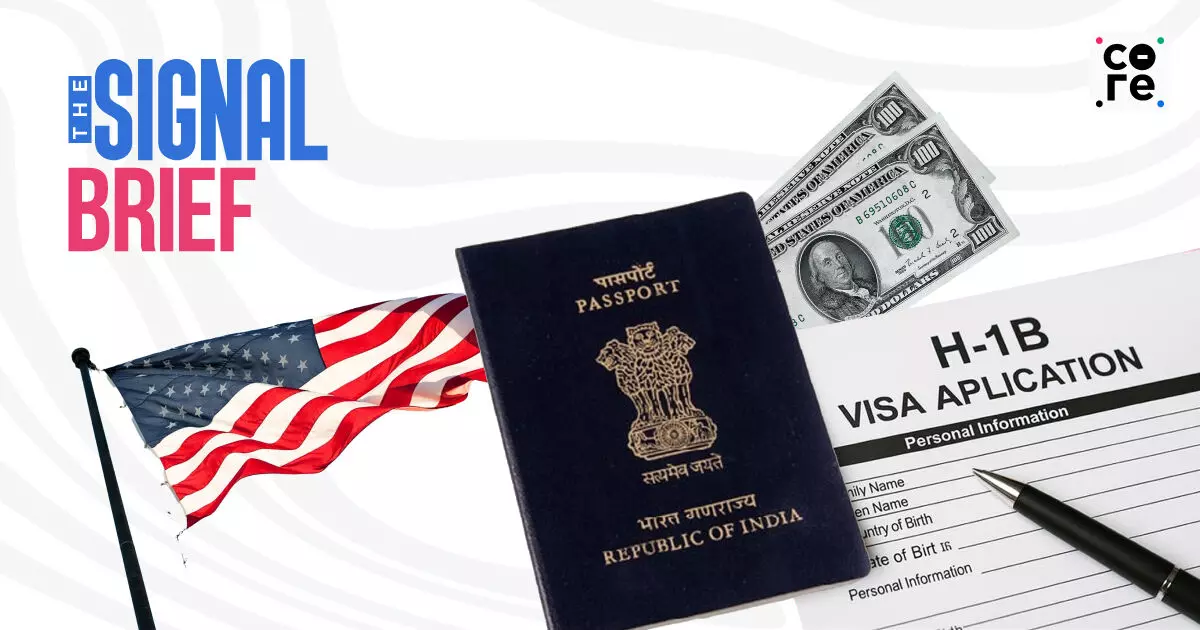
Is The H1-B Visa Still Worth It?
- Podcasts
- Published on 10 Oct 2025 7:00 AM IST

For decades, Indian professionals have chased the ‘American Dream’. At the centre of it all sits the H-1B visa, the pass that lets you live and work in America, and eventually apply for a green card.
But that dream is looking shaky. On September 19th, US President Donald Trump signed a proclamation adding a one-time fee of 100,000 dollars to every new H-1B application. For young Indians hoping to build their lives abroad, this changes everything.
So what happens to the ‘American Dream’ now? In this episode of The Signal Brief, we hear from students, workers and immigration lawyers who are confronting these questions in real time.
Link to The Signal Brief's previous episode: Inside the Student Visa Crisis of 2025
The Signal Daily is now The Signal Brief. The Core produces The Signal Brief. Follow us wherever you get your favourite podcasts. To check out the rest of our work, go to www.thecore.in
NOTE: A machine transcribed this episode. A human has looked at this text but there might still be errors. Please refer to the audio above, if you need to clarify something. If you want to give us feedback, please write to us at feedback@thecore.in.
—
TRANSCRIPT
Kudrat (Host): AA is 25. He moved to the US last year for a Master’s in Industrial Engineering. He doesn’t want us to use his full name — so we’ll call him AA. The job market wasn’t great when he graduated in May of this year, but he managed to land a job at a public agency in Boston. He planned to pay off his loans, buy a house, settle down. Then, on September 19, US President Trump dropped a bombshell: a $100,000 fee on every new H-1B visa.
AA: But after that, when this news last week came out that um, the100K fee applies to everyone, and obviously the first thought was that..
It's over. I mean, you finish your three years and you have to go back home and the, like, it's, it's like uprooting the life that you've been making over here and you've been working really hard. You've, you've put up, you've put down such a huge investment. Obviously now is the time that you wanna reap those benefits, but you can't because the government won't let you stay.
Kudrat (Host): My name is Kudrat Wadhwa and you’re listening to The Signal Brief. We don’t do hot takes. Instead, we bring you deep dives into the how and why of consumer trends.
Today, we’ll learn about what’s in store for Indians wanting to immigrate to the US. Does Trump’s second presidency spell doom for their American Dream?
Kudrat (Host): In the 90s and 2000s, Silicon Valley was booming — and the US needed talent to keep up.
In 1990, the U.S. Congress — that’s basically India’s Parliament — passed the Immigration Act. This created the H-1B specialty-occupation visa and set numerical caps. The official line? America didn’t have enough engineers and coders to stay competitive.
The H1-B visa allowed many smart and talented people to build their careers in the US. Some popular Indians who’ve had the visa before are Satya Nadella of Microsoft and Sundar Pichai of Google. That visa turned dreamers into coders, and coders into CEOs.
Kudrat (Host): No doubt the H1-B has brought top international talent to American firms. But, since the program’s inception, it’s also received criticism from many.
Some say that shortage never existed. Others say it’s long over. Critics say it’s now a way for companies to replace US workers with cheaper foreign labour.
Reporting backs this. In 2015, The New York Times uncovered how Disney laid off hundreds of IT staff — and even asked some to train the very people replacing them. The replacements worked for contractors that brought in H-1B visa holders.
Kudrat (Host): But the H-1B story isn’t simple for workers either. On the one hand, it allows people from middle-class families in countries like India to make their futures in the US. We’ve all heard stories of people who took loans to get a Master’s in, say, Computer Science in the US. They study hard, land a good job. A few years later, they’ve cleared their loans, bought a house, maybe a car — and send money home.
This vision of the ‘American Dream’ is also what attracted AA to go to the US. He said that in India, people with the same capabilities earn a lot less than those in the US.
AA: it was just the sheer quality of life that, you know, you get to see it. It's like it's something that you see in the movies and you know, you get, you get, you get, you get kinda tempted that, oh my God, I wanna live that kind of life.
Kudrat (Host): When people like AA go to the US and work there, they earn for themselves, yes, but they also send money back home. India tops the world in remittances. Nearly 28% comes from the US — about $34 billion of the $129 billion total.
Ending the H1-B could have disastrous consequences for those remittances. A recent report by Barclays warns the $100,000 fee could shave off nearly $5 billion. Not catastrophic — but not nothing either.
Kudrat (Host): Even so, Indians like AA are unhappy with this new proclamation and with the uncertainty this brings. AA was waiting for his employer to file his H-1B. Now they say they can’t afford the fee. Right now, AA says he’s waiting and watching, he’s hoping that someone challenges this rule in a court of law.
But, not all those on the H1-B love the experience. You see, people on the visa are tied to their employer, since it’s the employer who filed their petition. Lose your job — and the clock starts ticking. You get 60 days to find another or leave.
The Signal Brief also spoke to Rahul, who moved back to India from the Bay Area in the US last month. He went there for a Master’s in 2020 and later worked in Amazon for three years. He said he felt deeply exploited on the H1-B.
Rahul: Because H1-B people can be exploited, uh, to a level that you have to work 24x7.
Uh, you have to be like on call no matter what you do. Uh, I remember when I joined my first team in Amazon, there was this, there was this, uh, senior engineer. Who was online 24x7. Like basically you message him at two in the night, he will work.
In one of my one-on-one with, with my manager, I told her that, Hey, you know, I cannot work every day until 8:00 PM or it's not like I cannot do 12, 13 hours every day. And the same week I get a message from her that, Hey, is your visa renewed? Is it, is it up for renewal? So you are reminded that you are at our mercy in this country, so you have to do what we want.
So that's, that's what triggered me. I noticed this pattern in my company.
Kudrat (Host): This year, during a trip home for Holi, something clicked. He realised he hadn’t moved halfway across the world to be chained to a company. He decided to return to India.
When Rahul told his circle that he’s gonna move back, he said his Indian friends were shocked. “How could you let go of a once in a lifetime opportunity?” they asked him. But, his American friends supported his decision. They said America’s climate was turning hostile, maybe he’d be better off in India.
Kudrat (Host): His friends were referring to US President Trump’s broader pro-American agenda. Trump’s allies have long slammed the H-1B as a job-stealer, and some worry that this administration could crack down on the program further.
In his first term, Trump tightened the H-1B program with his 2017 “Buy American, Hire American” order — a move that raised denials and narrowed the rules. His team pushed wage-based prioritisation, raised compliance checks, and even froze new visas in 2020.The result? A program tougher, riskier, and far less predictable.
Kudrat (Host): And then, this month, Trump doubled down — slapping a $100,000 fee on new H-1B applications. Already, 2024 saw a record F-1 denial rate (~41%). In Mar–May 2025, F-1 issuances to Indians fell ~27% year-over-year.
The Signal Brief covered this topic some time ago, I’ve linked the episode in the show notes above. Applicants said officers grilled them harder than ever. One applicant said the officer even checked his social-media likes. The next day, the consulate denied his visa — though they said he could reapply.
So what’s really going on at the consulates? I reached out to immigration lawyer Gnanamookan Senthurjothi to learn more.
Gnanamookan Senthurjothi: A downside. It looks like it is a ll affair. Because, uh, the if student Visa applications, uh, they're not able to secure any Visa interview dates and it's pretty difficult for them to get the interview dates and even if they have the interview dates, technically the Visa rejection is on the higher side, and, uh, at least until now,
And, uh, the latest proclamation that, uh, recently came on 19th of September. That has had, uh, kind of a put all the people on H one B employers or the visa holders on a panic mode and chaos.
Kudrat (Host): Gnanmookan says that it’s not as if people aren’t getting visas altogether though. He’s had multiple clients get both the H1-B and the F-1 (that’s the student visa); so people should make sure their applications are squeaky clean.
Gnanamookan Senthurjothi: whenever they apply for a Visa interview, they have to make sure that they have the best presentation on their first Visa application because if they fail to make the uh, uh, best impression on the first interview and that the visa is refused, they hardly have a chance of securing another interview date and within less than six months.
They have to calm down. They have to be very, very careful and the charge of words, how they present their application if they do that. I think we still have people who are securing visas. The visa are being approved. It's not like everyone is getting a refusal, so they have to kind of be very calm and composed when they attend the Visa interviews.
Kudrat (Host): If you’re still applying, go the extra mile — perfect your paperwork, stay calm, be ready.
You might want to also look into alternative visas, like the O-1 or even the J-1. The Signal Brief spoke to Nicole Gunara, an immigration lawyer at Manifest Law, a law firm based in the US. She told me that this administration has made it clear that they only want the best of the best in the US.
Nicole: Definitely looking at alternative plans and not relying on the H one B is the biggest thing that I can tell every single person, whether they're a student or they're already on the H one B.
Um, and primarily because what we saw saw, like what we saw during like this, every evolving situation was a key vulnerability.
the reality is that there is a whole alphabet soup of Visas that are out there. And actually, like I mentioned earlier, the government has clearly pinpointed what they're trying to prioritize, which is the concept of extraordinary ability. They've also focused on the best of researchers. The best of scientists, right. And there are other visas that cater to that, like the O one visa or even the J one visa for research scholars and specialists.
Right? I do think that people should be actively looking at these other visas and preparing for them. Because even if someone isn't feeling like they're already extraordinary to get to that level, right? Especially when you're a student, there's a lot of things that you can do and cultivate to get to that point before you run out of time.
Kudrat (Host): But even if you get the visa, the waiting never ends, especially for Indians. Let’s say, you get the H1-B or the O-1, your journey doesn’t end there. For many Indians, the green card is a waiting game — one that can last decades. So their future in the US is never certain.
AA: I'm no longer happy with the uncertainty and it's definitely not, no, not a place where you wanna see your future, right?
I mean, you don't, you can't look into the future, I mean, for example. Um, I see my friends in India, um, buying houses or something, you know, settling down. Whereas I cannot even buy a house because I don't know if I'm in this country. Um, I cannot invest into a retirement plan because I don't know if I'm gonna be in this country.
So those kind of options really make you wonder that how long am I gonna be in this uncertainty whether. I'm here or there. It's like having, it's like being in two boats at the same time. So I feel like, yeah, now it's definitely taking a toll.
Kudrat (Host): AA now tells others — don’t go to the US.
AA: Definitely not. Um, if anyone wants to come to us now is not the time. Um, you have to wait out for another three years until this administration's over at least, and.
After, or, or you just have to wait out until things you know are more calmer.
You're gonna put down that kinda money and you, you're not gonna be able to earn it back because the job market is honestly so bad that no one, none of the companies want to hire you,
So you can imagine that the market is so bad and. Now that this whole 100K fee has come into place, I feel like there's a huge disadvantage to international students and there's not, there's, even if jobs are out there, it's highly unlikely that a company would be okay hiring an international candidate.
Kudrat (Host): The American Dream isn’t dead for Indians, but it is changing. For decades, it meant going to the US, working hard, and eventually building a life there. Today, it looks far less certain. Visa hurdles, unpredictable politics, and the cost of migration have turned what was once a clear path into a gamble. Some, like AA, feel the risk no longer makes sense. Others still believe the US is worth the fight.
Either way, the question is no longer whether Indians can go to America. It’s whether the dream is still worth chasing.
Kudrat (Host): That's all for today. You just heard The Signal Brief. We don't do hot takes. Instead, we bring you deep dives into the how and why of consumer trends. The Core produces The Signal Brief. Follow us wherever you get your favourite podcasts.
To check out the rest of our work, go to www.thecore.in.
If you have feedback, we'd love to hear from you. Write to us at feedback@thecore.in or you can write to me personally at kudrat@thecore.in.
Thank you for listening.


