



 Newsletter
 Search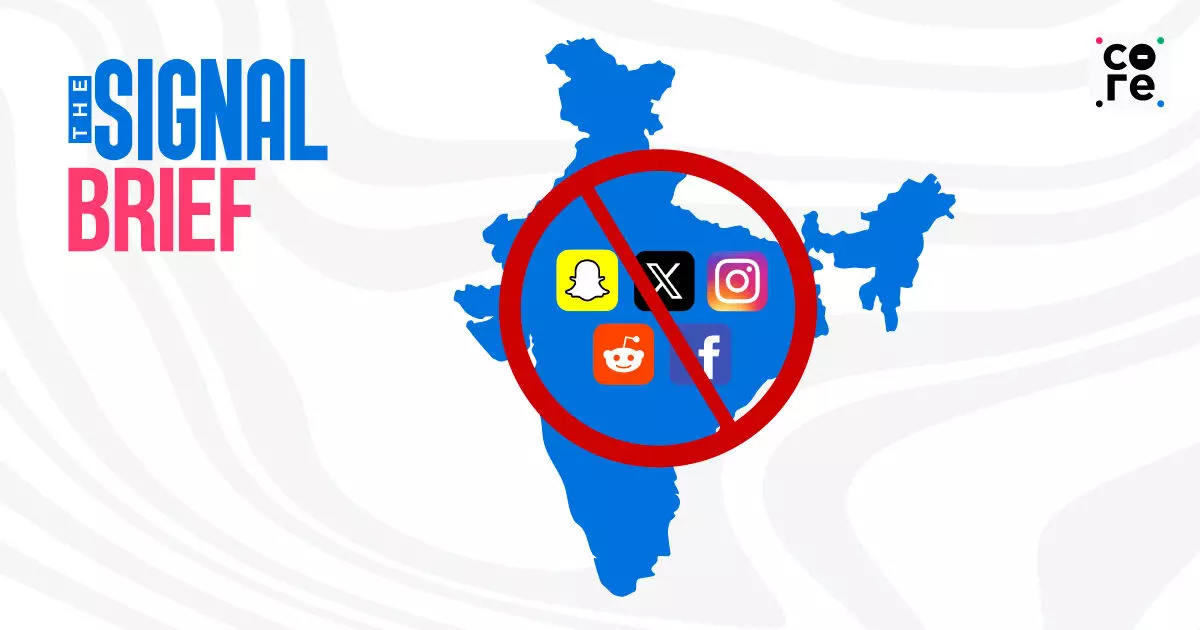
Ban The Apps? India’s Youth Are Split
- Podcasts
- Published on 27 Feb 2026 7:00 AM IST

Last December, Australia became the first country in the world to ban social media for users under 16.
Now, reports suggest that in India too, the central government and some states are also considering banning social media for teenagers.
The concerns are simple: endless scrolling, addictive design, online bullying, depression as well as rising anxiety.
India has over 460 million social media users. Many of them are teenagers.
So, the question is simple. Is banning the solution?
In the latest episode of The Signal Brief, we hear on this from child psychologists, journalists and digital rights advocates.
As well as from the people most affected: teenagers themselves.
The Core produces The Signal Brief. Follow us wherever you get your favourite podcasts.
Register for India Finance and Innovation Forum 2026
NOTE: A machine transcribed this episode. A human has looked at this text but there might still be errors. Please refer to the audio above, if you need to clarify something. If you want to give us feedback, please write to us at feedback@thecore.in.
—
TRANSCRIPT
Kudrat (Host): Ziana Mehta is 16. She lives in Borivali, Mumbai. She’s preparing for NEET, India’s medical entrance exam.
She says she cannot afford distractions right now.
And yet, distraction finds her.
Ziana: It’s just the Instagram. Um, I open like if I need a break. Sometimes I just think that, okay, 10 minutes, I’ll take a break, I’ll pick up my phone, I’ll scroll the messages, I’ll scroll the reels on Instagram, but the 10 minutes, I don’t know when they turn into 30 minutes or even one hour. And then I’m like, shit, I need to finish all of these, um, assignments and I need to submit them tomorrow.
And I’m still not done with them. And I just wasted an hour on my phone. So yeah.
Kudrat (Host): What Ziana described isn’t random.
Tech companies have built social media platforms to maximise engagement. The longer users scroll, the more ads they see. The more data platforms collect and the more revenue they generate.
Teenagers are particularly valuable to these companies.
A 2022 peer-reviewed analysis estimated that Instagram, TikTok and Snapchat generated nearly $11 billion in advertising revenue from American users under 18 in just one year.
And, governments around the world are taking action against social media.
In December 2025, Australia became the first country to introduce a nationwide ban on social media access for children under 16. Denmark and Germany are moving toward restrictions for younger teens, and lawmakers in France are also debating similar measures.
In India, the Chief Economic Advisor recently warned about rising digital addiction among young people.
CLIP: Should Social Media Be Restricted For Kids Under 16?
Since then, reports suggest the government is considering whether India should follow suit.
Kudrat (Host): My name is Kudrat Wadhwa and you’re listening to The Signal Brief. We don’t do hot takes. Instead, we bring you deep dives into the how and why of consumer trends.
Today, we ask: should India ban social media for teens?
Kudrat (Host): Anyone who uses social media knows how easy it is to lose time.
You open your phone for five minutes. You decide to watch one short reel or read some spicy takes on X.
And then, an infinite scroll kicks in. Ten minutes pass. Twenty. An hour.
And, like Ziana you’re left wondering, where did the time go?
Researchers across the world have also found consistent links between heavy social media use and poorer mental health outcomes among teenagers.
Large systematic reviews published in the US’s National Library of Medicine show that adolescents who spend more time on social media are more likely to report symptoms of anxiety, depression, stress and poor sleep.
A major longitudinal study published in the medical journal JAMA Network found that higher social media use in early adolescence predicted increased depressive symptoms over time.
Scientists caution that the relationship is complex and often runs both ways. But the pattern is strong enough to concern public health experts.
Kudrat (Host): All of this is solid evidence. But what do these effects actually look like in real life?
I asked Delhi-based child psychologist Kiran Tevtiya.
Kiran: I get children, young children who, surprisingly, show very low interest in the toys which I have in my center, just because they have been on a very high level of screens. Why? Because those passive toys do not interact, do not dance, do not say, “hello,” in those quick voices, right?
So they look very passive, very dull, very low in rewards.
Kudrat (Host): Kiran added it’s true that we’ve always worried about new technologies. Television, for example, once earned the nickname “the idiot box.”
But today’s platforms differ in one key way.
Kiran: The tricky part about the screen that is available now is the interactivity. You know, the interactive level is very high. The lack of building of skills which are helpful in real life.
That is frustration tolerance, right? The personalisation, highly personalised content. Content which tweaks itself based on who is watching. So if a 3-year-old is watching, the content will be different. If a 10-year-old is watching, the content is different. If a boy child is watching, the content is different. If a girl child is watching, the content is different.
Kudrat (Host): Here, she’s referring to instagram reels or youtube shorts, with their personalised feeds and infinite scroll features.
Kiran says the impact cuts across class.
Kiran: In fact, surprisingly, this event of Instagram reels and YouTube Shorts is immaterial of socioeconomic status, immaterial of, you know, which families the child is in. You would notice that children, um, I get cases where the child is speaking, the speech is wonderful, but nobody understands what the child is speaking because the child is watching Korean and Japanese animes and videos.
So it’s what we have been doing out here. We could feel very happy that, wow, my child is learning, but what is the child learning?
Kudrat (Host): Even adults struggle with self-control when it comes to screens and social media.
Kiran told me that kids and adolescents are still learning impulse control. Their brains are like sponges. The very act of being online can cause long term harm to their growing minds.
When the Australian PM announced the ban in December of last year, he encouraged children to get off their phones and learn a new skill.
CLIP: Australian PM makes last pitch to the nation’s teenagers ahead of social media ban
Kudrat (Host): For the ban’s supporters, the logic is simple: teens struggle to regulate themselves inside these systems, so, the state should step in.
But critics do not agree with a blanket ban.
In fact, the comments on the youtube clip that we just played encapsulate that complexity.
Some people accused the government of overreach. Others argued that decisions about children’s screen time belong to parents, and not governments.
One commenter wrote, “Welcome to Chinaustralia,” suggesting the ban felt authoritarian.
Kudrat (Host): There are substantive concerns behind the outrage.
Apar Gupta, founder of the Internet Freedom Foundation — a digital rights organisation that advocates for privacy and civil liberties — warns that enforcing a ban would likely require age verification.
That could mean linking social media accounts to government IDs.
Critics argue that this would expand data collection and raise serious questions about privacy and data sovereignty, especially since many platforms are headquartered abroad.
There are also practical challenges.
Teenagers often understand the digital ecosystem better than adults. They could use VPNs to bypass restrictions. Or worse, they could migrate to unregulated platforms that are harder to monitor and potentially more dangerous.
Kudrat (Host): My colleague, Adrija Bose, who edits Decode and has reported on technology and children for several years, agrees with the ban’s critics.
She says that at the outset, social media’s makers promised us community.
Though its current iteration is far from ideal, Adrija said social media is still a safe space for some, like queer youth, for instance.
Adrija: You know, a lot of times families are the ones, and there are enough reports to show families are the ones that kind of create a lot of unsafe environment for children themselves. And the Ghaziabad story kind of explained and explicitly showed that it was the home that was unsafe for them. So when something like that happens, teenagers will go and try to find some other place, and that’s the right thing to do. Find their own communities if they can’t find that safe space among their family or school teachers or anything.
So my idea is that instead of banning it, I think there has to be more digital literacy, where we instead go and help teenagers understand how to be safe on platforms, how to create their own email IDs, how to not share their passwords and be safe on their own.
Kudrat (Host): She pointed to the recent Ghaziabad case, where three sisters aged 16, 14 and 12, died by suicide.
Initial reports blamed Korean shows and online games. Later investigations revealed a far more layered reality — economic stress, family instability, and isolation.
Blaming social media alone obscured deeper problems.
Adrija also highlighted India’s digital divide.
Recent research from the Mumbai-based gender rights NGO Rati Foundation shows that girls are less likely to use phones than boys. Many children still use their parents’ email IDs. Digital literacy remains uneven.
Adrija: As a child, the first thing I had was an email ID before going on to Yahoo Messengers or whatever we used at that point of time. So the gap is that they don’t even have the basic digital literacy on these platforms, which is horrible, especially for Indian children because of the language, because of the inequality, et cetera, and because of the hatred that kind of exists in these spaces.
Kudrat (Host): Adrija also argued that banning platforms shifts responsibility away from companies, families and policymakers.
Adrija: One thing is, of course, digital literacy and doing both ways, right? One is to equip people to navigate platforms critically, young people to understand how to report. That’s one thing that came out of the report as well, that children are seeing violent content, but they don’t know how to even report because the language is a barrier.
It’s written in a completely different manner that they don’t grasp. So that has to be explained, okay? That needs to be taken up in our mass communication.
You know, we need to see how a platform can be designed to make a child safe and not go into a whole loop of addiction, where there’s an infinite scroll and they’re constantly going from one to another to find their dopamine hit. That is not how a child should be able to access social media.
So those designs can be changed. So my idea would be that platforms should work on changing design, at least for children, have perhaps a different sort of design. I think for everybody. We, as adults also, get addicted because of the reinforcement loop. But the design has to be changed.
And currently what it is, it is intended to be addictive. It's not supposed to be like this. This is what they have chosen to be and we need to, we need to push against it.
Kudrat (Host): There are no clear answers.
It’s only been two months since Australia announced the ban, so we don’t have longer-term data on what’s changed since, either.
Of course, India isn’t Australia. We have different challenges. Our youth’s backgrounds, and aspirations too, are different from those of Australia’s young people.
So we thought, enough pontification by adults. Let’s hear from India’s youth directly.
Seven-year-old Sonam remembers finishing her family’s entire data pack in one night, watching reels.
Sonam: मैं ना फोन मैंने एक दिन फोन में 2:00 से चला रही थी तो पूरा नेट खत्म कर दी थी। मुझे इतना मजा आया इतना मजा आया इतना मजा आया की मैं हस हस के पागल हो गयी। सुबह उठ के मम्मी पापा ने देखा नेट तो नेट ही नहीं है और फिर फिर मैं तो कोने में जाके हसने लगी। मुझे इतना मज़ा आया इतना मज़ा आया की मैं सोच सकती अपने पैर में जूता
Kudrat (Host): There’s no policy debate in her voice. Just joy. And maybe, the early beginnings of habit.
17-year old Ziana, who we heard from at the beginning of the episode, said her only concern with the ban was that social media is how many young people stay in touch.
Ziana: I think it is a good step at one point of view because it actually helps you focus more. The reels also decrease your attention span a lot, like 30 seconds. You hardly even see the reel. So it is harming, but the communication at one point does get less or creates a drift between people. But I think that you can do it once you turn 16 or 18, whatever the age limit.
Kudrat (Host): Ziana’s brother Shaurya, who’s 14, thinks restrictions should apply only to younger children.
Shaurya: Even if they want to ban it, it should be banned for under 12 or under 10, for kids who are not in their teenage and they do not use phone so much, or like for studies and all.
Kudrat (Host): Nikhil, 18, agrees that a blanket ban feels extreme.
Nikhil: I think 16 might be too high a bar if I were to impose a ban or think about what age it would be. I think 13 is a good age since that’s when you become a teenager, that’s when you start having more responsibility and autonomy, and banning seems a bit extreme to me. I feel like if there were more regulation on what kind of content you could consume and maybe some kind of guidelines on how to use it, how to deal with maybe cyber bullying, and somewhat awareness about how addictive it can be instead of just a complete ban.
Kudrat (Host): Anuj, who’s 16, recounted a story of when his friend spent thousands of rupees of dad’s hard-earned money on a game. He said he supports the ban.
Anuj: इसलिए नॉर्मल 18 प्लस से कम बच्चों को बिल्कुल ही फोन देना नहीं चाहिए, जिनको नॉलेज बिल्कुल न हो और फिर फ्री टाइम के लिए अपने डैड के इतने सारे पैसे खर्च कर रहे हैं। मैं तो चाहता हूँ, मैडम, कि इन लोगों को कम से कम टाइम मिले मोबाइल्स के लिए और ज्यादा पढ़ें, और उनके साथ-साथ उन्हें एक्टिविटी और मोटिवेशन वीडियोस देखने चाहिए। फ्री टाइम के लिए फोन ले भी लेते हो, मैं तो इतना ही कहना चाहूँगा।
Kudrat (Host): Even among teens, there’s no consensus. Some want protection. Others want autonomy.
The Ministry of Electronics is currently discussing the ban with legislators and industry bodies.
Whatever they decide will shape how millions of Indian teenagers live online. And we think that teenagers deserve a seat at that table too.
Outro: That's all for today. You just heard The Signal Brief. We don't do hot takes. Instead, we bring you deep dives into the how and why of consumer trends. The Core produces The Signal Brief. Follow us wherever you get your favourite podcasts.
To check out the rest of our work, go to www.thecore.in.
If you have feedback, we'd love to hear from you. Write to us at feedback@thecore.in or you can write to me personally at kudrat@thecore.in.
Thank you for listening.


