



 Newsletter
 Search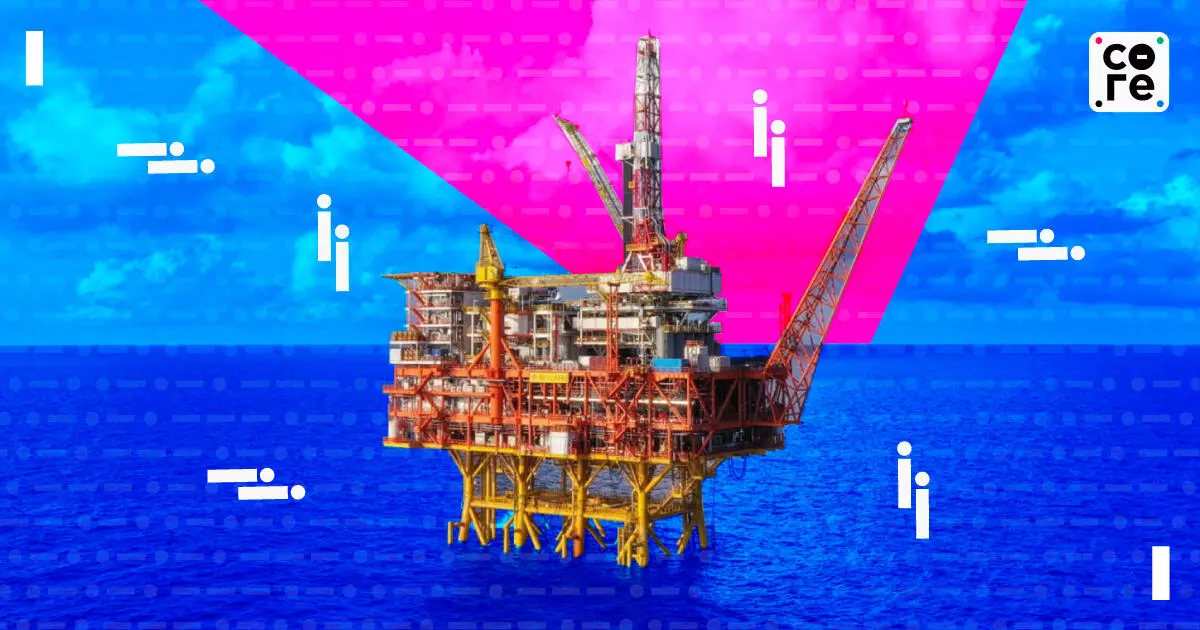
Proven KG Basin to Iffy Andaman: A $10 Billion Gamble For Ultra-Deepwater Crude

With over 88% import dependency, India's state oil companies are investing massively in offshore drilling, balancing safe bets in proven basins against risky frontier exploration.
The Gist
India's national oil companies are betting on deepwater exploration to secure energy independence.
- ONGC and Oil India are pursuing two strategies in the Krishna-Godavari and Andaman Basins.
- India's dependency on imported crude oil is increasing, highlighting the urgency for local production.
- Massive investments are being made, with ONGC's capital expenditure reaching Rs 62,000 crore in FY25.
India's national oil companies are placing a high-stakes bet on the ocean floor that could have the potential to rewrite the country’s energy future, but could also turn out to be the most expensive campaign that didn’t yield results.
The companies are pursuing a two-track deepwater strategy ranging from extending proven production in the Krishna-Godavari Basin to high-stakes geological bets in the untested Andaman Basin.
The urgency is driven by India’s energy reality. In the 2025 fiscal year, India’s dependency on imported crude climbed to 88.2%, up from 87.8% the previous year. The scale of capital now committed to offshore drilling suggests India is aiming for transformational finds.
To break this cycle, ONGC) and Oil India Ltd. are pivoting to depths exceeding 2,000 meters, where the risks are astronomical, but the rewards could be massive.
Two Track Strategy
The strategy is a tale of two basins. In the Krishna-Godavari (KG) Basin, the proof of concept already exists. The partnership between Reliance Industries and BP currently produces 28 million standard cubic meters of gas daily from the KG-D6 block. This single source accounts for roughly 30% of India’s total gas output, maintaining a staggering 99.9% uptime over 14 years.
However, the real moonshot is the Andaman Basin. Geologists often draw optimistic parallels between the Andaman’s Tertiary-age structures and Indonesia’s legendary Sumatran fields, which have yielded nearly 28 billion barrels of oil equivalent since the 1970s. But geological analogies are not proven reserves.
In September, ONGC and Oil India signalled their intent by launching a Rs 3,200 crore ($385 million) stratigraphic drilling campaign. Working with BP, they are targeting four wells across the Andaman, Mahanadi, Saurashtra, and Bengal basins. Some of these targets sit beneath 6,000 meters of water and rock — commitments that dwarf any exploration effort since the iconic Bombay High strikes of the 1970s.
Oil India reported a natural gas occurrence at Vijayapuram-2 in September, prompting technology service agreements with TotalEnergies for wells at 2,000 metre water depths with total drilling approaching 7,000 metres. Even smaller operators are pushing offshore: HOEC's B-80 block produced 31,468 barrels in Q2 FY26, down 35% from Q1 due to monsoon disruptions.
Massive Capex Commitments
The companies are making massive financial commitments for the ultra-deepwater bet.
ONGC invested nearly Rs 62,000 crore in capital expenditure during FY25, a significant increase from Rs 37,494 crore in FY24, while Oil India's consolidated capex was Rs 18,170 crore in FY25.
"We have been spending Rs 4000 crore per year on the data acquisition alone," ONGC chairman Arun Kumar Singh told The Core.
ONGC is bidding aggressively in the OALP-X (Open Acreage Licensing Policy-X) auctions to expand its exploration acreage to 500,000 square kilometres by March 2026, up from nearly 180,000 square kilometres in early 2025; to support this, annual exploration ONGC’s spending is set to rise to Rs 110 billion ($1.3 billion), up from its previous range of Rs 70–80 billion.
ONGC is targeting 5 lakh square kilometres under exploration by March 2026, up from the current 1.63 lakh square kilometres.
A single dry hole can exceed $200 million (Rs 1,830 crore) at ultra-deepwater depths. Oil India provided Rs 723 crore in Q2 FY26 for the Vijayapuram-2 well, as accounting treatment before commercial discovery is declared.
The global offshore industry currently operates 133 floating rigs, with high-spec drillships capable of operating beyond 2,000 metres now commanding leading-edge day rates that exceed $500,000 (Rs 4.60 crore).
Besides, geological analogies with, say, Indonesia, aren't proven reserves.
Yet, India's energy security calculus makes the gamble rational despite individual well risks. National 2P reserves for oil declined from 450 to 434 million metric tons between FY22-FY24. Without offshore success, India risks depleting reserves faster than discovering new ones.
Regulatory Reforms Encourage Risk
The timing of this offshore pivot coincides with the government making regulatory changes designed to de-risk frontier exploration. Amendments to the Oilfields Regulation and Development Act passed in early 2025 expanded the definition of mineral oils to include unconventional hydrocarbons and eliminated royalty payments in Category II basins, including the Andaman offshore areas. For exploration in deep and ultra-deepwater areas like the Andaman and Nicobar basins, there is nil royalty to be paid.
The 20% premium on new well gas provides additional financial incentive. For ONGC, the price for New Well Gas was $8.26 per MMBtu versus $6.64 per MMBtu for nomination gas in Q1 FY26. This premium delivered Rs 3,352 crore in revenue during the first half of FY26, providing an extra Rs 651 crore compared to standard pricing.
The Open Acreage Licensing Policy Round X offered 25 blocks spanning 190,000 square kilometres. Nearly 65% of the blocks were situated in ultra-deepwater areas. Oil India secured 40,000 square kilometres in OALP-IX, bringing its total exploration acreage to 112,000 square kilometres. The government has unlocked nearly one million square kilometres of previously restricted areas for exploration by 2030.
KG Basin Proves India's Deepwater Potential
The Krishna-Godavari Basin success establishes both a proven geological model and operational benchmark. The challenge is whether this track record justifies the far higher risks and costs of exploring completely untested frontiers like Andaman, where no commercial production exists, and geological assumptions rest on Indonesian and Myanmar analogies.
The Andaman Basin faces distinct risks beyond those encountered in Sumatra: greater tectonic complexity at the triple-junction of Indian, Burmese and Sunda plates, significantly deeper water depths exceeding 2,000 metres versus Sumatra's predominantly shallower operations, and critically, zero well control to validate reservoir quality assumptions drawn from Indonesian analogies. Unlike Sumatra's five decades of exploration data, Andaman remains largely undrilled with limited seismic coverage, meaning porosity, permeability, and fluid characteristics—this includes potential high CO2 content—remain entirely unproven until wells penetrate target formations.
Company-Specific Offshore Milestones
The Indonesian comparison offers a useful perspective. The Natuna gas field holds reserves exceeding 200 trillion cubic feet but remains largely undeveloped due to high carbon dioxide content requiring expensive separation facilities. Geological potential does not automatically translate into commercial viability. Production economics depend on reservoir quality, fluid composition, distance to processing infrastructure and market pricing.
Initial drilling results from ONGC's Krishna-Godavari stratigraphic campaign are expected within 12-18 months from the programme's launch, while Andaman's ultra-deepwater wells at 6,000+ metre depths require extended appraisal through 2028-2030 before any commercial viability determination. Full field development in Andaman, if commercially viable, would likely commence only around the mid 2030’s, representing a decade-long timeline compared to KG Basin's established production infrastructure."Technology Gaps Drive Partnerships.
The difference between ambition and execution shows up in the partnership roster. ONGC has signed memoranda of understanding with ExxonMobil, Chevron, TotalEnergies and BP specifically for deepwater technical assistance. Oil India brought in Petrobras, the Brazilian giant that pioneered pre-salt ultra-deepwater drilling in the Santos Basin. These partnerships represent explicit admissions that the expertise required to drill at these depths resides with international operators who have spent decades refining techniques in the Gulf of Mexico, offshore Brazil and West Africa.
International Partnerships Enabled by ORDA Amendments
"We are in talks with international oil companies seeking collaboration for technology sharing," Oil India chairman Ranjit Rath reportedly highlighted in September the need for global expertise in ultra-deepwater operations. The technology transfers matter because ultra-deepwater drilling operates on knife-edge tolerances. TotalEnergies will assist Oil India with stratigraphic well design, critical when penetrating formations where pore pressures can shift dramatically within vertical intervals of a few hundred metres.
ONGC chairman Arun Kumar Singh stresses the technology imperative. "If India at all succeeds in our exploration mission, it is going to be deep and ultra-deep water," he told The Core, acknowledging that the country's energy future hinges entirely on offshore success. The company has signed MoUs with ExxonMobil, Chevron, TotalEnergies, and BP for deepwater exploration and technical service proposals, highlighting the strategy to leverage global expertise for frontier exploration.
ONGC is deploying 4C-3D Ocean Bottom Node seismic acquisition in its Krishna-Godavari blocks to achieve the subsurface resolution necessary to map reservoir geometries at depths where conventional seismic imaging becomes unreliable. Oil India uses Petrel software for real-time geological modelling and low-frequency, precise seismic for challenging areas.
Over the next 18-24 months, wells will penetrate prospective formations in both proven and frontier basins. The companies have mobilised rigs, assembled expertise, and committed capital. What remains uncertain is what lies beneath several kilometres of water and rock—and whether geological success in established basins justifies the exponentially higher costs of exploring virgin deepwater territory.
Core.
Core.


