
A Billion-Dollar Deadlock: Why Tata Sons Is Deferring Its Leadership Vote
The leadership clash at the Tata group may impact future strategic direction, as the $149 billion salt‑to‑software giant braces for a decisive transformation.
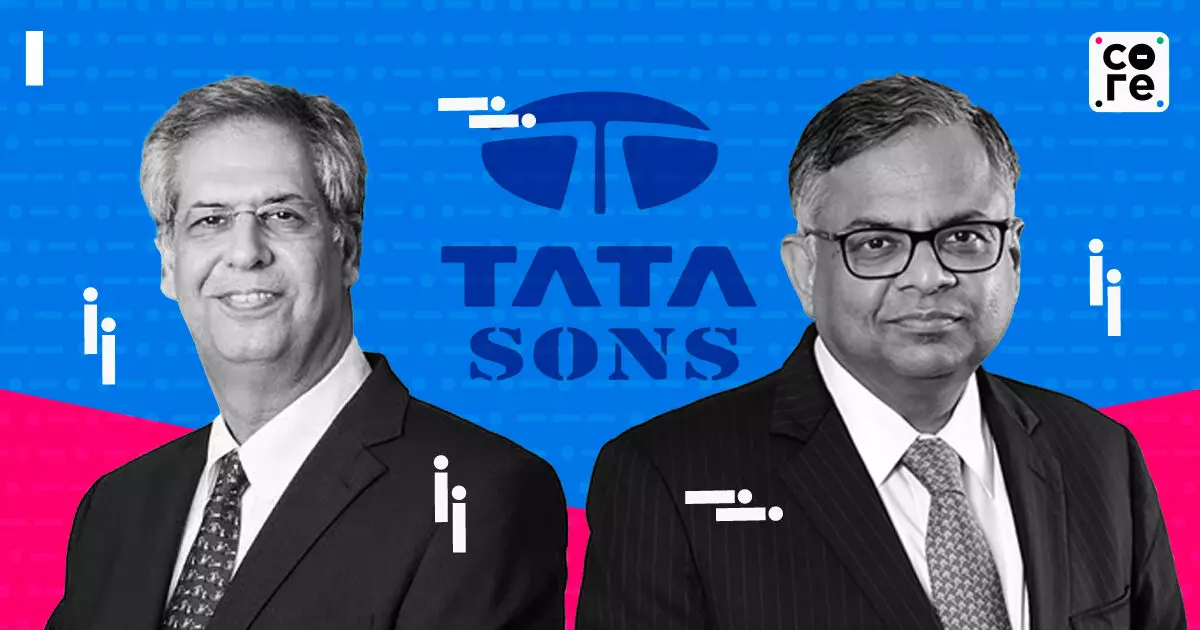
The Tata group, India’s most storied conglomerate, finds itself at a defining moment. At stake is not just the extension of Natarajan Chandrasekaran’s leadership at Tata Sons, but the very structure of how the $149‑billion empire will be governed in the years ahead. With Noel Tata now chairing Tata Trusts — the holding company that controls 66% of Tata Sons — boardroom debates have sharpened around succession, accountability, and the group’s strategic direction.
Tensions spilt into public view after the Tata Sons board abruptly deferred a decision on whether to grant 62-year-old Natarajan Chandrasekaran a third five-year term on February 24, triggering fresh questions about leadership continuity at the helm of India’s most powerful conglomerate. Coming just four days before his current term was set to expire, this exposed the latent fault lines between Tata Sons and Tata Trusts.
What was once seen as a routine endorsement has now become a flashpoint, with Noel Tata pressing for stricter oversight and Chandrasekaran’s camp arguing for continuity. The leadership impasse may force long‑pending decisions on succession and governance, as the salt‑to‑software giant braces for a decisive transformation.
“Some businesses within the group are currently in the investment phase and not yet profitable, for example, Air India and digital ventures like Tata Cliq. These businesses are still building scale, but their losses have raised concerns within the group,” said Deven Choksey, veteran market analyst and Managing Director of Mumbai‑based DRChoksey Finserv Pvt Ltd. “There is a view that stricter decisions may be needed on such businesses.”
The Tata‑led board — while reportedly not averse to Chandrasekaran’s candidature — has raised questions about the group’s strategic direction and financial performance, including mounting losses in certain verticals.
Noel Tata has called for a more rigorous review of leadership continuity and accountability before endorsing Chandrasekaran’s extension. At the same time, the trustees of Tata Trusts have reaffirmed the validity of a July 2025 resolution approving a third term for Chandrasekaran. The sequence of events highlights the push‑and‑pull between continuity and reform that now defines much of the internal conversations at Bombay House. The colonial‑era basalt-stone headquarters in Mumbai has witnessed some of the group’s most consequential decisions over the past century.
Legacy Fault Lines
Legal experts The Core spoke to trace the discord to concerns raised by the late Cyrus Mistry that were left unaddressed. Mistry was appointed Chairman of Tata Sons in December 2012, before his abrupt removal by the board in October 2016, when Ratan Tata returned as interim chairman. He had flagged excessive debt, unprofitable ventures, and opaque Tata Trusts oversight.
Shravanth Shanker, New Delhi‑based Supreme Court advocate and Managing Partner at B Shanker Advocates LLP, said, “The current friction is, in many ways, a resurgence of the fault lines first exposed during Mistry’s ouster. The latest dispute reflects several of his core contentions that were never fully resolved.”
Mistry had also argued that the Articles of Association gave Tata Trusts’ nominee directors excessive veto powers over business decisions. Shanker said, “The current rift between the reformist bloc and the Trusts’ leadership echoes this concern over backseat driving in matters of capital allocation and board appointments.” This tension between a charitable organisation (the Trusts) and a capitalist entity (Tata Sons) remains unresolved.
Mistry had sought to challenge the private status of Tata Sons to ensure greater accountability. Shanker added, “Today, the group faces a similar crossroads due to the RBI’s mandate for Tata Sons to list as an NBFC (non‑banking financial company), a move the Trusts have resisted to maintain control and privacy.” Chandrasekaran, however, has indicated that he is open to a listing if required, signalling readiness to comply with regulatory directives even as the Trusts remain opposed.
Alay Razvi, Managing Partner at the Hyderabad-based Accord Juris LLP, notes that Noel Tata’s conditions for Chandrasekaran’s extension — low‑debt policies, restrained capex, and profitability in acquisitions like Air India — echoed Mistry’s earlier warnings. He said, “Legacy themes of Trusts‑Sons balance persist but are moderated by Chandrasekaran’s successes in TCS and Tata Motors. Full resolution requires addressing governance transparency without disrupting operations.”
Strategic Planning
When Chandrasekaran took charge in 2017, the Tata group had a consolidated revenue of around $100 billion. In the nine years since, it has grown to approximately $149 billion, a near 50% increase. The period has also seen the group foraying into new verticals such as semiconductors and digital platforms, as well as reclaiming the ownership of Air India from the government after 69 years.
Chandrasekaran both stabilised and steered the group forward, which is now targeting a $400 billion valuation by the early 2030s. This reflects the Tata group’s ambition to nearly triple its current size over the next decade, to position itself as a global leader in clean energy, advanced manufacturing, and digital commerce.
Yet, despite this growth, other verticals have bled serious money. Air India has sought around Rs 100 billion in funding from Tata Sons and Singapore Airlines for FY2026‑27, amid losses. Overseas, Tata Steel UK has struggled since the company’s $11.3 billion acquisition of Corus Group Plc in 2007. The subsidiary reported losses of about Rs 40 billion in FY2023‑24, with losses continuing into FY2024‑25.
Observers like Choksey see succession planning as inevitable. “Noel Tata’s son [Neville] may eventually be groomed as a candidate, though that will take time. Chandrasekaran’s tenure may realistically be extended by up to five years, given his age. Succession planning is inevitable, and the group is thinking maturely about how leadership should evolve.”
The differences have emerged at a time when the group is striving to define its future roadmap by adopting emerging technologies and entering next‑generation businesses. Therefore, an inordinate delay may result in paralysing these plans. Shanker of B Shanker Advocates sees a prolonged logjam as delaying capital allocation, eroding the Tata premium and an eventual leadership drain.
Major capital‑intensive projects, such as the turnaround of Air India, the expansion of semiconductor fabrication, and the green energy transition, require swift board approvals for multi‑billion‑dollar investments, which could be delayed. “The group has historically enjoyed a governance premium from investors. Market analysts have already noted fluctuations in group stocks like TCS and Tata Motors when news of boardroom rifts breaks, as uncertainty undermines investor confidence,” observes Shanker. Besides, a culture of internal friction can make it difficult to attract and retain top‑tier professional talent, “especially if the role of the Chairman of Tata Sons is perceived as being constantly undermined by the Trusts.”
According to Accord Juris’ Razvi, reputational damage to Tata’s governance would erode stakeholder trust, inviting scrutiny from agencies such as the Securities and Exchange Board of India (SEBI) and the Registrar of Companies (ROC) on Tata Trusts’ compliance. “Operational hits include stalled Air India revival and EV (electric vehicle) push, amplifying debt burdens. Legally, it breaches fiduciary norms under Section 166 of the Companies Act, potentially sparking shareholder lawsuits.” The said section seeks company directors to act in good faith by exercising due care and independent judgment, and prioritise the interests of the company and its stakeholders over personal gain. A consensus is, therefore, vital to sustain the ambitious future trajectory.
Governance Framework
So, what could be some of the ways out of the current impasse? With Noel Tata heading the Trusts and Natarajan Chandrasekaran leading Tata Sons, an amicable resolution will depend on a governance framework that clearly defines the roles of the two entities. Such a structure would be essential to manage succession and accountability without overlap or ambiguity. Matters such as major brand changes or long‑term planning would require Tata Trusts’ approval, while day‑to‑day operations and specific investments should remain the sole purview of the Tata Sons board.
This would also demand a strategy centred on low debt, restrained capex, and reversal of losses in the new ventures. “Given the involvement of high‑profile personalities and family ties, a neutral mediator such as a respected retired jurist or a global corporate governance expert could help harmonise the board’s composition,” noted Shanker.
Past precedents like the 2011 Trusts Ordinance, which aligned Tata Trusts’ decision‑making with Tata Sons’ board processes, can be suitably leveraged. This would preserve leadership continuity, avoid litigation, and uphold fiduciary duties under the Companies Act, 2013, ensuring the Trusts’ majority control remains effective during transition. Razvi posits, “Form a joint Tata Trusts-Tata Sons committee for oversight, revisiting extension by June 2026, with profitability timelines for Air India and BigBasket. Chandrasekaran’s self‑proposed deferral fosters dialogue; senior trustees can mediate, prioritising consensus per Tata’s ethical charter.”
Moreover, reaching a consensus on the RBI listing mandate is critical. Resolving whether to list Tata Sons or successfully surrender its NBFC licence would remove a major impediment.
Structural Evolution
Choksey reiterates that it is ultimately a question of the group realigning its strategy to sharpen competitiveness. “The debate is not about whether Chandrasekaran continues; he will. It is more about exploring whether the group should continue with its current conglomerate structure or adopt a different model. That is likely why discussions have been deferred: to buy time and consider structural options.”
In the last nine years, Tata Sons has classified group businesses into broad clusters, including technology, consumer and retail, infrastructure, automotive, steel, financial services, and new ventures, to streamline oversight and growth. The question now is whether each vertical should be given independent leadership, rather than one chairman overseeing everything.
If the group wants accelerated growth, decentralisation may be necessary. Mukesh Ambani, Chairman & Managing Director of Reliance Industries, has embedded his three children — Akash, Isha, and Anant — into leadership roles across telecom, retail, and energy. Similarly, Gautam Adani has allocated responsibilities among family members, with Karan Adani and others overseeing key verticals such as ports, airports, and energy. “The Tata group, too, will need to evolve and create ownership structures. This is inevitable, and the current board discussions are part of that process,” stated Choksey.
Today, the Tata group is often a follower rather than a leader in many businesses, and that needs to change. Choksey elaborates, “Decentralising into verticals with independent ownership could, therefore, strengthen succession planning and growth. Noel Tata is driving this objective. He is empowering Tata Sons to grow better. It’s not conflict, it’s a deliberate effort to build a stronger future.”
All eyes will now be on the outcome of the June 2026 meeting of the Tata Sons board, where consensus with Tata Trusts will be critical to laying out a future roadmap.