

Superintelligence To Diffusion Gap: Altman, Sikka And Amodei Map AI’s Productivity Surge And Risks
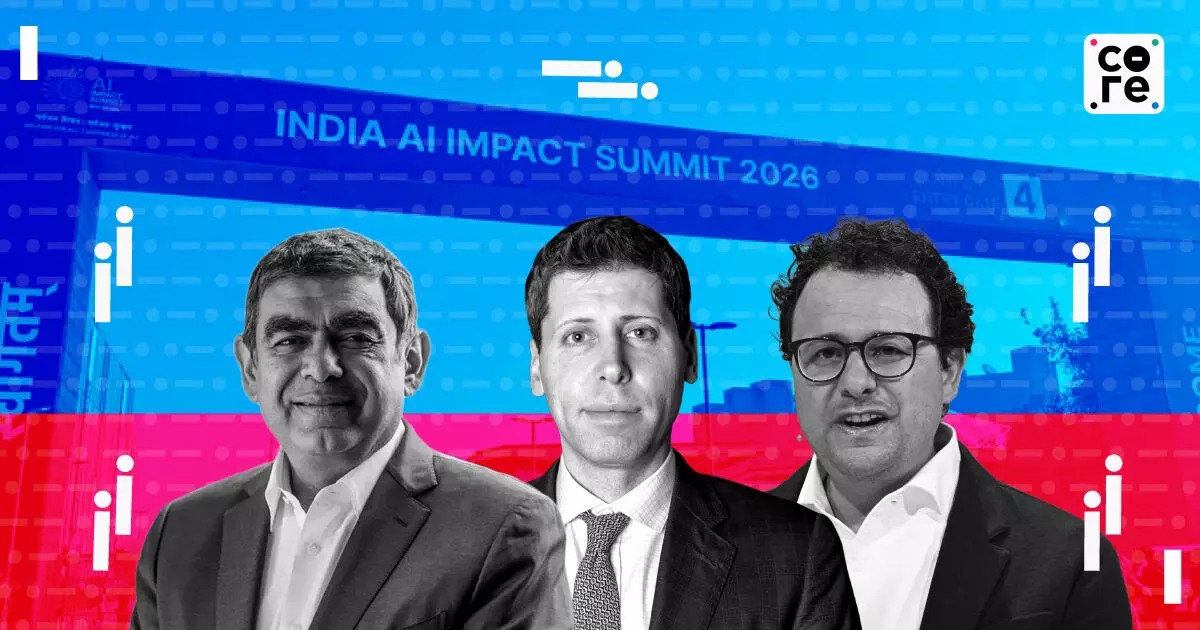
OpenAI’s Sam Altman, Vianai founder Vishal Sikka and Anthropic CEO Dario Amodei highlight rapid AI capability gains, enterprise productivity shifts and the challenge of translating progress into broad economic impact.
The Gist
Leaders at the India AI Summit discuss the duality of AI capabilities and adoption challenges.
- Sikka illustrated AI's efficiency by sharing examples of reduced project timelines.
- Amodei highlighted the slow integration of AI in enterprises despite advanced models.
- All speakers agreed on the importance of addressing safety risks and ensuring equitable access to AI technology.
Artificial intelligence’s explosive productivity gains, alongside safety concerns and uneven adoption, dominated discussions at the India AI Summit 2026, where Sam Altman, Vishal Sikka and Dario Amodei laid out a shared narrative of transformation tempered by friction.
Speaking at the summit, Altman described the pace of AI progress as unprecedented. “We’ve gone from AI systems that struggle with high school-level math to systems that can do research-level mathematics now and derive novel results in theoretical physics,” he said, adding that early forms of superintelligence may emerge within a few years.
Altman said such progress could fundamentally reshape the global economy. “If we are right, by the end of 2028, more of the world’s intellectual capacity could reside inside of data centres than outside of them,” he said, while noting that falling costs in healthcare, education and manufacturing could drive faster growth.
At the same time, he warned that disruption to employment is inevitable, saying, “It’ll be very hard to outwork a GPU in many ways.”
The Productivity Inflexion
Sikka reinforced the productivity shift through enterprise examples that illustrated AI’s immediate impact on knowledge work and decision-making.
“People who know what they are doing with AI are astonishingly effective with AI,” he said, recounting how a developer rebuilt a large public service alone in 14 days using generative coding tools — work that previously required a 15-member team over nine months.
In another instance, AI-driven analysis enabled a distributor to make a major market exit decision in days rather than a year. “We now have instant access to knowledge in any language… it is an incredible power,” Sikka said, adding that the technology is deeply disruptive but also enables unprecedented capabilities.
Diffusion Gap: Capability vs Adoption
Amodei added a complementary perspective, highlighting a growing gap between AI capability and real-world adoption.
“There is this duality between the fundamental capabilities of the technology and the time that it takes for those capabilities to diffuse into the world,” he said.
While models are already strong in areas such as software engineering and biomedical innovation, Amodei said organisational frictions continue to slow enterprise integration.
“Even if we freezed in place what the technology was capable of today, I think the economic impact could be much greater than it is because it just takes time,” he said.
His observation echoed Sikka’s emphasis on bridging the gap between language models and enterprise users through trusted, reliable systems. Sikka argued that overcoming limitations such as hallucinations and a lack of real-world understanding is essential to unlock business value.
Safety, Governance and Economic Disruption
Beyond productivity, all three leaders emphasised risks. Altman argued that the democratisation of AI is critical to prevent excessive concentration of power.
“Centralisation of this technology in one company or country could lead to ruin,” he said, calling for global coordination mechanisms similar to nuclear oversight frameworks.
Sikka described safety as an existential issue, warning that autonomous agent swarms could behave unpredictably without robust controls. He also pointed to the enormous energy consumption of AI infrastructure, arguing that future systems must become far more efficient.
Amodei echoed the safety concerns, saying, “We need to make sure that AI systems are safe and predictable and autonomously behave in a way that’s under our control,” while highlighting economic displacement as a key risk even as AI expands overall growth.
India As A Testbed for Inclusive Growth
All three speakers positioned India as central to the next phase of AI adoption. Amodei described the country as a key example of how diffusion could unlock broad benefits. “In the global south, there’s an opportunity for AI to accelerate catch-up growth,” he said, adding that the upside may be larger in emerging economies despite persistent risks.
He linked that potential to India’s digital public infrastructure efforts led by Nandan Nilekani, arguing that such foundations help ensure broad access to technology. Amodei also pointed to rising developer enthusiasm, noting that coding usage of Anthropic’s models has doubled in India in recent months.
Altman similarly highlighted India’s role in shaping AI’s future, citing strong student adoption and developer activity, while Sikka emphasised the country’s entrepreneurial potential. “India has all of this in great abundance,” Sikka said, referring to talent, imagination and the ability to build new AI-driven systems.
Shared Outlook
Taken together, the remarks outlined a consistent theme: AI’s productivity impact is already visible, but the pace, safety and inclusiveness of its diffusion will determine long-term outcomes. As Altman noted, “The next few years will test global society as this technology continues to improve at a rapid pace,” underscoring the balance between opportunity and responsibility that defined the summit’s discussions.