



 Newsletter
 Search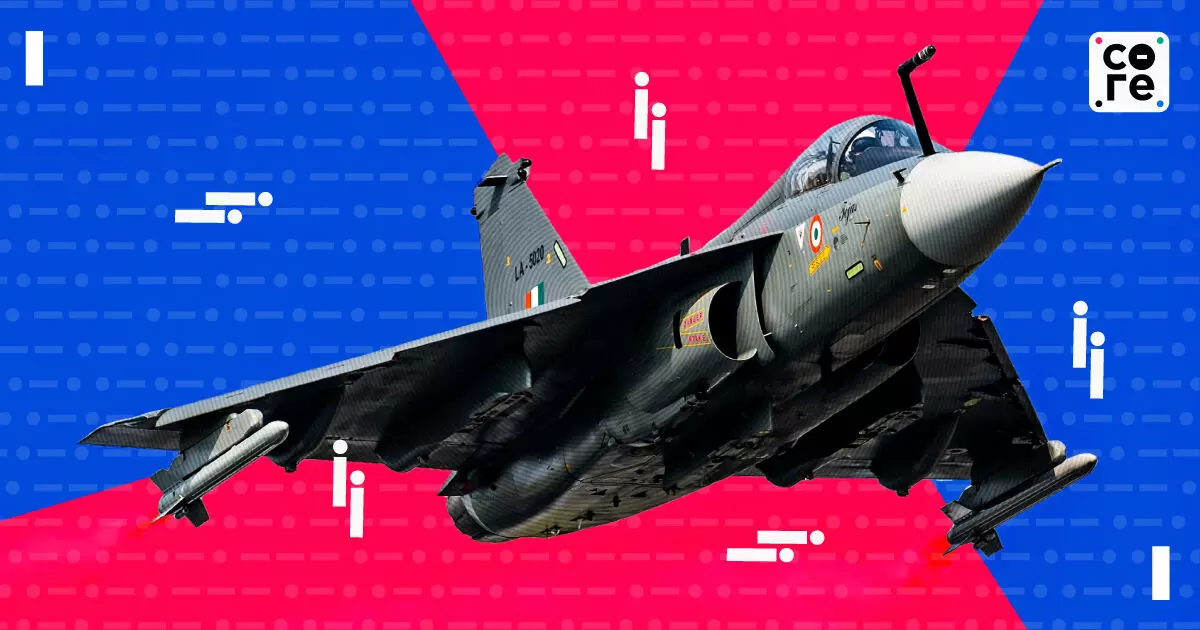
Dubai Tejas Crash: Spotlight Back On Defence Privatisation

Dubai’s Tejas crash highlights bureaucratic setbacks to indigenous defence. As drone warfare rises, India must prioritise strategic manufacturing for security.
The Gist
The disparity between India's space achievements and its defence sector struggles is highlighted by the contrasting histories and operational structures of ISRO and Hindustan Aeronautics Limited (HAL).
- ISRO operates with more autonomy compared to HAL, which has been government-controlled since 1942.
- The recent crash of a HAL-manufactured LCA Tejas at the Dubai air show raises concerns about India's defence production capabilities.
- Despite advancements, delays in the Tejas program reveal the long-term impact of weak leadership and a lack of privatisation in defence.
I asked a former head of the Indian Space Research Organisation (ISRO) why, all other things constant, India’s space programme has much to show and boast of as compared to our efforts in defence, which has, to put it most mildly, struggled in comparison.
His answer was a smile and a question in return, which I could paraphrase as, “Why do you think so?”
Whether it was bureaucrats or bureaucracy, the answer was in many ways self-evident.
India’s Aircraft Story
Everything has context. ISRO was created by Vikram Sarabhai, a gifted physicist who hailed from a successful business family.
India’s first aircraft manufacturing firm, Hindustan Aircraft, as it was then called, was also set up by a businessman, Seth Walchand Hirachand, in December 1940, as a partnership with the princely state of Mysore.
However, in 1942, it was taken over by the government, which took full administrative control in 1951. The company made aircraft for the Indian Air Force, as it does now.
ISRO was always an arm of the government but functioned then and now, more autonomously.
Which brings us to the present.
The Dubai Debacle
Last week, a Hindustan Aeronautics Limited (HAL)-manufactured light combat aircraft (LCA) Tejas crashed at the Dubai air show. The Dubai show, incidentally, is considered the third largest after Paris and the UK’s Farnborough.
The reasons for the crash, which saw the unfortunate demise of an Indian Air Force (IAF) pilot, are not fully clear as of now. What is clear is that the fighter jet, which was also on display for export orders, is not likely to see a rush for them, at least for a while.
The LCA Tejas programme highlights once again what India has lost by not privatising its defence sector sooner. Or, conversely, by not letting Hindustan Aircraft continue as it was set up.
This is, of course, perfect hindsight.
But the long-term damage of weak leadership in our defence production and the strategic approach to it is hurting us.
The Tejas programme began in the 1980s as India tried to replace the vintage Soviet-origin MiG-21s — the last of which retired as recently as September.
The government-owned HAL has 180 of the advanced Mk-1A variant on order domestically but is yet to begin deliveries due to engine supply chain issues at GE Aerospace, a report in Reuters summed up.
LCA Tejas is described by HAL as a 4.5 generation, all-weather and multi-role fighter capable of offensive air support, close combat and ground attack roles apart from ground maritime operations.
However, it seems that the aircraft has not actually participated in any of these situations in a combat environment, which would stress test the capabilities of man and machine.
Lost In Procrastination
Shekhar Gupta, Editor of The Print, wrote in his column over the weekend that the project has been caught in a seven-decade technology race.
The project was cleared in 1983. It took 18 years to take its first flight, having been named Tejas by former Prime Minister Atal Bihari Vajpayee. It took another 15 years for initial operational clearance, and another four for full operational clearance.
The story continues, he writes.
The unfortunate part of this story is that we have tried to import substitute in an area where we could have done better by importing the best in the world.
Remember, your enemy does not award you brownie points for turning up in a homegrown product. And while importing defence equipment of any kind is fraught with political risk, that is not a reason to not do it.
Drones To Our Defence
Defence analysts, of which there are many, are better qualified to go into why we don’t have state-of-the-art fighter jets or equipment. But, the Dubai crash only highlighted the need to speed up and, or, let go.
To be fair, India has now increasingly brought in private sector participation into defence, particularly in recent years.
Many private drone companies are now supplying to India’s armed forces.
Though the use of drones in warfare is something that no one could have predicted. Least of all the many Indian drone companies that started out building for applications like surveillance, mapping and agriculture.
But it does feel like there is a long way to go before catching up in terms of cutting-edge defence or fighter jet technology.
Unless the parameters of war change completely, and we leapfrog by default rather than by design.
And that too is happening.
The Hindustan Aeronautics website defines the LCA Tejas as dimensionally smallest, with an excellent flight safety record and a remarkable achievement of accident free flying.
The website may or may not get updated, post Dubai, but hopefully our approach to defence, in the literal sense, will.
Core.
Core.


