



 Newsletter
 Search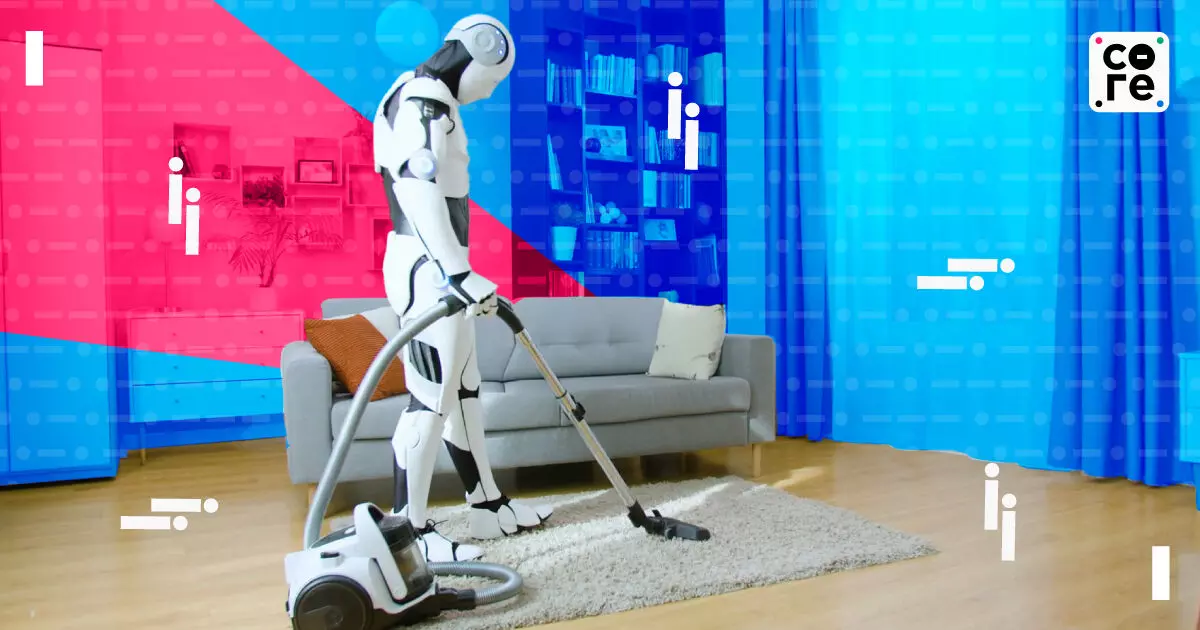
AI Comes For White Collar Jobs, Robots For Blue Collar Jobs

In the near future, robots may replace domestic help, transforming homes while potentially causing job losses across lower-income sectors.
The Gist
Domestic help in India faces competition from robotics, prompting discussions on job displacement.
- Domestic workers, often seen as family, perform essential tasks like cleaning and dishwashing.
- With advancements in robotics, menial jobs in homes and factories are increasingly at risk.
- Policymakers are attempting to address these changes while the workforce is being reskilled to adapt to the evolving job market.
A ubiquitous part of many middle class Indian homes is domestic help. For many, they are an extended part of the family.
The help’s principal job is to sweep, mop and wash dishes.
There is considerable discussion about AI taking away jobs. In all probability they will, though the extent of it is not clear. The industry is nevertheless gearing up for this shift in many ways, including by reskilling its workforce. And the policymakers are attempting to frame policies to address it.
Robots Take Over Factories
Yet, another kind of job is increasingly under threat and less discussed. That’s the menial, repetitive physical tasks, both in factories and at homes. Like factory workers who pick, sort, pack, label and place or retrieve goods or the househelp who sweeps, cleans and washes dishes.
An upcoming wave of robotics that are getting more sophisticated and accessible at the same time; could cause tectonic shifts in this segment of the job market.
Domestic work is classified as ‘informal’ by the Periodic Labour Force Survey. There are 4.75 million domestic workers in India, as per official statistics. Only 10 of the 31 states and Union territories in India have included domestic workers in the schedule of Minimum Wages Act.
The numbers don’t seem that high but official estimates are contested and the figures suggested can range up to 10 times.
Meanwhile, data from the Annual Survey of Industries put together by portal dataforindia says over two lakh operational factories of India employed 18.5 million people as of 2023.
This represents about 30% of the manufacturing workforce, and 3% of India's workforce as a whole.
They are the people who are directly part of the manufacturing process, and thus stand to be affected, as per my understanding. Though this has already been happening for a while now.
Visit any modern car plant, even in India, and you will see robots having taken over many tasks done by human hand a few years ago.
A Million Robots & More
Companies like Amazon are driving change at scale.
The e-commerce giant started a big thrust into robotics in 2012, when it paid $775 million to buy the robotics maker Kiva.
Thanks to which robots now roam Amazon’s warehouses, which are becoming more sophisticated by the day, almost.
In two years time, Amazon will avoid hiring 160,000 more workers, according to an NYT Report. Eventually, it believes it can automate up to 75% of the company’s operations.
In June, as Professor Scott Galloway, author and professor of marketing at NYU Stern School of Business points out, Amazon deployed its millionth robot worker putting the company on pace to have more robots than humans in its warehouses by year end.
Amazon employs over 1.5 million people globally and recently announced it was cutting around 14,000 corporate jobs. Professor Galloway believes reduction in warehouse workforce is imminent.
Amazon is not alone, DHL is among the many logistics companies that is increasingly roboticising its warehouses which serve customers in the ecommerce and other spaces.
Conversely, most robotics innovation right now is actually aimed at warehouses and logistics.
The Rise Of The Humanoids
Which brings us back to homes.
Maya Cakmak, professor at the Paul G. Allen School of Computer Science & Engineering at the University of Washington in an article for the Institute of Electrical and Electronics Engineers recently wrote that if machines could match human form and function, they could simply step into human jobs without requiring us to change our environments.
She was referring to humanoids, the next level so to speak. It is also Elon Musk’s grand vision and promise for Tesla. Yes, he has already moved on from cars.
If humanoids could do everything people can, then in theory they could replace workers on the factory floor or in warehouse aisles.
It’s no surprise, then, that many humanoid companies are targeting what they believe are sectors with labour shortages and undesirable jobs—manufacturing, logistics, distribution, retail—as near-term markets.
Robots Make A Clean Sweep
Cakmak says, it is factories first, homes next. A subset of humanoid companies see homes as the next frontier.
There are several examples and prototypes floating around.
Some companies, she says, claim humanoids will revolutionize “assisting individuals in the home” and “caring for the elderly and in cases vacuuming, serving tea, wiping windows and tables, and carrying laundry and grocery bags”.
Speaking of vacuuming, the machines are already here, right in many homes across India.
An article in Times of India quotes retailers and companies like Eureka Forbes saying sales of robotic vacuum cleaners; Roomba is a popular one; rose dramatically in the last two years.
The reasons range from unavailability of domestic help to convenience.
The TOI article quotes a Pune resident saying she bought a robotic home cleaner online last year because it was tough to get househelp to come at a convenient time.
Another consumer says robotic cleaners were available only overseas but now cheaper ones, including those around Rs 15,000, are available in India.
From experience, robotic vacuum cleaners which sweep and mop floors autonomously are quite effective.
The Robotic Hand That Helps
It is evident that the cost will come down, the intelligence driving these machines will improve as will the machines themselves. Thus, over a long term, they can reduce the need for manual labour.
So while humanoids are still some time away, robots are already taking over individual components of our physical work like the vacuum cleaner. Or robotic lawn mowers in countries like the United States where homes typically have large lawns.
Dish washers and washing machines are not exactly robots but they also reduce levels of labour for most households.
But between factories and homes, robots will undoubtedly start taking away or taking over jobs and potential jobs in India.
One way to look at it is that this forces labour to seek more value-added jobs. That is feasible and possible and of course desirable; but the transition is not that simple in a country like India.
Between robots and AI, there are massive challenges on the horizon, something that we are not fully prepared for or are in a position to respond right now.
Thinking about robots and their impact on the workforce is a good place to start.
Core.
Core.


