

Maruti’s EV Gamble: Can It Dent The Market Despite Late Entry?
The market it enters is slow-moving and crowded. Competitors like Tata Passenger Electric Mobility, JSW MG Motor, and Mahindra & Mahindra have already established a lead, catering to early adopters and building proprietary ecosystems.
The Gist
Maruti Suzuki, once hesitant to enter the electric vehicle market, is launching its first eVitara SUV in India amidst a competitive landscape.
- Chairman RC Bhargava previously viewed EVs as niche and costly but now aims to expand into the market.
- The company has exported over 16,000 EVs globally and plans to increase its footprint to 100 countries.
- Maruti's strategy includes a focus on competitive pricing and localisation to address market challenges.
Until a couple of years ago, Maruti Suzuki wasn’t too keen to enter the electric vehicle (EV) market.
RC Bhargava, the company’s chairman, had brushed aside the urgency to join the EV race, calling the segment niche and citing the prohibitive costs of lithium-ion technology. His preference was hybrid cars, which he argued offered a more practical route to reducing carbon footprints in a developing economy.
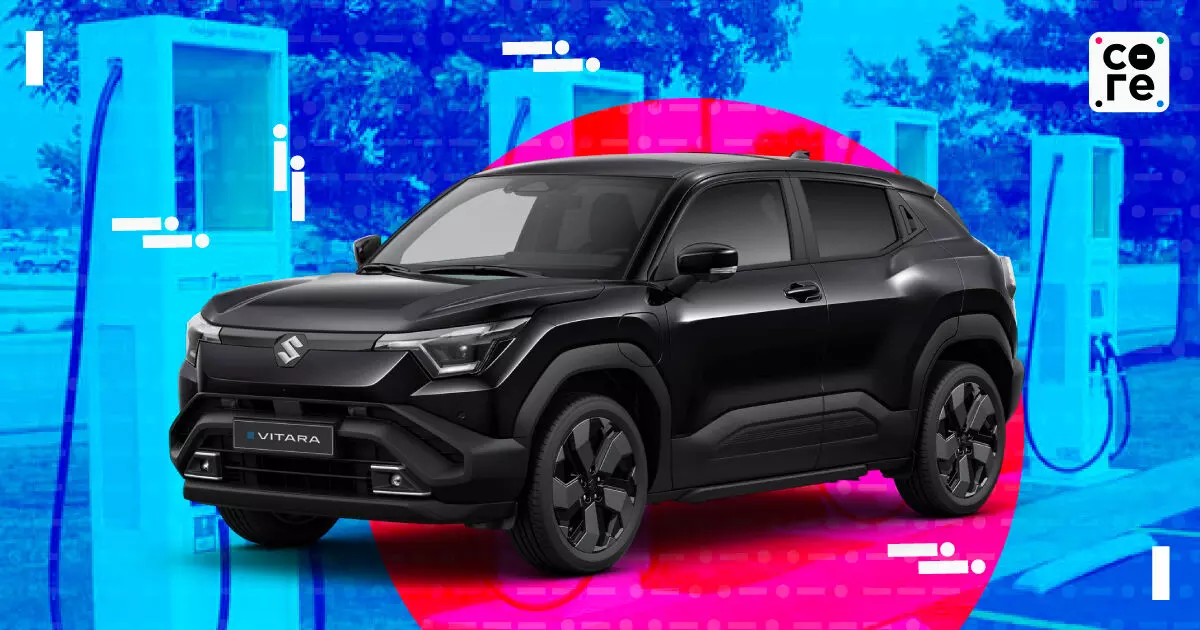
The Japanese carmaker is now on the threshold of rolling out its first electric vehicle, the premium eVitara SUV, in India’s domestic market. Set to launch early this year, the e-SUV faces a daunting challenge. Maruti, a brand built on being everywhere at once, is uncharacteristically late to the EV race.
The market it enters is slow-moving and crowded. Competitors like Tata Passenger Electric Mobility, JSW MG Motor, and Mahindra & Mahindra have already established a lead, catering to early adopters and building proprietary ecosystems.
“There is always someone coming before you. That doesn’t mean you are delayed,” Bhargava told The Core.
The Export Buffer
Bhargava’s confidence is backed by strategy that looks beyond India. Maruti began exporting the eVitara in August last year, using international markets as a testing ground before the domestic launch.
The numbers suggest a steady start. To date, Maruti Suzuki has exported over 16,000 EVs to 36 countries, including those in Europe. The goal is to scale that footprint to 100 countries across Europe and Japan. This global volume is intended to shore up total sales of the electric SUV while diversifying the company’s revenue stream.
Domestically, Maruti's challenge will be more than just about volume, it will also be about market share. Maruti currently holds a dominant share of 40% of the total passenger vehicle market as of December 2025 (FY26), with sales of 1.32 million vehicles. Its nearest rival, Mahindra & Mahindra, sits at a distant 14%. But in the EV segment, these numbers are reversed. Tata Motors is the market leader in the EV segment with a share of roughly over 40%.
Hedging Risks
Maruti’s strategy to dent the local market involves a calculated hedge. According to Suzuki’s mid-term plan for 2025-30, the carmaker will roll out four electric models by 2030. Even then, electrics are only expected to contribute 15% of Maruti’s total product portfolio.
Hybrid electric vehicle (HEVs) combinations with petrol will chip in with a 25% share of the product pie, with other powertrains like CNG, petrol and flex-fuel bringing up the rear.
This approach aims to meet the twin goals of carbon neutrality and climate change, while retaining its cost-conscious buyers who have made Maruti a household name, with its small cars.
Pricing Wars
To crack the EV market, Maruti is leaning on its historical strength, which is value for money. The e-Vitara SUV is expected to be pitched between Rs 15 lakh and Rs 20 lakh (ex-showroom).
Pricing is key in Maruti’s strategy to undercut competition. For comparison, the e-Vitara’s badge-engineered sibling, shared with Toyota Kirloskar Motor, is likely to be priced at around Rs 18 lakh and Rs 22 lakh (ex-showroom). The Toyota Urban Cruiser Ebella was revealed by Toyota on January 20.
Most other rivals are priced higher than the prospective pricing of the eVitara:
- Mahindra BE6: Rs 18.90 lakh and Rs 26.90 lakh
- Mahindra XEV9e: Rs 21.90 and Rs 31.25 lakh
- Hyundai Creta: Rs 18.02 lakh and Rs 24.39 lakh
- Tata Harrier Electric: Rs 21.49 lakh and Rs 28.99 lakh
- Tata Curvv Electric: Rs 17.49 lakh and Rs 22.24 lakh
(All ex-showroom)
The pricing strategy will reflect whether Maruti is in the electric segment for the long haul or if it's just a launch, said an industry expert.
Localisation Hurdle
Maruti’s gameplan to crack the EV market is to step up localisation of the electric powertrain and battery pack in a phased manner. This will enable competitive pricing for the EV, especially as Maruti Suzuki has always been a value-for-money brand.
A major hurdle to that aggressive pricing is the lithium-ion battery pack, which accounts for roughly 40% of the cost of an EV.
Battery cells alone make up 80% of that figure. Currently, these cells are imported because the rare earth materials required are sourced primarily from China, a supply chain that remains volatile. Last year, China imposed restrictions on rare earth magnets following US tariff hikes, causing a global shortage.
The government’s production-linked incentive (PLI) scheme is extending incentives to vehicle manufacturers to localise the manufacturing of EVs and their components. Maruti Suzuki is among the companies approved under the PLI scheme for both programmes, but it must hit that 50% threshold to unlock the subsidies that would help it expand its market reach.
Scaling The Premium Wall
The eVitara enters the premium SUV segment (vehicles priced above Rs 16 lakh), which is relatively small. The segment is estimated to have an annual volume of just 70,000 to 75,000 units.
“So the challenge for Maruti will be scaling up numbers,” said Puneet Gupta, director, automotive, S&P Global Mobility. A major issue, he said, is that the eVitara is not unique (read radical), in terms of design or features, compared to rivals, so its impact on the market could pose a challenge.
However, Maruti Suzuki’s competitive edge will remain its dealer and charging network. “That will be the biggest differentiator. It addresses one of the key anxieties in adopting electric mobility as an individual,” said Avik Chattopadhyay, co-founder of Expereal India, a branding and marketing strategy consultancy firm
Building The Ecosystem
Maruti has announced plans for 1 lakh public charging points by 2030. To date, it has partnered with operators to install 2,000 chargers across 1,100 cities, with a specific focus on placing a charger every 5 to 10 kilometres on major highways.
A Maruti dealer says that the company has set up charging points at dealer workshops where a dedicated bay for the eVitara has been earmarked.
Technicians, sales staff and the managerial team have been undergoing a three-day training at the company office for the last six-seven months to ensure a smooth transition to EV sales, and to address customer doubts on the EV as well as provide after-sales support.
The Road Ahead
Maruti’s entry can give a fillip to the electric vehicle category since it is the market leader with an extensive consumer reach.
“Once Maruti starts selling the eVitara, they can turn around the whole EV story,” said Gupta, adding that the Japanese carmaker can explore a strategy for marketing their EVs through a separate network similar to Tata Motors.
While the eVitara is Maruti’s first electric model, the real shift may come with more affordable products. Currently, only the Tata Punch, Tiago EV, and MG Comet occupy the bracket below Rs 10 lakh.
“Only Maruti Suzuki has the heft to offer mainstream pure-electric vehicles below 10 lakh rupees to bring large-scale adoption,” Chattopadhyay said. He also pointed to fleet sales — government agencies and public transport — as a massive potential segment for Maruti.
While Maruti has not disclosed the production volumes that it is targeting from its Gujarat manufacturing facility for the e-Vitara, an auto analyst believes the Japanese carmaker is positioning the e-Vitara more for exports than the domestic market.
“However, as a display of Maruti's technology prowess, even if the brand does 1500-2000 units per month, it is a good bet,” he added.
Further Challenges
The broader market environment also remains volatile. After the GST 2.0 tax changes, the price gap between traditional internal combustion engine (ICE) cars and EVs has narrowed. Small petrol cars (under 1200cc) now see a GST of 18%, down from 28%, while EVs remain at 5%.
However, Partho Banerjee, senior executive officer, marketing and sales of Maruti Suzuki, cautioned that EV penetration may actually be dipping. “EV penetration will grow when households start buying it as their primary car. At present, it is bought more as a secondary car,” he said.
With the eVitara offering a range of up to 500km on its 61kWh battery pack, Maruti is betting that it can convince the Indian consumer to make the switch. In a market where EV share rose from 2.1% in 2023 to 4% in 2025, the battle for supremacy is just beginning.
As Sam Fiorani, VP of global vehicle forecasting at AutoForecast Solutions, puts it, “With the Maruti Suzuki eVitara just hitting the European market, its debut has been good.”