



 Newsletter
 Search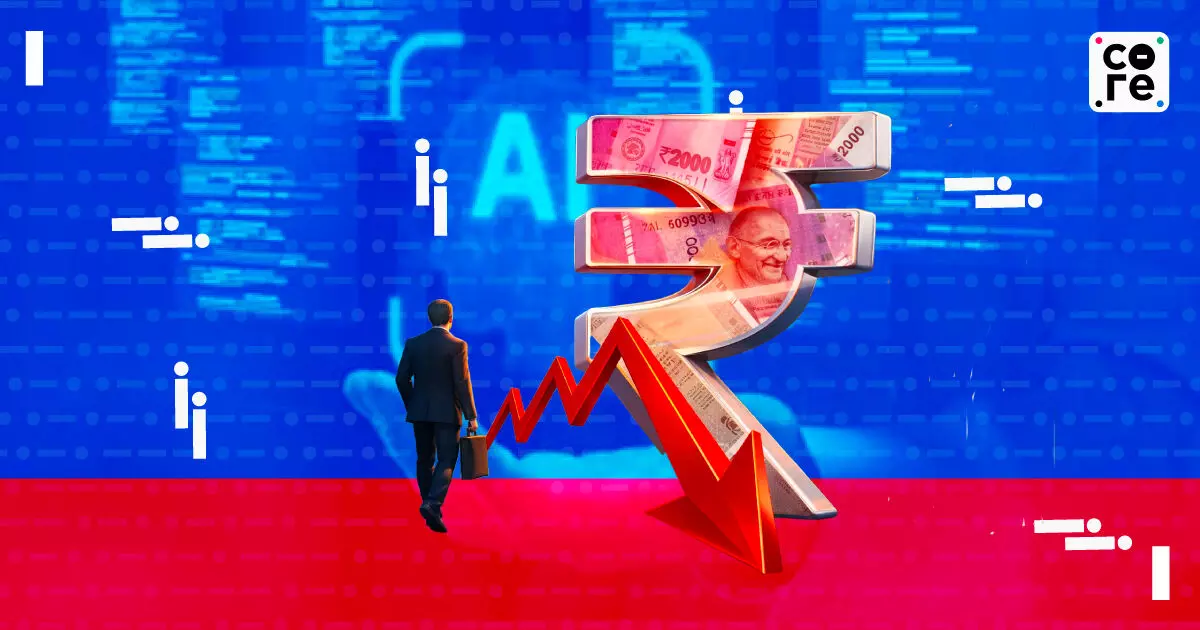
From Boon To Bane: How Predictability Is Costing Indian IT In The Age Of AI
Market experts warn that Indian IT majors may have prioritised quarterly guidance over a decade of disruption, leaving them stuck in a transition zone as GenAI matures.
Indian software services’ predictable earnings and guidance—once a boon for investors—may have become a bane in the age of AI. Experts believe these companies could have pivoted sooner to match the supercharged execution speeds AI promises.
“If you look at the last five to seven years, IT service companies’ predictability in terms of earnings growth and guidance was impeccable. Now with AI and huge development in disruptive models, the markets are confused. Investors are now asking – did you miss the next decade for the next quarter?” said Vishal Kampani, vice chairman and managing director of JM Financial, on the sidelines of the launch of JM Financial Hurun India’s Unlisted Gems 2026.
A fifth of the Nifty IT’s value vanished in February as Anthropic and OpenAI released new generative models. Fears of AI-driven revenue deflation triggered a sharp crash; in eight days, Rs 6 lakh crore was wiped out, with blue chips like TCS, Infosys, HCL Tech, and Wipro losing 13–21% in value.
Stuck In A Zone
“IT service companies have the smartest management teams. I am confident that they will pivot. But their traditional revenues are significant and while AI revenues are growing very fast, their base effect is small. It will take some time for the plateau in traditional revenues to be offset by AI revenue. That’s the zone they are stuck in,” adds Kampani.
Kampani believes it will take a year or two for clarity to emerge. Other experts agree that the "haze" around AI’s success in enterprise solutions—and its effect on Indian IT—needs time to clear.
“A possible question is whether GenAI models can be trained specifically for each task category. This is possible and is currently being undertaken by Frontier AI labs and various GenAI startups. We do not have a definite answer currently. We expect better clarity in the next 1-2 years as we get a better picture of the costs and benefits involved,” said a recent report by Kotak Institutional Equities
Existing With AI
Research firms believe AI is not a direct threat, as IT majors can become execution partners. While consumers drive AI consumption, enterprises are focused on how AI aids productivity.
“Indian IT companies can be partners to global enterprises as their clients to legacy systems plus AI. The senior CEOs of IT service companies are deeply introspecting on it,” said Sonia Dasgupta, MD & CEO of investment banking at JM Financial.
As clarity emerges, IT companies’ valuations might be stuck in a narrative war, reports suggest. “The concerns are due to the rapid pace of development of frontier GenAI models and agents, especially in software engineering and the assumption that improvement in capabilities is generalizable to other IT services segments. The risks are understandable, though overstated. Deflation, in our view, can also co‑exist with healthy enterprise tech spending,” said Kotak Institutional Equities.
An HSBC report adds that enterprise-class software has evolved over decades to be almost error-free with high throughput and reliability. It believes that software will be the primary mechanism for the diffusion of AI across the world’s largest enterprises.
“Foundation AI models are inherently flawed, technically, and are not suited for a ‘lift-and-replacement’ of major software platforms. While there are limited cases where this is appropriate, like an image creation program or small software app, this is not realistic for the majority of high-fidelity enterprise class platforms, in our view,” HSBC adds.
In a separate event on February 24, IT industry body Nasscom leaders said that AI might shrink deal sizes but can also expand the opportunity. Nasscom vice president Srikanth Velamakanni, and the co-founder of Fractal, highlighted that AI-enabled tools can bring down the cost of code. He said that a billion-dollar project could effectively become a $100-million project.
Private Can Pivot
Kampani used IT as an example of why private companies are often more agile. “If the environment changes, a private company can pivot faster and go public later in a new avatar,” he said.
“If the business environment changes, a private company has the advantage of pivoting. And can go public in a new avatar,” he adds.
Reliance Retail topped the 100 Unlisted Gems List with revenues to the tune of Rs 2.7 lakh crore. It’s followed by Flipkart with revenues of Rs 83,105 crore, followed by Malabar Gold at Rs 66,872 crore. The 100 companies in the list clocked in revenues of Rs 8.9 lakh crore in 2025, growing at a compounded annual growth rate (CAGR) of 15.2% in two years.
Core.
Core.


