



 Newsletter
 Search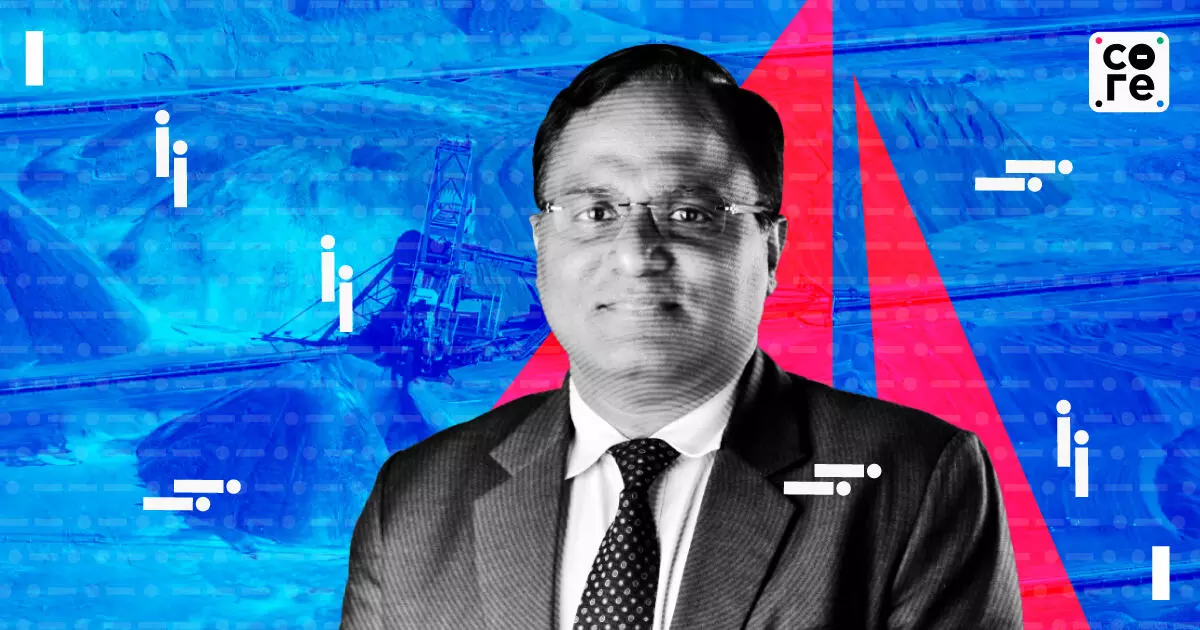
India Sees New Promise In Rare Earths And Oil
- Business
- Published on 20 Dec 2025 6:00 AM IST

In this week’s The Core Report: Weekend Edition, Govindraj Ethiraj speaks with Dr. Ranjit Rath, chairman and managing director of Oil India on India’s push into rare earths and critical minerals, combining exploration, processing and public-sector coordination to cut dependence on China.
NOTE: This transcript contains the host's monologue and includes interview transcripts by a machine. Human eyes have gone through the script but there might still be errors in some of the text, so please refer to the audio in case you need to clarify any part. If you want to get in touch regarding any feedback, you can drop us a message on feedback@thecore.in.
Doctor, thank you very much for joining me. It's been a year since we last met. So let me pick up on two things. One is what we spoke about last time and what we did not speak about last time. So what we did not speak about last time, which is clearly in the news now, is critical minerals. So why has critical minerals become so important in the larger context of where we are as a country and for Coil India Ltd?
Govind, it's always a pleasure speaking with you. And yes, it's been a year before we made the last IEW edition, while we are all waiting to see this year's, not this year's, 2026 IEW. Once again, greetings on behalf of Oil India Ltd.
Critical mineral, as you know, is called critical because it's very, very important as part of both the supply chain and the sourcing and then the processing and then its usage across the domains within the economy. Whether you call it as health, you take Department of Space, you take our space research, you take our defence, you take our medical systems, you take our mobility purpose, you take our communication, everywhere you have these small critical elements useful, whether it is lithium, cobalt, nickel, vanadium, graphite, blah, blah, blah. As far as Oil India is concerned, you are right, last year we didn't talk about it.
We were about to diversify. Under the National Critical Mineral Mission, which Government of India has rolled to enhance our exploration efforts in critical minerals, our production efforts in critical minerals, our overseas collaborations in critical minerals, Oil India being an E&P company primarily focused on exploration and production, we saw that there is a commonality of exploration in critical minerals. As we do exploration for oil and gas, we saw that same exists for critical minerals, a select few.
So, out of the identified 24, we have shortlisted about 8 of them. And basis, we also had another shortlisting parameter, we said wherever we have our area of operation. So, as we speak, we have got two blocks, exploratory blocks, it's in composite licence mode, unlike the oil and gas block.
One is a graphite and vanadium block in Arunachal Pradesh, near Itanagar, a place called Pope. About 5 million metric tonne of reserves in terms of graphite and 5 million metric tonne of reserves of vanadium. It's a composite licence.
We will do exploration, establish its economic viability and then take up mining. Similarly, for a first time in the country, we have also picked up one potash block, which is a 100% import substitution opportunity in Hanumangad in Rajasthan, where we have got access to about 25 to 26 million metric tonne of potash. So that is also an exploratory block now and it will be a composite licence.
Once we establish how the mining process will happen, we will get into production. So that's the thing as far as domestic critical mineral ecosystem is concerned. Currently, the Trench 6 is underway.
We are evaluating a couple of more blocks. But in addition to this, as we are scouting assets overseas for our oil and gas, we are also scouting assets overseas in critical minerals in collaboration with Kabil, that is Khanis Bidas India Limited. It's a JV promoted by Ministry of Mines, where Oil India has collaborated.
We are looking at geographies like Australia, Argentina, Bolivia, Chile and African continents. So that's the critical mineral story for Oil India.
Right. So let me start with graphite and vanadium that you talked about. So graphite is something that one encounters or comes across. Tell us about vanadium. Tell us about potash. I mean, where do they fit?
Potash is one of the major input for your fertiliser. So today you are import dependent on that.
And why are we import dependent on that?
Because potash is not available in the country so far. It is not yet mined so far.
And is that because of the cost of mining it?
It has not been done before. It was never been auctioned. This was lying at a depth of about 500 to 600 metres.
So it was never been attempted. So we thought we will take a pioneering step. Two ways of looking at it.
The drilling component for exploring potash and the harvesting of potash, there is a commonality of the way we drill in oil and gas. And there is a commonality of doing work over in such solution mining. Should we decide to go for solution mining in potash?
Or if we go for a conventional mining, then it's a normal mining. But there is a commonality of approach. As far as Itanagar graphite is concerned, we feel that northeast is a place where we have a significant presence and a lot of data that is available with us in terms of seismic.
That's we do otherwise. But recently we have acquired about 40,000 square kilometre of advanced airborne gravity radiometry data, basis Government of India's campaign. So we thought those data could be an input for such exercises.
And of course, we have got a very good collaborative framework with Geological Survey of India. Therefore, these inputs are helping us to zero down. So we were very choosy in selecting which blocks to be taken.
And then we participated in auction and we wanted to win. As far as vanadium is concerned, while its utility is very well established, what is important is to establish the process flow diagram of this vanadium. So we are collaborating with CSIR lab, say IAMT and NML.
We are also collaborating with Indian Bureau of Mines. We are also collaborating with global players to establish the process flow diagram. And then we will take it forward.
But the first is being an exploration company, we are taking off drilling and exploration of these assets.
So I'll come back to the drilling and exploration. But you know, when we talk about minerals and rare earths, usually they're spoken of together. And obviously the world's attention has been focused on rare earths because of China and the fact that they've been holding back exports to most countries, including India. So tell us about where rare earths fits in the overall critical minerals outlook.
Rare earths is just another critical mineral. It's a group of minerals. They are primarily occurring in shallow, but a very typical geological setting.
Till now in the country, there was a focus on bulk minerals and hydrothermal minerals. So we were currently, we were earlier focused on limestones, bauxites, iron ores, manganese and hydrothermal is copper, lead, zinc and black. So the thrust on rare earths and critical minerals literally happened last four years or so.
There is something, a concept called obvious geological potential areas with GSI maps. That mapping has already been done. There is a significant thrust from government of India as a two-pronged strategy.
One is enhanced exploration per se. So that GSI and under NCMM, National Critical Mineral Mission, certain identified public sector undertaking like OVL, Oil India, Coal India, then ONGCBJS Limited. Then we have the other Indian Rare Earths Limited and the Department of Atomic Energy.
So we are together pursuing this agenda of doing exploration. Simultaneously, government is also putting thrust because what is more important in this particular value chain is the processing part. So significant thrust is underway to acquire processing technology and also to encourage both private sector and public sector and the research organisations to work on the processing technology.
In the case of China, for example, it's not that they are producing all these minerals. It's that they're processing a lot of it, including, they're producing and importing raw material, processing and sending it back. So they have the processing capacity.
They have established a significant quantum of monopoly in terms of processing facility.
So let me come back to India and the path that you've taken. So if you were to look at this as a young geoscientist, would you say that basically I could now look at drill for anything that subsurface, including oil? Because what I would think is normally I set out to be an oil engineer or an oil man or a woman, and that's where my career takes me. But what you're saying now is that today your career could go in any direction. You could be drilling for minerals or you could be drilling for oil. And these are fairly distinct, at least from a user's point of view.
You are absolutely right. These are from a host rock point of view, certain minerals, they have a common presence. Say lithium. You could find out in sedimentary rocks where oil and gas resides.
It also occurs on hard rock where minerals resides. Potash, it is actually coexistence with oil and gas because the potash exploration that we intend to do in Rajasthan, we do foresee that there is a possibility of establishing presence of hydrocarbon there. So there is a commonality, there is an overlap, but probably this is the greatest time from a geoscience point of view to be able to pursue exploration in either of minerals because oil and gas is also a mineral.
So whether it is hard rock mineral, sedimentary rock mineral or liquid fuels, it's a very exciting period.
So if I were to ask you to sort of say where we are in the journey to achieving some level of optimum output and capacity in minerals, as a country first and then as Oil India Limited, where are we?
In minerals we are pretty advanced, whereas critical mineral is concerned, we have got a significant thrust today through international collaborations, through domestic efforts, but we have to cross a certain path, maybe a decade or so.
And in general, maybe one of the last questions on critical minerals before I come to exploration of oil. In general, what is the lay of the land when it comes to the world at large? You said Australia and Argentina and you mentioned Bolivia.
It's like this, if you look at lithium and lithium occurs in two formats, one is hard rock, Australia is full of it. The lithium brine, you have significant presence of lithium brine in Argentina, Bolivia, Chile, that's called ABC for lithium. But lithium is just one such mineral.
You have significant presence of lithium in America, in USA, in Canada, in Russia. Potash is available across the globe in select geographies. All the critical minerals, see oil and gas is just one portfolio.
Critical minerals from an India point of view, there is 24 of them and entire Africa is a destination for critical minerals. Even I would like to say through you to the August audience, India is also having enough of critical minerals. It's a matter of exploration and to prove it.
So significant work has kick-started. It's a matter of time we establish the resource pool.
So the bottom line or top line question. So we are importing more than 80 percent of our crude oil requirements and we're only able to produce 20 percent. I'm talking about crude oil, not natural gas and so on. When it comes to minerals, where do we stand in terms of what we are?
Minerals, it's across the scope. Like we have enough of bauxite, we have enough of iron ore, we have massive deposits of coal, we have massive deposits of limestone. The entire value chain is in place.
As far as critical mineral is concerned, our import dependency is on a very high order, touching 100. More in terms of the revolutions I would use, revolutions which is happening in EVs or in various other sectors, we are actually buying the finished products. So it will take time to establish the entire value chain.
So I mean my question I guess is that if we were to look a little ahead, could we achieve greater self-sufficiency in minerals, critical minerals, than we have achieved in oil because of what we have or we have been naturally endowed with?
I wish we have greater sufficiency across the value chain for all the natural resources because that's why exploration is very important. Whether you do it for critical minerals, you do it for REs or you do it for natural gas or crude oil. So the story remains the same that greater self-sufficiency is so important for us.
So let me come to oil now and crude oil. So one of the things that you've talked about this year particularly is the focus on deep water and ultra-deep water drilling as a way to enhance what is already there.
So and you also collaborated with Total Energies for that. So tell us about where that journey is.
As I speak, I think just to connect from last year's discussion, as I speak today we are drilling the third well in Andaman Nicobar shallow water offshore basin, Kerala Konkan shallow water offshore basin. The both deep water acreages in KG and in Mahanadi which we acquired during the OLP 9 round because last time I had not talked about it. We got the petroleum exploration licencing awarded to us in the month of April.
And as we speak, two of the vessels are currently suiting for us and for acquiring 3D seismic data 5000 square kilometre. And we foresee going forward these deep water blocks in Mahanadi and KG going to be the mainstay of our exploration because we have done a substantial amount of petroleum system modelling studies. As far as Andaman is concerned, you rightly said on the second well and I reiterate on the second well of Oil India's effort on in Andaman Nicobar, we have established occurrence of natural gas.
And I'm not saying or claiming it as a discovery considering the fact that you have to establish where is the source rock, where is the pathway and where is the entrapment. But one thing that we have established by virtue of this reported occurrence that petroleum system exists in Andaman Nicobar basin. And that's our achievement or an accomplishment.
While we are drilling the third well, we expect that a similar setup would provide us a similar kind of signature. We have also started our appraisal programme. The first second well where we have established natural gas, we could do it with 2D seismic lines.
And explain to us what that means.
When you do a 2D seismic line, you only talk about XY plane. And when you do it 3D, it's an XYZ block. So having established, now we want to establish what is the structure, where is the source rock, what is the likelihood of potential for that 3D seismic is a need.
So we have already identified about 300 square kilometre of area for 3D seismic. And we are going to drill an appraisal well to re-establish the potential. And the collaboration with Total is very, very significant for us.
And I must acknowledge and having discussed this, I must tell you, we have got tremendous amount of support from Honourable Minister of Petroleum and Natural Gas, Secretary PNG and entire ministry in navigating this process. So by virtue of this collaboration, we are looking forward to three things. One, Total is on board to help us in the appraisal process.
Two, Total by virtue of our collaboration with Total Energy, they are going to help us in pursuing all the seismic data acquisition for the deep water because that is where the story begins. Three, they are also going to help us in identifying the locations for drilling and helping us in the well design and overseeing the drilling process for those deep waters. Most importantly, as I speak, in West Coast, we also have now spotted a well in Kerala Konkan basin.
This is another shallow water, but our target is to reach 6000 metre. So this will be, if we are successful in terms of drilling, we will come back to the potential. This will be the deepest offshore well in this part of the globe.
So anything more than other oil majors have done, including OENC and others.
Yes. So that's 6 kilometres down from the sea bottom. We are targeting two horizons below the trap because we did and all these efforts of offshore shallow water, deep water and ultra deep water are backed by robust petroleum system modelling studies done both in-house assessment and global consultants. So all the locations that we have released for the purpose of drilling is vetted or reaffirmed by external consultants.
So, you know, many people felt, I mean, those who are looking at oil and gas from outside that, you know, we've run out of options. I mean, we are drilling what we are drilling and we are flogging existing wells and maybe we'll find a few more here and there, particularly talking about the Indian subcontinent.
But it was looking tough. And then we started seeing, let's say, more technology inputs, collaborations like TOTAR or British Petroleum, BP as well. Tell us about how these collaborations help.
And more importantly, what is the technology that can actually help us derive or extract more oil than we could earlier do? And what is the game changing factor here?
There are two parts to it. One is let's talk about the exploration. What is important in exploration is the selection of that location, which is a million dollar question, rather billion dollar today. How do you select that?
First is how, what are the design assumptions you would consider given the terrain that you have? This is the vintage data that is available, whether 2D, 3D and old wells. You do a petroleum system modelling study.
That is the first application of technology. Then basis the modelling study, you do an assumption that what are the likelihood of occurrence of or reported possibility of such hydrocarbon enrichment. Second, basis the design assumption, once you do the seismic, how do you process it?
And these processing takes a huge amount of time with intervention of AI and ML and commonality of basin approach. These international oil companies who has tested success elsewhere brings in that value addition at the processing stage. And then comes the most important thing is the interpretation.
After you do interpretation, then you do a comparative assessment of those locations and then you target one location. Now the story doesn't end there. After you target, how do you drill it?
These are all 6,000 metre drilling, water depth of 2000 metre. From an India context, we haven't done it before. But if you ask me, the 3.5 million square kilometre of sedimentary basin that is available for hydrocarbon exploration, 50% resides in offshore. So we haven't done. And as far as the OLP 8, 9, 10 bidding round is concerned, 1 million square kilometre needs to be explored. So this interpretation has to be absolutely near perfection.
And then having interpreted, you have to do a ranking and choose. Once the location is done, how do you drill it? You have to get the best of the drilling.
Drilling is not easy. You have to have the load, the depth, the base of the drill ship, and the uncertainties that you are going to encounter as part of the drilling. This is where collaboration with these international oil companies is very, very essential, because they have already navigated and negotiated such complexities.
So let me ask the question slightly different way. So you're also saying that now there is a new ray of hope when it comes to finding oil in areas where we thought we could not find any more. We didn't have access.
And we did not have access. But does that mean that there is a possibility that we have actually more oil around us? When I say around, I mean India, than we earlier thought?
Govind, you know I'm an eternal optimist and being a geologist by academics, I strongly believe so. Because the petroleum system modelling study which we have done, the data that I have seen, we are convinced that is why we are pursuing this exploration. And most important is, let's not draw a conclusion without doing exploration.
Let's run the exploration campaign. Let's have an assessment done in collaboration with international oil companies. Let's drill a couple of wells.
Then we talk about it. Maybe two years, three years down the line.
So when you look at data, and this is sort of, if you were to put on your student hat again, if when you look at the data that's coming in, what is it about that data or what aspects of that data really strike you or make you sort of feel more excited? I mean, what is the new data that you're seeing where you say, wow, this is something new that I've not seen before?
It's the story of oil exploration, you know, we got success after 47th well in Guyana. Bombay High happened after 15th well. I mean, today we have got access to 1700 wells, out of which 500 wells are producing.
In Mahanadi Basin, we have already drilled six, some ray of hope they are going to drill another six. So now what happens, over a period of time, your seismic processing capability evolve. You bring in more detailed processing.
So you do inversion, you do full wave inversions, you do pre-stack, post-stack merging. And initially, we were doing only 2D seismic. Now we are doing 3D seismic.
In our main producing area, we had done, they were saying it's stamp size. This is a small field. Let's do seismic there.
This is a small field. So we are actually re-imagining all the seismic data. And to tell you, last year...
So can I ask you, and for those who don't understand, is it the difference between a chest X-ray versus an MRI? In simplified terms, yes. And you have... In terms of what you're able to see in resolution and so on.
Exactly. In simplification, yes. So by re-imagining, we are actually identifying or assessing and then re-affirming more locations for success. Earlier, I think last time also I had said, the first well we discovered at a depth of 50 metres.
Today, 5,000 metres is a given for oil India limit. We are now attempting to drill, government has already approved a location. We are now attempting to drill 6,500 metres.
So all these...
The same Kerala Konkan?
No. Assam. All these deeper horizon targeting has happened because of the seismic processing and re-processing and more depth imaging that is possible. So that is how we are evolving.
Got it. So let me come to downstream now. You know, so Numaliga Refinery, which belongs to you, is now going on stream, has gone on stream partly. Tell us about... And it's also got Navaratna status. So what does that mean for the company itself and as you look ahead?
I'll tell you, this is a fantastic experience and thank you very much for that Navaratna status best wishes. NRL, we are in the verge of kick-starting the pre-commissioning process of the mother units, both CDU and VDU. The pipeline...
What is CDU and what is VDU? The crude distillation unit and then the... Now, the way we are looking at is 3 million tonne getting capacity expanded to 9 million metric tonne and we are going to import about 5.5 million metric tonne from imported source and we are laying a pipeline from Paradip to Numaliga, 1640 kilometre. So by March we intend to complete that pipeline also. And by H2 of 2026-27, we foresee that entire process of commissioning will be over, will take some time for stabilisation. So we will have a 9 million tonne refinery as part of the downstream.
In addition to that, I must share with you, I didn't share before, we got one of its kind in the whole world, a bamboo-based feedstock for 2G ethanol, which Honourable PM inaugurated on September 14th this year. And we have also, Honourable PM laid the foundation stone of a 360 kTPA of polypropylene unit and that is what is also already, project has already kick-started. So we are looking at a kind of a hazing option that we will have the downstream and our upstream would give us higher production.
By the way, I must tell you, 24-25 we secured highest ever production, both oil and gas equivalent, 6.71 million metric tonne, highest ever gas production, highest ever work over, highest ever drilling in terms of spreading the wells. So that is also helping us in hazing our operations. So that's how we are looking at the presence of Numaligarh in the portfolio of oil in Yelanikar.
And you said the pipeline that's going to come from Paradeep is going to be ready by March. So all your crude is going to be coming to Paradeep first and then being pumped towards?
No, not all. So 9 million, we envisage about 3.5 to 3.6, 3.7 we will give from our domestic group. The remaining will be imported through Paradeep. We have, there are three SPMs of IOCL off the coast of Paradeep.
So those will be used. We have created a small tank farm in Paradeep also and through that tank farm it will be.
And I mean, you talked about polypropylene as well. So obviously if you have a refinery, then you're looking at downstream. So, you know, petrochemicals was looking more exciting or sounding more exciting a year or two ago for everyone, not just Oil India. Does it look equally exciting and remunerative? It is a cycle.
You would appreciate petrochemical is a cycle. And from an India point of view, we foresee demand. And in northeast plus the eastern part of the country, we foresee significant demand.
That's one. Second, given the fact that we are going to be a refinery of 9 million tonne, we also want to enhance our petrochemical intensity index. So with this 360 kTPA, we are looking at a 4%.
And one more thing which I must share with you, while we are enhancing the petrochemical or refining capacity, we have also upgraded evacuation capacity in terms of the product pipeline from Numaliga to Siligudi. So currently it is 1.72. As we speak, the pipeline is upgraded to 5.5 mm TPA. And you should know this, recently we have signed an MOE with BPCL and NRL to further lay the pipeline from Siligudi via Mujafarpur and Patna to Dindal Upadhyay, that is Moghul Sarai, about 700 kilometre of pipeline for product evacuation.
But your intra-northeast network is not fully complete as yet.
There are two pipelines as part of gas evacuation. As far as crude oil is concerned, there is no problem. For gas evacuation, we have got two pipelines.
One is the IGGL line, Indra Dhanu gas grid. It has already reached from Guwahati to Numaliga and the capitals that is getting connected. The Dulyagand-Numaligand pipeline, which is a captive pipeline currently, from Numaligand to Dulyagand, which is currently feeding Numaligand, that is getting upgraded by end of this year or March, that will be able to carry from 1 to 2.5. There is another feeder line which is under discussion and we are hopeful that any moment it will get approved, is from Dulyagand to Numaligand, another line, which will be a feeder line for IGGL. So that will help us to evacuate all the gas in northeast, which will flow to the entire mainland India.
Because you know, we are importing 54% of natural gas, our approach is to kind of reduce that by another 10%.
I am going to come to India Energy Week in a moment. We have talked about critical minerals, we have talked about exploration, the work you are doing in deep water, the deepest wells that you are drilling, and we have talked about Numaligand.
If you were to now take a step back and say, these are some of the major things or major activities that OIL is pursuing in the next year. What is the sort of strategic vision here, but let me ask you to put this in context as well. The world outside is seeing an interesting phase.
Oil prices are right now under 65 dollars, but we do not know. The general optimism, at least on OPEC, seems to be that oil prices are going to be low. But in the context of all of this, what is OIL's strategic vision and how is it flowing?
I must thank you for this question. Excellent. First, there are two things which we are doing.
As an E&P company, we will continue to have a thrust on exploration and also production. So I create two buckets. The rank exploration, we have got access to 1 lakh square kilometre of area.
We would continue to do that. That would entail drilling in onshore, drilling in offshore. Then there is another component of exploration which is called near field exploration, which helps us to create a more resilient reservoir replacement ratio.
So we want to maintain that RRR always 1. While we are enhancing our production, our reserve accretion has to also match with it. So the near field exploration also needs to be pursued.
And then the third bucket is the development. To tell you, last year we spotted 70 wells. We completed in all respect 59, I remember 59 or 60 and completed about 62 or so.
This year our target is to drill 80 wells. Next year it will be 100 wells. So this will have a mix of both exploration, near field and development.
For this you need CAPEX. With $65 outlook, where do you get your CAPEX? So what we did, we did an entire organisation-wide cost optimisation campaign.
So we have figured out where do we optimise our cost, how sooner we have a turnaround time of all the activities, how sooner we can enhance our revenue possibilities by certain areas or in certain areas like the transportation of pipeline, crude oil and product transportation in the pipeline. How do we enhance our productivity per person? Today, as we speak, our workover rate has gone beyond 300.
And same level of resources, more recount, no more additional manpower, the number of drilling wells have increased. The inventory holding cost we are attempting to reduce. So what we intend to do, what I am trying to tell you is, through this cost optimisation process, we want to generate about 1000 crore, 752,000 crore in next 18 months.
So that will give us the potential for ploughing back in exploration and production efforts because all this is internal active work. As far as the other portfolio is concerned, this will see us through the $65 outlook for at least next two years.
So I'm going to come to India Energy Week, but you talked about 300 as a figure when it comes to workover. So if you could explain what 300 means in terms of units. And the second question which is added to that, how does this compare with global benchmarks?
See, I would not like to have a global benchmark comparison per se. Workover is an operation where you look after your permissions through various means. Plus you also re-perforate, you do acid job, you again re-study and then change the bin.
We do. In fact, let me tell you, we did a detailed gap analysis. How do we revisit the onshore installations or the subs, this is subsurface, the surface installations to get rid of the bottlenecks so that you enhance production.
That is also one. Because this is not, in a refinery, you would see it's a boundary driven, defined. Here you drill one well, you produce, you bring in an early production system and then you bring another well to production, you bring another well to production, then you revisit your field development.
So it's a continuous process. And having had vintage installations, we are also revisiting or refurbishing the entire surface installations. So I would not like to draw a comparison.
But what we were doing three years ago, that number we have surpassed by miles. And that's the way we strongly believe we can enhance and reach our target of four million metric tonnes of total production.
And cloud that back into new things as well. Last question. So the India Energy Week, you were there last year. So two kind of questions from that. One is, what is the kind of learning that you hope to take away from that? And what do you hope to present there?
I'll tell you, India Energy Week has been a great platform. Honourable Minister of Petroleum and Natural Gas and the entire, I mean, led by Secretary Sir and MOPNG and all other stakeholders, we get an excellent platform not only to showcase our prowess, but we showcase the opportunity that India offers to the global players. A, the international community which visits.
B, India as the exploration landscape, I would say, because OLP 9 just happened. OLP 10 bidding round is in the offing. OLP 11 will be there.
And you know, Sagar Manthan, which Honourable PM announced during the last Independence Day, is also another flagship initiative government is currently working, we are all looking forward to. Plus the stratigraphic well, which is the one such activity. We intend to have collaborations with international oil companies.
The way we fructified our collaboration with Total Energy through this India Energy Week only, of course, followed up with our collaborations, our investor presentations global. So it's an exchange platform, both for Oil India Limited to reach out to the visiting delegations and the visiting delegations to look at the possible opportunities which Oil India provides.
And what's the one thing that, let's say, in terms of technology again, I mean, there are every year there will be one or two breakthrough technologies. Is there something that happened in 25 that could go on to 26 that you want to see or see a demonstration of it? Something that could maybe change things?
We would like to highlight three things in this India Energy Week. One is our offshore drilling campaign and the success that we have reported in Andamari and the likely possibility of potential hydrocarbon in Kerala Konkan, because that is something which will be a discussion for you. That's one bucket.
Second, we would like to also collaborate or seek collaboration for enhancing our production opportunity, which I have not talked about last time also. We have got something called upper carbonate reservoirs and then the heavy oil reservoirs reserves that we have in Rajasthan. That is one area which we have ramped up our production, but we want to multiply that.
That's where we would seek collaboration. Third, which is very important, is bringing in some level of technology for our ongoing production efforts to enhance our production and most importantly, to seek collaboration for OLP 10.
So you're going into IEW as chairman of Oil India Limited. If you were there as a student, as a geoscientist, what would you be looking for?
I would actually visit all the stalls. I would go and talk to all, go and see all the displays of not only the oil companies, but also the service providers, but also the startups that we are going to curate. The alternative energy portfolios, the bioethanol space, Oil India is going to curate, like last year, the hydrogen space.
The learning curve of participating in these platforms is immense. But I must tell you, I remember when we were a student, we never had this opportunity. And as part of the IEW campaign under the patronage of the Ministry of Petroleum and Natural Gas, as oil companies, we take pride in collaborating and create opportunities for these students because this helps us in two ways.
They are our catchment because the future of Oil India is contingent upon the good resources and self-motivated, passionate, young engineers, young geologists, young geophysicists who would actually pursue this profession for the future. And second, this also creates a kind of awareness across the society, across the landscape, because end of the day, unlike the boundary-driven other projects, our interface with the local community is on a different level. So, this exposure to the student gives us that leverage.
In fact, on a similar note, I must tell you, we have got collaborative MOUs or arrangements with all the major universities in North-East, with two things, creating opportunity for the students, but also creating a goodwill with the local community.
Wonderful note to end on and thank you so much for your time.
Thank you very much, Govind. It's always a pleasure speaking to you, at least on the platform of IEW, I would look forward to and through you, I will reach out to all the August audiences who are listening to us, who will be watching us, have a standing invitation to visit Oil India stand in IEW.
Thank you very much.
Thank you very much.
Core.
Core.


