



 Newsletter
 Search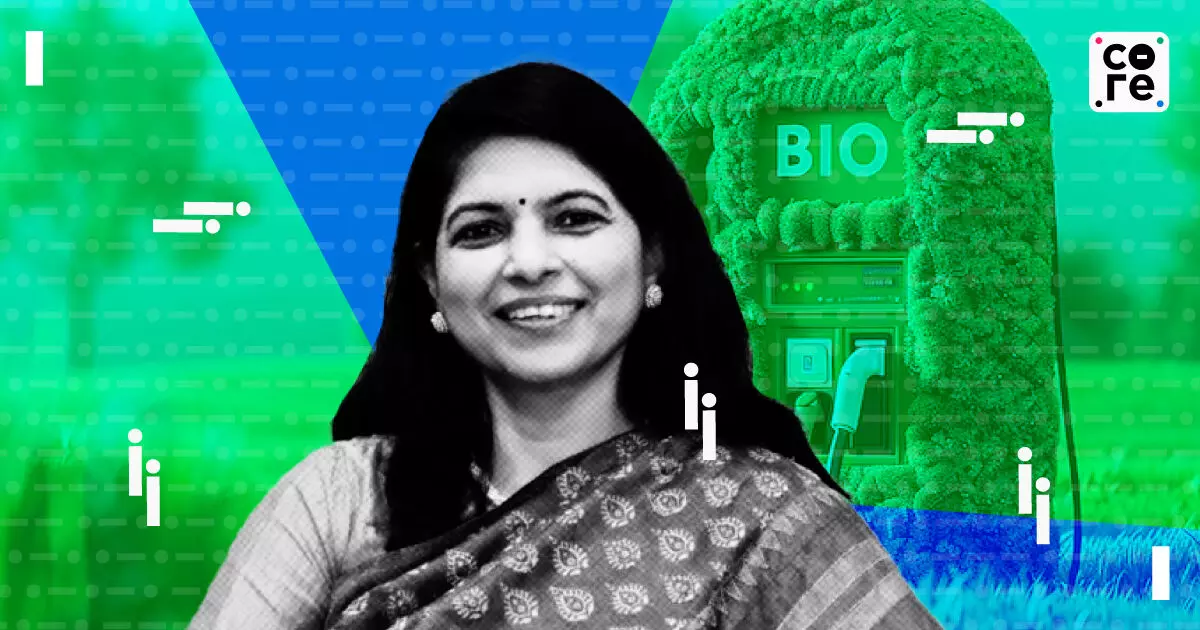
Bamboo Biofuel Signals India’s Move Beyond Conventional Ethanol Feedstocks
In this week's The Core Report Weekend Edition, Govindraj Ethiraj speaks with Vartika Shukla, Chairman and Managing Director at Engineers India, about the new bamboo refinery, which demonstrates feedstock innovation, complex engineering, and India’s expanding ambition in second-generation clean fuels.
NOTE: This transcript contains the host's monologue and includes interview transcripts by a machine. Human eyes have gone through the script but there might still be errors in some of the text, so please refer to the audio in case you need to clarify any part. If you want to get in touch regarding any feedback, you can drop us a message on feedback@thecore.in.
Shukla, thank you so much for joining me. So it's been an eventful year, maybe in geopolitics, with geopolitics linked to energy as well. But that's not what I'm going to ask you about.
What's the most interesting or the most interesting challenge that you've been posed in the context of the work that you're doing from perhaps the clients that you talk to, either existing or potential?
First of all, thank you for speaking with me again. And it's an absolute delight to speak on so many issues that we continue from last year. Interestingly, the question that you ask is my answer wouldn't be entirely from the oil and gas.
Very recently, in fact, this has been for the last about a year or so. And very recently, our honourable minister directed that we look at one development which has happened in the sector, which is a solar cooker. And this was this is developed by Indian Oils, R&D.
And he challenged that whether we as a team jointly or otherwise can look at reducing the cost as well as the weight of the solar cooker such that it becomes, you know, affordable and friendly to the mass that, you know, who would be the end user. And it can have a better efficiency as well. So this is one challenge which would probably be a game changer for, you know, steering the solar mission as well and using the solar heat for cooking medium.
Also bring down the energy requirement and the energy cost, especially of households which are challenged in terms of their capacity to purchase, you know, oil and gas for their electricity.
And that's and I'm going to ask you more about the cooker. But that's an interesting point which maybe people have missed, which is that we can address the problems on the demand side as well. And really going right into the house and saying that each of these components of consumption of energy and how can I maybe find solar sources for them?
So the cooker sounds interesting. So tell us more about the cooker itself. And how is your cooker different from Indian Oils?
So I think it's a collaborative effort because the initiation and the credit of the first development and the second development goes to Indian Oil R&D. And we put an independent mind and it's always good to have a second round or a third round of in-depth analysis of the elements that can go into improvement of efficiency, reduction of cost, reduction of weight. And as Engineers India, we have a team which has the expertise in insulation, on materials, on electrical systems.
So it's a, you know, a task in progress, work in progress. It has achieved some milestones and we have challenged ourselves that within a month's time, we would target a really significant reduction on that, on all of the fronts, such that it becomes affordable, you know, for the for end-users. Now, although the solar energy is not a 24-7 available, but today we need all kinds of energy and any element of decarbonised energy and especially solar-based you know, heat that can be used at the end for any of us would be anything, would be an added benefit, you know, in the whole ecosystem of the energy space.
So let's take a step back. And if you were to look at the last year and the work that you've been doing, you've been doing a lot of international work.
Your order book has been the highest ever. And you're also doing a lot of domestic work, which is not to do with oil and gas. You're working in academia, building infrastructure, urban infrastructure and data centres, which is the hottest thing right now.
And I'll come to that in a bit. So tell us about what are the more exciting landmarks for you in the last year?
So the last year has been, last few years, I would say, have been instrumental in steering and shaping the landscape of our business portfolio, the current business portfolio as it is. And where we look forward in the future to lead from the front as an engineering company with excellence and international footprint. So on the international front, very recently we signed a contract to build four very large fertiliser trains in Nigeria for the Dangote group.
These are larger than any of the Indian Urea trains. They are four to five zero TPD of urea. And that puts us into the global map of engineering consultants who have the ability and who have garnered the trust of a very prestigious, large group internationally to implement these projects on a PCM basis.
Similarly, the Dangote group is also looking at adding another 33 million tonnes, 650,000 barrels per day of refinery in the same region, in the same location as we have built the first one, which will bring up the capacity of that single location to 1.2 million barrels per day, which is a very, very large capacity at one place. Again, it is a testimony of the ability of our engineering and project management teams. Would that be larger than any single installation in India?
Yes. Yes. It would be put together at least two such installations of our nation at Patlu and also the six fertiliser trains eventually.
So that will be a conglomeration of refinery, petrochemicals, as well as fertiliser, one of its kind in the entire world. So that's one historic landmark which we have achieved in the last year. Besides, as you mentioned on the diversification part on the other than oil and gas, the world and our clients have found merit and found value in the abilities that our teams have and the experience that they have, you know, over the last 60 years or so, and the strong database and, you know, the wherewithal to solve any of the problems.
So those kind of USPs that we bring on the table for our clients have helped us steer and navigate in, let's say, the fertiliser sector for one, which we weren't a major player earlier and in the infrastructure sector, because there is any client who puts in investments, who puts in, you know, have large capital projects, looks at the ability of the consultant to give a quality delivery, delivery as much as can be possible in the schedule. But more importantly, having cost control, good processes and procedures for procurement. And all these are they are inherent in our teams.
And that's one reason why we have gone beyond the oil and gas. And today, as we speak for this financial year, we have almost 50 percent of our order inflow from international operations. And our order book, which is about 13,700 crores, is an all time high for our organisation.
And we are also hopeful for growing it further.
And tell us about the most technologically complex or fascinating or interesting projects that you're working on right now compared to your past, whether it's an oil and gas or outside.
I think the project which is unique to the industry and the world as well is the Bamboo Refinery, which was dedicated by the Honourable Prime Minister in September in Umar Egar. And that is a second generation ethanol project with some byproducts, which is unique in comparison to other 2G ethanol projects, which just makes second generation ethanol. And we put together that plant with the most exotic material, metallurgy, with new vendors, both national and international, with the equipments which no one has ever operated before.
And our team has supported that plant in troubleshooting, in pre-commissioning. There were huge challenges because people have not faced environments of the nature of slurry, of acidity in the process streams and how to manage the corrosion aspects, the plugging aspects and so many other aspects. These all fluids are not proper fluids, they're non-Newtonian fluids.
So you cannot apply the same principles of chemical engineering, transport phenomena as you do in the plants that we have conventionally done. So that's been a great learning. And the success of the commissioning and operation of that plant is actually is a testimony of the fact that it was extremely exciting, challenging, yet very satisfying at the end when it all came together.
And there's a sort of general knowledge question, perhaps. How do you start with bamboo or because bamboo is already available there and you say, OK, now let's see if we can find another use for it, because obviously one would think of sugar when one thinks of ethanol or maize.
So see, these technologies are some of them are feed agnostic. So whether you look at rice straw or you look at wheat straw or you look at cotton, it's likely tough to, you know, go to second generation ethanol, it's a tough feedstock per se. Or you look at stubble or, you know, any kind of those feedstocks.
People also look at growing some kind of grasses on purpose to get second generation ethanol. So these are all feedstocks which are, you know, available for technology, technologies which are feed agnostic. This particular technology is designed for bamboo because it has a separate processing steps.
Bamboo being, you know, the nature of bamboo being slightly different than, you know, the straw. So the lignin content, the cellulosic content is quite unique in that. And this process deploys a solvent, which is again in variance to the typical enzymatic hydrolysis processes which are there in technology.
And therefore, it finds value in making byproducts like acetic acid and furfural. So that way, this, in fact, was brought up from a technology readiness level, which was very low. So it's one thing to repeat a technology which has been commercialised.
That's the easy part. It could be complex. It could be extremely like a steam cracker or a dual feed cracker, which is very complex.
But you've done it before. World has done it before. And there are set equipment, set suppliers, set systems.
Not much, except you need to kind of put it together. But in this particular case, there was nothing on ground. It's absolutely a blank slate.
And you cannot fail because it is a sizable investment. So I think that itself is, you know, proving the fact that on the client end, there was huge support from maybe RPL, NRL, as well as EIL teams. They work together to put this marvel together, which is totally unique in terms of the context where we are talking today.
Moving from the conventional energy space, the fossil space, slowly by and by transitioning to the green fuels.
And I'm going to come back to this in a moment. You know, but when you look at the entire energy spectrum at one level, let's say there are data centres today who are being set up. The companies that are investing in data centres are also investing in energy companies or setting up energy plants, which was completely unknown or unheard of even a few years ago.
So there are large gigawatt capacity because they have to feed those data centres. So that's a new requirement. An extension of that is obviously investments in nuclear power.
And that is something that you're also involved in with small, small modular reactor. So when you look at the energy, the energy spectrum, it's very difficult to make out what is going in where and what is coming out, because everything inside is being changed around, including the bamboo example that you gave. So how do you see this world?
Yeah, so it's it's a complex world, but I think everybody attempts to make it simple. For example, let's say today the Delhi metro is run by power generated in Madhya Pradesh. So it is complex.
And we were looking at a project of making green ammonia in Odissa with power generated in Rajasthan. So there are this kind of synergies. Yet there are challenges how to put together these elements of, you know, in the game of things.
So you're right. Data centres are a big thing. And especially data centres with renewable power, with a lower carbon footprint, will definitely need huge power capacity for computation needs and data storage, etc.
That is one of the big sectors which is likely to see and we have heard so many announcements. I don't want to name them or how they will pan out and, you know, play out will be seen, but it's a huge opportunity for making capital investments and for us to do project execution as well. So we are in the finishing stages of one data centre, which is a 10 megawatt four data centres at one location.
We've done before some data centres for SBI, for state government of Rajasthan, for UADI here in Delhi. So that experience of creating the framework of the data centre, making it ready for certification for tier four uptime. I think these are the experiences which we as a company bring on the table and the end customer needs, you know, companies who have that prior experience so that their work gets executed smoothly in a kind of efficient and affordable manner as well.
I'm going to come to nuclear in a moment, but you talked about customers, right? I mean, even the nature of customer. I mean, one day, let's say you were dealing with a oil and gas conglomerate in Nigeria or for that matter, in India.
But tomorrow you could be dealing with a social platform like a Meta or someone who's because they're investing in so much. And you two are looking at urban infrastructure and others. So how does that play on your own as a company?
I mean, how does that play in terms of, you know, because it calls for a different frequency because you're not, you know, dealing with maybe, you know, a new age tech organisation is quite different from dealing with a traditional petrochemical or oil and gas company. True, true.
You're so right. Today, we have clients from across the world and across sectors. And you're very right.
The both the expectations, the working style, the procurement processes, the work culture is very, very different. In fact, at times we are challenged by adopting to that work culture. And many times clients also look for that flexibility.
They look for agility and they look for many other responsiveness, communication. These are a lot of skills which especially international clients and especially marquee clients, if you talk of Meta and clients like those, they would look expect from a consultant. So we have different teams, like, for example, the teams which work in Abu Dhabi are very well orientated to the needs of that region.
They're very familiar with the processes, the protocols, the standards and how to even converse, how to even communicate, how to even give documentation. So they are trained in that manner. Similarly, let's say we are looking at data centre when we work for SBI or we work for state.
Let's tell you, let me tell you the one that we are doing now, although it's a client of the central, you know, the government sector, but they're very demanding. It's not that and they're very knowledgeable as yet. So that's another point that clients today are very knowledgeable, sometimes more knowledgeable than us.
And that creates, poses a challenge for us, also an opportunity to build up that skill set to match, you know, their wavelength or give what they expect of us. Likewise, if you see some of the private sector clients, there are some private sector clients who work with a very work breakdown approach. They would like to be controlling every little bits and pieces of it because they need good cost control.
They need, you know, they don't have the bandwidth and rightfully so. They're very efficiently run with a smaller team and they're very conscious of the fact that we should be. So we do work with them.
Then you have also some clients who look at, who don't look at the cost, let us say, of the whole project in somebody who looks at a macro level, somebody who can look at a micro level. So you need to go down to the detail because the devil also lies there. So those are the things which are very different across clients.
And it takes time for the company and the teams to understand that often we are able to fulfil the client's expectations right away. Often we need to recalibrate ourselves, retune ourselves. Sometimes we get feedbacks which we need to, you know, reinvent ourselves and kind of reposition our work style also.
But the good part is that we are there to listen. We are there to take feedbacks and also take corrective actions. The teams are excellent.
The teams are very energetic. We have a low average age. We have youngsters and experienced people who work hand in hand to kind of, and they're very proud of the fact that they belong to a company which has built the energy infrastructure all over the globe for 60 years.
I think they carry that pride on their shoulders and that keeps them going with the ambition and the desire to do better and better.
So let me come to small modular reactors and what's happening in that in that area? What is EIL bringing to the table?
And do you see that whole space taking off?
So we have been attempting to re-enter the nuclear sector. Decades ago, we worked for the heavy water board. We built up their ManuGuru facilities.
Later on, we also supported IGKAR in some liquid sodium technology. We also did the balance of plant for Kodambkulam train one and two and some other projects here and there. Also nuclear fuel complex at Kota for enriching uranium.
So we have been there in the sector for the last few years. We have been attempting to enter the space which will open up post the nuclear liability bill going through, particularly in small modular reactors for the private sector and the public sector. And we have been speaking to the private sector.
Some of the private sector companies who are there in the public domain, we are in touch with them to engage with them. And some of them are also keen to take us on board to do, you know, the seismic and geographical studies to make sure that area is safe to put up a nuclear facility. So this continued attempt and attempt to collaborate to bring on the table the value proposition has actually resulted us in getting the, you know, the trust and faith of NPCIL in them awarding us two modular reactors.
One is a light water reactor, one is a pressurised heavy water reactor, again same to 20 megawatt kind of scale to 20 to 300 megawatt. And we are working on both of them. One is a conceptual design, one is a checking of an existing design such that they can be transformed into an offering for the sector.
And it is very exciting for us. It is also extremely, you know, transformative in the manner that it will take us to a platform where we are having that ability to do conceptual work in the core facility. So many of this, the work that we have done is out of the core nuclear, you know, island.
And this will help us go in there and look at offering our expertise there itself. So not only will it expand our portfolio, it will also make us part of the growth journey. And that's what we want.
EIL has always been there as and when the industry has developed, whether the refinery industry developed, then the petrochemical or offshore or the green technologies or data centres or buildings or wherever you go. So we want to be there when the actual investments happen so that we are better positioned than many other, you know, similar companies. Plus, also, let us keep in mind that nuclear is a strategic sector and a very critical sector which needs a high level of safety and reliability.
And who other than us would be, should be the natural partners of, you know, clients who would like to make that investment.
You mentioned Kudankulam, so a lot of that would be 20-25 years ago. I mean, I'm just wondering how many people who worked on nuclear in EIL are still around?
So that is about 2015-2016. So about 10-12 years ago. So we have teams.
We have some youngsters who have now become the middle level leaders and they are very much there. They, in fact, are very familiar with the teams on the other side as well. So the teams know each other.
That brings, you know, comfort as well as confidence. So we have talent. We have talent and we always intake more talent.
So we have the experience. We have the talent. We have the will.
So we hope to make huge inroads when the sector opens.
So let me come back to the bamboo part and not the bamboo part so much when you talked about the feedstock agnostic technology. Yes. So what else could we be using if we want to do ethanol?
I'm not saying only ethanol, but let's say even as we try and solve or sort of fill in the many energy blanks.
Right. So as we move forward, we have already got 20 percent blending of ethanol and gasoline. And as we move forward, either we get the flex engines, you know, wherein the sectoral, cross-sectoral kind of collaboration is required from the automotive sector as well as from the consumer.
They should also have the comfort to get that, you know, 100 percent ethanol. And they are already, I don't know the number, the many pumps which are also selling 100 percent ethanol. So it's a market driven, customer centric, product centric and, you know, those kind of factors.
But the target to get a blending of sustainable aviation fuel in jet fuel, when we're looking at 1 percent in 2027 and 2 percent in 2028, and we need to meet the regulatory framework, of course, in times to come, being the hub of aviation today as we speak. And so many airlines which are fuelling in the country, we will need to build up that capacity. And why I'm saying this, because ethanol becomes one of the feedstocks for taking A to J, alcohol to jet.
And that's one of the pathways to creating a sustainable pool of jet fuel. So going back to the feedstocks of ethanol, where you would limit the feedstocks for the second generation ethanol, again, second generation ethanol has its own challenges. It is having a price point which needs, which will find it difficult to have multiplicity of investments.
Also, the seasonality of the feedstocks, the price of the feedstocks and the ecosystem, the whole supply chain of feedstocks would be challenged. So the industry is looking at other feedstocks like spoiled grains, dented corn and feedstocks which are not good for, which don't conflict with the, you know, the dialogue about fuel and food and fuel. So those non-conflicting feedstocks, if they can be converted to alcohol, which have more sugar content than the other feedstocks, which are more lignin like straws, etc., I think those pathways are going to take a prominent position in the future to make way for creating a pool of, you know, SAF, which would help in keeping the hegemony of India as, you know, the hub of the airlines, which is going to be huge in times to come. There's fastest growing fuel as well as creating, you know, a decarbonised fuel system, also use of food grains. We have with surplus of food grains.
God has not been kind in giving us as much of the, you know, the like the Middle East, the oil and gas maybe, but we have food grains which we export in plenty, wherein we are surplus in several of them. So some kind of balance wherein we bridge, we overcome the nuances of, you know, kind of keeping the food safety in place, food security in place, I would say, well, where and also meet the second element of sustainable fuels. I think those kind of that kind of ecosystem will be in place in times to come.
Right. And it's interesting because what you're saying is that when we think about sustainable fuels or ethanol injection into fuel, we shouldn't be only thinking about cars and bikes. We should be seeing about aircraft.
Yes.
Which is not what normally comes to mind.
Yes. Yes, definitely.
So, OK, so if, you know, if you were to look at strategically, so as a country, we were investing heavily in renewable, which we continue to, but we're also meeting a lot of targets earlier than perhaps what we thought. So that's good. On the other side.
For geopolitical reasons, among other things, we are facing pressure, let's say, on the fossil fuel side. And I can see that or I can sense that there's a lot of pressure now to amp up our fossil fuel once again.
Yes.
How is that playing out for you?
So for us, I think all fuels are good. As many, the better. So we are there in green hydrogen.
We are doing, we are working in SAP with the 2G ethanol on the sustainable fuel. We are, we know the core, you know, space as well. But what we see going forward is we see a huge growth in the demand.
So it is only seasonal. To assume that this low seasonal growth is going to be sustainable may not be true. We are a growing economy and you've seen the numbers as, you know, every quarter results surprise you.
They, even if you see the real GDP or, you know, it is, you can feel the vibrancy of the economy as you move in the country, you know, and that is evident in the investments, the projects that you see all over. It is actually there and you travel in many other countries, you won't find that. And I think that is something which is going to continue.
So the growth in the energy demand is going to continue. Coupled with that will also be both our own INDCs, our own intrinsic commitment to the COP as well as ourselves to decarbonise will remain. So we need to have a balance of both the fossil fuels as well as the green fuels.
And as an organisation, EIL has been able to position itself very well on both domestic and international front on both. Today, we are also looking at a SAF project in Indonesia because we are doing a SAF project here. And we are talking to others as well, looking at, you know, green projects internationally because now that we have the, so what we have been doing all our life as an organisation is we build our core in India because we have more leverage, we have more dialogue, more easy access, more acceptability, price point competitiveness and so on and so forth.
We build that capability here, then we start looking at opportunities internationally. So we've got a breakthrough very recently of a SAF project in Indonesia, which is a testimony of the fact that we did one second generation ethanol here. We've done, we're doing a SAF project in Mangalore for MRPL and now we've got this project.
So this is how I see there is huge opportunity, both domestically and internationally. In fact, there is so much opportunity that delivery becomes a challenge. Just in SAF?
No, no. In general, in overall, that delivery becomes a challenge. You know, how to keep up your capacity and delivery to meet the, you know, the commitments that we have made as a company to deliver these projects.
So we need to upscale our people. We need to expand the resources. We need to get more talent in both at entry level and lateral level.
We need to keep our people more engaged. We have to bring in systems and processes in the organisation which are bringing in a leanness to both the operational aspects. We have to bring in empowerment, which we've done already, empowered the people to take more decisions, both in qualitative and quantitative terms.
So these are all the need to rebuild, to strengthen the organisation from within when we go outside and, you know, commit ourselves to putting projects together.
And I'm going to come to the India Energy Week point in a minute or two. But a couple of questions before that. One is to do with people and the other is to do with Nigeria, which is obviously a giant country in terms of oil or oil and gas.
And tell us about what you encountered there and what is it that we could pick up? I mean, you know, there's a lot of talk nowadays, for example, of South-South collaboration. And you're obviously implementing a very large project there, bigger than anything in India, at least in the refinery space.
So what is it that we can take away from some of these countries and some of these projects that we're working on?
I think the since that the client is a completely international private sector client, there is the desire to complete the project, to get it up and running, have a fast COD. It's watched all over the world. So that puts pressure on both the client as well as us to deliver.
That project scale is tremendous. One thing which strikes us different, which I have not been able to put together in the system in the country, is a lot of use of automation in terms of construction. So because of the challenges of the region, the non-availability of materials, manpower, the skill set machines in Nigeria, there was all the contractors who came there, largely from India, brought in automatic machines, whether it is for welding, for lifting, a lot of automation.
That kind of automation also brings in quality. It brings in a neatness in the product, which is unique. Something similar we are seeing in Mongolia.
We are implementing the largest LOC project in Mongolia. Again, it's an Indian contractor. But the finishing of the work has a different quality.
I think that's one thing which we are trying our best to adopt for our contractors here. Second element, especially in Mongolia, is safety. The angle of safety, even one incident, can be very serious to both the reputation of the owner, us, as well as the contractor.
So the element of safety, consciousness of safety, the desire for safety, so both the quality and safety aspects, similar things in ADNOC also. When we talk to the ADNOC team, I think these are the two learnings which we can and we must bring in into the country. Safety, we are still conscious in the country, but the quality, which could have a little element of cost, you know, because if you bring automation, because you don't have workers there, you need to have automation.
Here you have the workforce, so you bring in less automation, but then you compromise on time and quality. I think this kind of shift would help all three elements. It will help us as consultants, EPCM or PMC.
It will help the contractor finish their work faster. It will also help the owner achieve their completion. I think this is one learning which has to be put up in the ecosystem of the implementation of the oil and gas projects.
The third element which we had there is the constructability that we could experience, the experience that we got in construction. The largest diameter crude column, how we lifted it, how we placed it, the largest diameter RFCC reactor regenerated in diameter, in weight, in the world. So those are something bigger than any of the refineries.
So that experience is the icing on the cake for us, you know, because that is needing a lot of skill, a lot of supervision. That is unique. And that's why we not only train those people, but all the teams who are there bring back that learning into the company as well.
Right. So let me ask you about India Energy Week. So a lot of all of what you've talked about is what you want to showcase.
So people see it and then they obviously come and do business with you and younger people find this interesting and they come and work for you as well. So what are you hoping to showcase?
So the times of today needs that the talent and the talent that we draw in is excited enough to join us on that front. Secondly, on the customer front, we need to showcase the multifarious expertise that we bring on the table and the ability to stitch together not just the less commercially proven technologies, but also complex mega projects, whether it is in India or international. I think that kind of uniqueness, that kind of diverse talent which is available in one organisation, it is extremely rare to find.
So when we bring on the table the concept to commissioning, kind of end to end services under one roof to customer, we want to showcase that in terms of and showcase that in terms of executed projects, which are mega scale, both domestic and international. I think that kind of message and that kind of value proposition we want to bring across to to our customers and to our viewers and attendees in India Energy Week. We also want to, on the second element, also bring on to the table in India Energy Week that we are a company which is always transforming.
We are a company which is forward looking, a company which not only rests on the laurels of the past, but also looks at avenues for future and is willing to position itself, nurture talent, bring in new, fearless in implementing new technologies. I think that kind of confidence that we have, we want to showcase that even if it's the first of its kind, whereas it's the first of a large acrylic plant in the country, whether it is the first of an LPG cavern, which we commissioned in Mangalore, whether it's the first bamboo refinery, first sustainable evasion fuel and first strategic reserve of crude that we built in years ago in in Vizag or the first giant columns in Nigeria or the mega 26 percent petrochemical intensity in Rajasthan. So we've done all that and we have the ability to not only that, but much more. I think that kind of spirit, that kind of confidence, that's what we want to showcase in India Energy Week.
And what do you want to take away?
So we want to take away a lot of client network with us because we need to build on. We have been steadily building on newer clients and we want to keep our customers who are traditionally our customers with us. We want to retain them so that they come back to us for work.
That's something which keeps us going in terms of our repeat delivery to customers. So we want to take away that the goodwill and the connects that we get, not just from our customers, but all stakeholders, because India Energy Week is also about our other stakeholders. We have a Make in India pavilion wherein we nurture the manufacturing industry of the country.
Today, we are more than 96 percent self-sufficient in refinery sector, about 82 percent in petrochemical. And it's largely because of the efforts of Engineers India over the years, decades of service we have done to the nation to build in the manufacturing sector. So these are all our stakeholders.
So they also bring in new products. They bring in new, let's say, pumps, compressors, instrumentation, electrical systems. It's a good platform for them to showcase that and for us to pick those newer technologies into our own specifications.
In addition, it is a platform to collaborate on international front. Every India Energy Week, we have built in some conversations with the world majors in terms of some collaborative effort, which is one of its kind. And being in India and India-centric, it also not only exposes them to, you know, the Indian companies, it also brings in the element that we are there to expand and grow.
There are a lot of investments going to happen. It's an exciting place to be and an aspiration to kind of find each of us, you know, finding some value proposition at the end of the day. So it's a very, very exciting place to be.
Last question. So the last time I asked you about passing out of IIT and then making a choice of one staying back, working in an engineering space with government and so on. When you look at young people today, they're looking at multiple choices and working in manufacturing, working in, let's say, oil and gas is not necessarily the first one.
What would you tell someone or your younger self if in terms of if they are assessing these opportunities, blockchain versus, you know, energy column in a refinery, why and what would you tell them and why should they do what you think they should do?
Again, it's a very personal choice, but I would say that if anybody wants to continue in engineering and keep engineering as a base, it is a very good, you know, the first few years of one's career is there to learn and that learning can happen when you involve yourself with the nuts and bolts of your profession. So the blockchain or any other thing can sit on top of it, you know. So if one wants to continue in an engineering profession and not take finance and not take marketing and not take something else, it would always be good to build one's base for the first few formative years of your career.
You have formative of your life, formative four or five years of your career in a core engineering company or a core company wherein you learn the nuances of everything, because that gives you the confidence and the strength to apply over and above, you know, on top of it, anything you want after five, six years. Not that people might like to spend, if you like it, you love it. You can spend 40 years, why not 50 years or 60 years on the same subject?
But I think the first few years are very important to build a base. My message would be to take a step back, no harm in investing the first few years in especially a company like the oil and gas sector, whether you have a private sector or public sector. The field is very vast.
The exposure is unique. And I would say in a public sector, the exposure is much better than the private sector. The pay comparisons are similar.
It's not that you're losing out on money. They're almost the same. You get more benefits in the public sector if you want to actually go and evaluate on that front as well.
You have nothing to lose per se in terms of value, but the exposure you get is far more important, far more enriching, far more valuable for a long term career growth. And every company is not the same company as it was some few years ago. Every company has a lot of opportunities.
There is a lot of talent. There's a lot of interaction from the top level or even the head level or the ED level to the people. And I have seen in our company a lot of new youngsters that we keep meeting.
They're very excited and we give them a lot of other opportunities like we have multifunctional teams doing some taking up the project on their own. They do their own, you know, improvement systems. So keep them engaged.
They have a lot of, you know, opportunities to take up some, participate in different award schemes, different exciting hackathons and stuff like that. So there is a lot of engagement from the company side also to the youngsters. So we are there to offer that to the youngsters.
And it would be really encouraging for the industry to keep that, you know, vibe of the youth too, because they're also bringing very new things, especially in the digital domain. And we have a team of digital technology services which looks at, you know, developing a lot of, we've developed a lot of ML within use, a lot of chatbots, etc. So there, somebody who's interested, they can go and join there.
There is a lot of opportunity. So it's good to build the first few years in a core engineering and move on if you think other waters are nicer or the grass is greener.
It's a wonderful note to end on. Thank you so much, Shukla I love talking to you.
Thank you. Thank you so much. Really pleasure is mine.
Core.
Core.


