



 Newsletter
 Search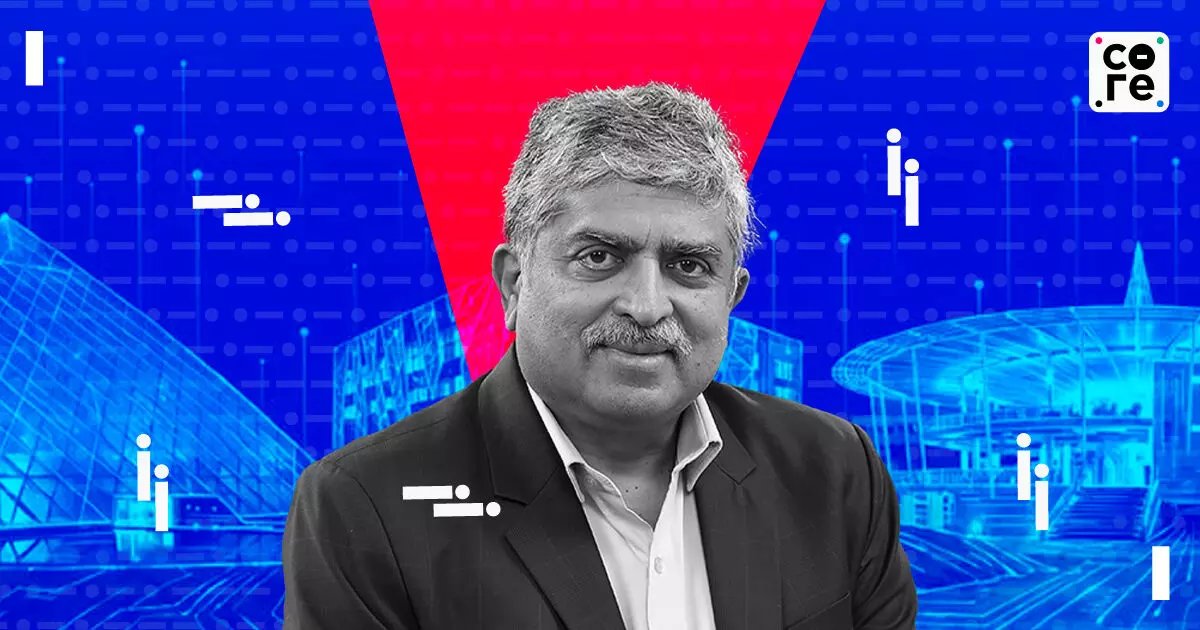
AI Will Tilt Software Market From ‘Buy’ to ‘Build’: Nandan Nilekani
- Business
- Published on 17 Feb 2026 9:07 PM IST
Generative AI is accelerating custom software development, widening a deployment gap for enterprises and creating fresh opportunities for IT services firms while challenging traditional SaaS providers.
The Gist
Infosys Chairman Nandan Nilekani forecasts a major shift in technology, emphasising that generative AI will prompt enterprises to create custom applications instead of purchasing standard software.
- Nilekani describes the AI transition as a significant transformation for global business.
- This shift favors IT services firms like Infosys over traditional SaaS models.
- He highlights a growing 'deployment gap' as companies struggle to implement new technologies effectively.
Infosys Ltd. Chairman Nandan Nilekani declared a fundamental shift in the global technology landscape Tuesday, predicting that the rise of generative AI will drive enterprises to build custom applications rather than buy off-the-shelf software, a trend he says poses a threat to traditional SaaS models while bolstering IT services firms.
Speaking at the company’s investor event, "Infosys AI Day 2026," Nilekani described the current AI transition as a "root and branch surgery" for global business—distinct from previous shifts like cloud or mobile because of its non-deterministic nature and the speed of its adoption.
In a move that caught investor attention, Infosys also expanded its tie-up with Anthropic, embedding the Claude models into its services stack — effectively pairing AI research with enterprise-scale execution.
The Shift to ‘Build’
"The balance of advantage is moving towards build rather than buy," Nilekani told analysts in Bengaluru. He argued that the ease of generating code and applications via AI agents is eroding the moat of traditional Software-as-a-Service (SaaS) companies.
"Very often you may just build, or you may replace something that you have which you bought with something to be built," Nilekani said. He noted that this shift plays directly into the hands of system integrators like Infosys. "Who is going to build it for them? It's going to be us."
The ‘Deployment Gap’
Despite the hype, Nilekani warned of a widening "deployment gap"—a concept he likened to Clayton Christensen’s "technology overshoot." While frontier models have scaled from 100 billion to 1 trillion parameters in just three years, enterprise adoption is lagging due to organisational inertia, data silos, and the complexity of retraining workforces.
"The technology is moving faster than the ability of enterprises to deploy," he said. "If you guys think that some better product has come, nothing's going to happen because the problem is here, not there. It's about how fast companies can implement."
Agentic Interfaces & Brownfield Challenges
Nilekani outlined a future where "Agentic AI"—autonomous agents that can perform tasks—becomes the primary interface for users, hiding the complexity of underlying "systems of record." However, he cautioned investors against being swayed by "Greenfield" productivity demos.
"Writing Greenfield is not a big deal. I can take a tool and give it to a kid, and he'll generate a million lines of code," Nilekani said. "The real world is the fact that companies have trillions of dollars invested in their systems... Taking Brownfield systems and modernising them is a hell of a lot more difficult."
He cited instances of companies relying on retired 75-year-old engineers to maintain undocumented legacy code, emphasising that the "unglamorous" work of cleaning up technical debt is where the real revenue opportunity lies.
Execution Risk
Concluding his address, Nilekani dismissed concerns about a lack of opportunity in the AI sector, framing the challenge solely as one of execution.
"There is no opportunity gap. If anything, the opportunity is bigger than ever before," he said. The critical question for investors, he advised, is to assess which firms have the execution discipline to navigate the massive change management required. "Are they able to do it with speed? Are they able to do it with scale?"
Core.
Core.


