



 Newsletter
 Search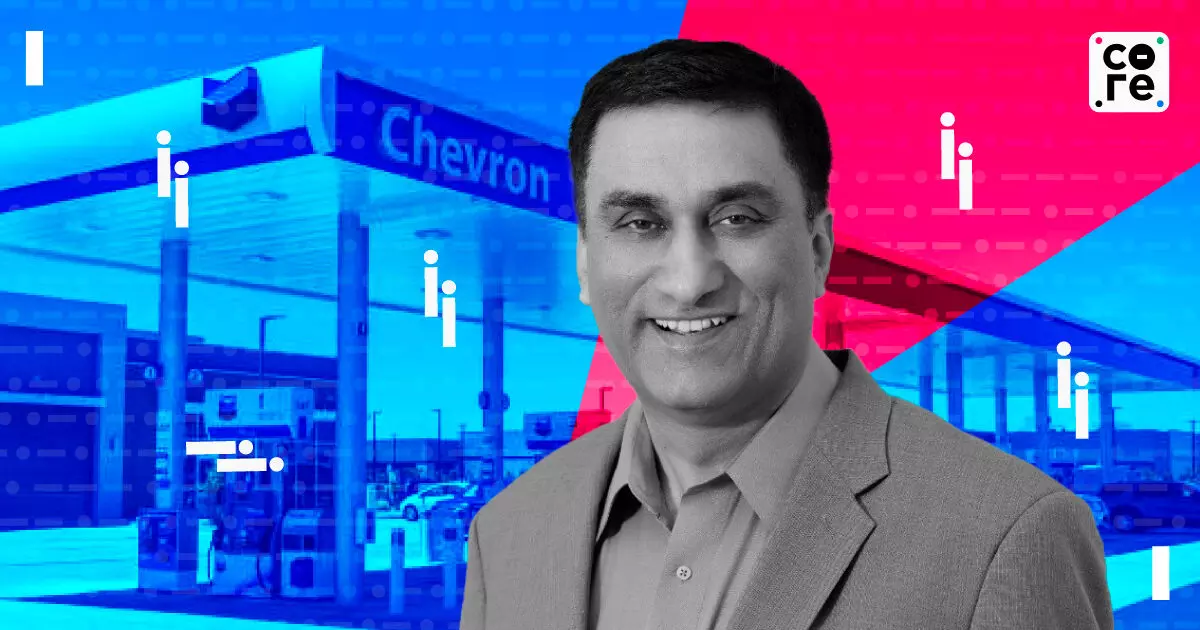
Agentic AI Is Transforming Subsurface Exploration: Akshay Sahni
- Business
- Published on 28 Feb 2026 6:00 AM IST
In this week’s The Core Report Weekend Edition, Govindraj Ethiraj speaks with Akshay Sahni, Country Head, Chevron India, about how AI is accelerating exploration cycles from predicting rock formations to estimating reserves — while improving accuracy and redefining decision-making across global energy operations.
NOTE: This transcript contains the host's monologue and includes interview transcripts by a machine. Human eyes have gone through the script but there might still be errors in some of the text, so please refer to the audio in case you need to clarify any part. If you want to get in touch regarding any feedback, you can drop us a message on feedback@thecore.in.
Akshay, thank you so much for joining me here in our studio in Lower Parel in Mumbai. So we're going to talk about Chevron. We're going to talk about what Chevron does worldwide and how India is feeding into that and doing some of the very interesting back-end technology or even front-end technology, to drive all of that.
So before I come to that, tell us a little bit about yourself. You come from a family of scientists and going back several generations in the same space. And that's quite fascinating.
Yeah, well, thank you, Govind, for having me here. I'm delighted to be having this conversation with you. Yeah, I do come with three generations of a family with three generations in earth sciences.
So my father, a geologist, my mother, a geophysicist, my grandfather, another geologist, and his brothers, my great uncles, all geologists. So it was fascinating growing up in a home where you're surrounded by fossils and rocks, where dinner conversations are around fossil shark tooths or about the theory of evolution. So I'm really happy that I've been able to stay in similar space and really happy and proud to be working here in India now after a number of years being overseas.
Okay. So and tell us about what's the distinction between or connection between a geophysicist and a geologist and what you're doing right now.
Well, a geologist looks at the earth from multiple different angles. Geologists could be looking at the broader sense about the history of earth. They could be looking at how plants and animals evolved over time.
They could be looking at how structures, geological structures like mountains and oceans evolved. A geophysicist is a branch of geology where you look at seismic images. This is physics of how things could be understood deep in the ground using seismic waves, which help you capture or image deep in the ground.
And what we do here in India, so we have established, Chevron has established an engineering and innovation excellence centre. It's called the engine in short. And it's a state of the art technology hub to support our global operations and projects.
So we work across all disciplines. Geology, geophysics is obviously one of them. But we look at other things, for example, operations, how to keep our projects up and running reliably and safely.
We look at how to drill wells. And obviously, we do a lot of work in the subsurface area as well.
Okay. So I'm going to come to that now. Chevron is $193 billion company and is all over the world.
And it's doing, even as we speak, new projects around the world, including from Nigeria to Australia. And of course, Permian Basin in Texas, which is where I guess the main sort of epicentre is. And which is where you were based before.
Okay. So tell us if I were to look at a map of Chevron today. So what's going on?
What do you see?
Well, let me start a little back, you know, in 1879, when Chevron was established. And we were established in California, actually in Southern California. And we've been around for now almost 147 years.
And since the very beginning, we've been an integrated energy company. An integrated energy company is one that is across the entire value chain of the energy ecosystem. That includes exploration and production.
That includes transportation of products through pipelines or through shipping. And we've had shipping since day one, since the late 1880s. And an integrated energy company will have downstream operations, for example, refining and manufacturing, converting products into or converting crude oil and other things that we produce into products that people can use.
And we also have now a business that is called the lower carbon energy business, or new energies business. So yeah, we've been an integrated energy company for a very long time. And we operate around the world.
Starting closer to this part of the world in Australia, we have some of the largest LNG assets in the world, where we take natural gas. And actually, that natural gas comes with carbon dioxide. So we separate the CO2 from natural gas.
We inject the CO2 back in the ground, which is carbon sequestration. And we chill the natural gas. We cool it down and convert it into LNG.
And then we transport it to markets in Asia. So that's in Australia. We have a fairly significant presence in Kazakhstan, where we operate one of the largest fields in that part of the world, where we produce oil by injecting gas back in the reservoir.
It's a process called enhanced oil recovery. And as we move further west, we have operations in Israel. We have operations in West Africa, Nigeria, and Angola.
And then if you cross the Atlantic and you come to the Americas, then from North America to South America, we operate across multiple basins. So you mentioned the Permian, which is shale and tight. This is like the hard, tight rock that we produce a lot of oil and gas from.
But we also have presence in the deep water Gulf of America, where one of our more recent projects is drilling and producing oil and gas from depths of 34,000 feet below sea level. So that's deeper than the height of Mount Everest. So it requires technology.
So yeah, so we operate globally around the world. We have, obviously, oil and gas exploration and production. These are some examples I shared.
We have refineries on the West Coast in the US.
Pasadena in California.
I mean, yes. Well…
So you still drill in California? Is it only you're refining now? No, because you said it was started in California.
Yes, so we do have exploration and production in Central California. In fact, I work there in a place called Bakersfield. It's in between San Francisco and Los Angeles.
Not too far from where oil was discovered. The oil was discovered in 1876, 1879, in that time frame in Southern California. This place may be 150 miles north of that, where we still operate some of the oldest fields.
In fact, the field I was managing was over 125 years old. So yeah, some of those fields are old.
And still producing, and that's amazing.
Yes, our refineries on the West Coast are also old. Our Richmond refinery, established in 1901, which is just east of San Francisco. And then our El Segundo refinery, which is right by the Los Angeles International Airport, established 1910.
And they're still operating. In fact, we are supporting the operation, making them safer, more reliable out of our office here in Bengaluru now.
Very interesting. And you've sort of taken me on a slightly different track, but I must ask this. So a refinery that was set up in 1901 or 1910, if it's still processing crude, which means that I'm sure it has been enhanced over the years.
But does that mean the technology is still roughly the same between then and now?
Technology evolves, and societal expectations evolve as well. So what the refinery was used in the early 1900s and what it is used for now could be slightly different. But we've always been in the business of providing affordable, reliable, and ever cleaner energy to a growing world.
So that has been our mission for a very, very long time. And if you look at the refineries of the 1900s, yes, the location is the same. But how we process has changed and has evolved.
And now some of those refineries are taking more bio feedstock. So instead of just taking fossil fuels, they can process bio feedstock like corn oil or soybean oil, so that you can get lower carbon output fuels from the same refineries. Right.
Okay. So I was asking you about the map, and I think you've given us a sense now on what is going on where. But if you were to split, let's say, between exploration, which is the hunt for oil or gas as it may be, versus all the operational stuff, how would you divide those efforts?
So yeah, we focus on both, right? Organic growth comes through exploration. And we explore around the world.
In fact, we explore in areas that are tough, like deep water. We explore in areas that could be challenging from a technology perspective, because we have the technology to produce and monetise the resource once we discover it. And we explore whether it's in the US or outside the US.
It depends on the opportunity. It depends upon the scope. It depends upon the scale of the opportunity.
So you talked about the 34,000 feet deep water drill. So deep water is more than 10,000 feet. Is that the usual cutoff?
I think 34,000 feet is from the sea level. So from a water depth of 5,000 to 6,000 feet, you could say it's deep water. But then you have to drill another almost 30,000 feet below the seabed to find the resources.
So that's the anchor project that we developed almost a year and a half ago.
And obviously, you have some sense that there could be oil there. But until you go right into that bed or under that bed, you don't know whether there will be oil there.
Yes. And you asked me the difference between a geologist and a geophysicist. As a geophysicist, whose job is to use seismic imaging and other techniques to see whether there's high probability you'll find something there.
I mean, the exploration probability is not very high. Sometimes it could be in the low teens. But with a good understanding of your seismic images, which, by the way, now with the advent of AI and other tools, you can reduce the cycle time of evaluation of the seismic waveforms that we can collect or have collected over a number of years to find the best locations to drill for oil and gas.
Or in today's work, we also find the best locations to inject CO2 so that it can stay in the ground for a long period of time using the seismic information.
Right. So and you've been in Chevron for about two and a half decades plus. So what has fundamentally changed in...
I mean, AI is clearly a new tool in the way you look at data or process data, which helps you find oil faster. But what were the two or three things you would say have fundamentally changed as you've seen this industry grow until now?
Yeah, well, I've been around for two and a half decades, as you mentioned. The good thing is the rocks have been around for hundreds of millions of years. So that hasn't changed.
And I've always believed that these rocks have been telling stories all these years. And what has changed is how we interpret the stories that they tell. So the rocks have been talking all along, and they were talking when I started with Chevron 27 years ago.
I've worked in one company for 27 years. It'll be 28 in June. It's how we interpret the stories that they tell.
And with AI and automation, with access to big data, with high performance computing solutions, we're able to reduce the cycle time of evaluation of rocks, cycle time of processing the seismic images to find the best locations to drill oil and gas. So that has changed. And similarly, across the energy value chain, optimising how we reduce downtime of our manufacturing facilities.
How do we improve the conversion efficiency of crude oil into products that we can use, diesel and petrol and gasoline? That has changed.
If you were to take an example, which is illustrative, I mean, this could be well off the coast of the United States. You said Gulf of America, which I'm assuming is what was Gulf of Mexico earlier. So tell us about how this technology is helping.
If you were to take one well as an example and the process that you would have worked, and then we can talk about how Bangalore is playing a role in all of this.
Yes. So AI has been around for a number of years, even four decades ago or three decades ago, when I was starting off and when I was a student doing my PhD, AI was there. And in those days, AI was used as a tool.
Today, we can say that AI is almost like a teammate or a colleague. So as a tool, three decades ago, we were using a form of artificial intelligence called neural networks to find or characterise the rock that is there, you know, thousands of feet below the ground using just the well that we are drilling. So you drill wells, and then you use neural networks to predict the type of rock.
Today, you can use agentic AI solutions that not only will predict the type of rock, but they could predict the type of fluids that are there, they can predict the volume of oil and gas that you can produce, and do it in a cycle time that could be, if not half, like a quarter of what it would be before, so with greater accuracy. So that is what has changed.
And in doing so, the time, so one is, of course, you're saying you're reducing time. But to do that, the machine obviously needs to be trained. Yes.
So where is the data for that training coming from? And how is that happening, which I'm assuming is simultaneous?
So as I said, the data, a lot of the data has been there for a number of years. We have taken seismic not just for the example.
It could be as old as the company, for example.
Yeah, it could be as old as the company, but it doesn't have to be just data from your company. You can get access to data. Of course, you have to pay some value for the data, but you could get access to seismic data, other types of data from the area of interest or similar areas in other parts of the world.
And then you can correlate success and unsuccessful outcomes based on the data. So that gives you your foundational data or database from which you can run your AI models to predict the high or low probability of success in a particular area.
Got it. So for example, you've acquired new exploration blocks in, I'm talking about South America now, in Brazil, Equatorial, Guinea, Uruguay. Now, everyone's been talking about how South America is really a newer sort of oil find region.
And there's Venezuela, which is a different story, of course, but everyone knows there is oil in Venezuela and lots of it. How has the technology and the data helped? And is that what's helped in sort of going back to South America and finding more oil and oil opportunities?
Yeah, well, when you look at where we explore, there are many factors that come into play. First of all, you need to have some understanding that the rocks will be oil or gas bearing. And some of that comes from processing seismic, but also comes from offset information.
You know, over the last three decades, four decades, there's so much information, so many wells have been drilled. You can put all of that in models to predict whether a certain location, whether it's in South America, or whether it's in Africa or Asia.
Equatorial Guinea in Africa.
Yes, yes, yes. So you can get some high level understanding whether that location is going to be successful. And then you have to see how difficult or easy it's going to be to put that product that you will produce to market.
You know, if you find a resource that is in the middle of nowhere without any infrastructure, yeah, it could be a technical success. But commercially, is it going to be viable or not? So you have to look at not just the probability of success in terms of finding oil and gas, but you have to look at where the markets are, and what type of commercial terms are available, and also the geopolitical risk in a given area.
So when you put all of that together, then you can make an informed decision on where to explore and what to expect if we are successful.
But the technology, my question also is that the technology and your tools, the newer tools that you're using, is allowing you or helping you to go back to places which you may not have gone back?
Well, the newer tools are certainly helping us.
And the data, of course.
The newer tools and access to data is certainly helping us migrate areas. Some of those areas could be areas that we may have looked many years ago and didn't do anything because the technology didn't exist. You talked about the Permian.
Permian is in West Texas. It's a type of formation where you have to produce oil and gas from very tight rock. And we have drilled in that area for many, many years, but not targeted that hard and tight rock because the technology for hydraulic fracturing hadn't really evolved.
There was technology, but it wasn't commercial at scale. It's only in the last 15 years that we've been really able to develop technology that can safely and efficiently produce from an area that we've been producing from, but from different reservoirs.
Got it. Okay, so let's come to Bangalore and what you're doing. So if on a normal day, if let's say there were 10 operations running simultaneously, what would they be in terms of the kind of work?
So would it be some exploration, some operations, some maintenance, some maybe pure R&D? Break that up for us.
Yes, well, as I said, ours is a state-of-the-art technology hub. So we don't do a lot of back office or transactional work. The work we do at the engine is meaningful, it's impactful, and it's cutting edge.
And it's across the entire energy value chain. So starting from wells, for example, so we have a wells decision support centre that monitors wells being drilled around the world. Real time?
Real time. And that could include exploration wells. It could include wells in existing fields.
But also, it could include improvements to wells that we are making. So all of that can be monitored through the wells decision support centre. We have...
And that's the only monitoring that's happening? That is in Bangalore? Or is simultaneous to some other centre?
So Chevron has another part of our organisation that is a technology centre in the US. And they do a lot of the work as well. But we are the single largest investment that Chevron has made in technology capacity and capability building outside of our headquarters in the US.
And I think what benefits us in the example of wells decision support centre that is monitoring wells around the clock that when America sleeps, the US sleeps, India is awake and vice versa. So we can almost provide 24-7 coverage for wells that are being drilled around the world.
So for someone who could understand, what would be the three or four parameters that this team is constantly tracking in a well that's being drilled right now?
Yeah, so I think the number one thing is the safety of the operation, right? So how do you ensure that we don't see any abnormal event? And if there is some indication that an abnormal event could happen.
An abnormal event when you're drilling a well could be that you suddenly see high pressure that could be difficult to control. So the wells decision support centre that is getting data from all these wells will be able to track and advise the person on the drilling rig that, hey, this abnormal event that we're seeing and how do you track that event is because all our wells have sensors, they have IoT sensors. So the data is coming live to Bangalore, also to our offices in Houston.
So we have smart engineers who can figure out that something could potentially go wrong. So that is from a safety perspective. But also our engineers look at the drilling performance, efficiency of drilling.
So just by doing basic talk and drag analysis, one can figure out that, hey, maybe you need to change the bit or we need to do something else so that the drilling can happen efficiently. But it always starts with making sure that our operations are safe and then how to improve the operation efficiency. So you can do all of that through the decision support centres that we have.
So that's for wells.
And what are the other areas that you're working?
So, yeah, so we have many other areas. So they would include, for example, for operations, we have a fairly sizable operations group and they are there to enable safe and reliable operations out of our facilities around the world. So historically, Chevron was a very decentralised organisation.
So each operation at any location was done somewhat differently. But now, over the last year or so, we've become a lot more centralised organisation. So we are bringing a lot of that work to one location, similar type of work from whether it's Australia or the refineries in the U.S. to one location and some of that work is coming to the engine. So you can then deploy technology solutions at scale. And, for example, if a pump or compressor has to be replaced because you could see some anomalous vibration data or temperature data, then the programme or the engineering work order that is essentially instructions to the person in the field to do the change can be all done in one central location. So I'm just giving you one example.
And then you can replicate that for other things as well.
And this is, so when, let's say something like this, or you talked about changing the That goes as a suggestion or what's the decision matrix here?
It goes as a recommendation. But it's always recommendation based on insights from data. So we are a very data driven company.
And what we do is convert data into actionable insights and recommendations. And then the actual work, whether it's doing something differently on a drilling rig or replacement of a pump, or for that matter, if we need to do preventive maintenance and bring part of the plant down, that will be done, obviously, in the field with support from the team in Bengaluru.
Right. So you talked about well, you talked about refineries. So how many such teams are working at any point of time?
Because these are, I'm assuming quite different skills and skill sets.
Yeah, well, we have, you know, we started off in September 2024. We had, at that time, I was employee number zero, they had no employees. Our first hire started in October of 2024.
So in the last 16, 17 months, we've grown to over 1000 employees. And these employees work across multiple teams. So we talked about two of those teams, operations and wells, but we also have projects teams.
So they do brownfield projects, which are essentially small projects within our existing facilities. They also support greenfield projects. We have a sizable subsurface group that besides geology and geophysics, they do other things like production engineering and reservoir simulation, high end reservoir simulation, predicting how much oil and gas can be produced over a given period of time.
We have a team that focusses on robotics. We have a robotics lab. And we have teams that support other types of work, for example, licencing our proprietary technology to companies in India, as well as around the world.
And tell us about the robotics. So this is robotics at again on the well side.
And well, for us, robotics is part of how we plan to operate and currently operating many of our fields. It could be in wells, but it could also be in our day to day operations, whether it's an LNG plant or a refinery or whether it's a pipeline. So we have drones that are currently being used to capture information about our facilities to detect leaks, to detect corrosion, other anomalous data.
And we have and actually we have in Bengaluru, our four legged robotic dogs, which we have acquired from Boston Dynamics. And we have customised them to collect, for example, thermal imaging data, vibration data. So they can walk in our facilities.
Yeah, they will walk in a refinery or in an LNG facility. And those sensors are then collecting information that we can process through AI solutions, looking at patterns in that information. And maybe some patterns are suggesting that the vibration for a particular machine has changed over the last number of days or weeks.
And is that an indicator that something could potentially happen? So that's how we are utilising.
So you're saying in addition to the IOTs, which are fixed, you have these robotic dogs which are walking around, which are controlled by you sitting in Bangalore.
Yes. While we're developing technology solutions to make those robotic dogs a lot more efficient and productive and to keep people out of harm's way. A lot of the work that we do requires us to enter confined spaces to inspect, for example, inside of a separator or inside of a tank.
In the past, we would send people inside. But now you can send drones that can capture images and then you can analyse the image back in the office to see what's going on.
As you look ahead or as you look at now where we are and as you look ahead, in terms of talent, what is the kind of, I'm assuming you're working with petroleum engineers and computer science engineers, but what else is the makeup of the current staff and what are you looking at? And also the question that I'm leading to is really what else can India do or will it do as we go ahead and we get integrated with the global chain?
We are hiring across all engineering disciplines. You mentioned petroleum engineers. Yes, we have petroleum engineers.
We have computer engineers. But we also have a lot of mechanical engineers, chemical engineers, electrical engineers. We have environmental scientists and we have the higher end of IT workforce as well because a lot of the work we do is underpinned with a strong focus on AI and data analytics.
But what we are looking for is, yes, we're looking for good engineering talent, but we're looking for people with an ability to learn and grow and have a growth mindset because the problems that we solve typically don't come with an instruction manual. They require systems level thinking. They require collaboration across functions.
So it could require collaboration across wells and subsurface or subsurface and IT or operations and wells. So we're looking for people who can learn and grow. But most importantly, they can thrive in a culture that breeds collaboration and we're trying to build that connective tissue so that we can differentiate on performance.
So slightly broader question. So, you know, there are many industries who work with, let's say, remote arms sitting in Bangalore or Hyderabad, as the case might be. I mean, Google works, their maps division works.
I mean, so there's a lot of real time data that's going back and forth, but a lot of it may not be as critical from a safety point of view, as you pointed out, you know, as it is in oil and gas. So as you look ahead, do you see Bangalore playing or a place like Bangalore in a kind of mission critical business or more like oil and gas playing a real time connected role or can it get more connected than what it is?
Well, I mean, the Houston NASA Space Centre controls what happens in the moon, right? So we've been doing that for a long time. So I think it depends on the tools and technology that we use.
So we have digital twins of all our complex processing facilities. So these are our safety critical facilities. And when our engineers walk into the office, they get access to digital twins that essentially have them walk through the facility that they support.
In fact, all the information, whether it's the look and feel of the facility, including live pictures or the data behind a particular equipment or a pipeline pressure data, temperature data, it's available at their fingertips. So if we can connect our workforce to business outcomes and give them access to the data and information that an engineer would have their own location, I believe that they can not just support our worldwide operations and projects, they can really make a huge impact in terms of changing business outcomes, because now we are centralising the work in one location. So you can share learnings between assets that was not possible before.
Similar assets doing work that is similar in Australia and in West Africa and in the U.S., once you bring that work to one location, you standardise it, then you can get the economies of scale and you can accelerate the deployment of technology solutions and do it in a very safe manner.
So from what I have sensed, I mean, you've given us four or five areas where your teams are working real time, they're connected and including to safety. So if something happens in a well or in a refinery, then you know about it first, quite likely because of the time difference as well. As you look ahead, what are the other areas that you could potentially be driving remotely or from a place like Bangalore, which perhaps is not right now for various reasons, could be geographic, technology related, or maybe even geopolitical?
Yeah, well, I think we take steps to make sure that what we do aligns with our overall enterprise strategy, which is always to leverage our strengths to safely deliver low carbon energy to a growing world. So there are areas where our enterprise has strength, whether it's in the area of oil and gas production or in refining or low carbon energy technologies, that's where we will likely grow. Other areas probably will be lower priority.
We are pushing for looking at every workflow that comes our way with AI and automation lens. So that is something that we hope to grow and is growing. And in addition, we'll always look to build on adjacent technology solutions to what we are developing.
So if we're developing something in a particular area, we want to scale it to another area. That's the beauty of bringing work to one central location. So those are some of the areas that we want to explore and expand over the coming months and years.
Govindraj Ethiraj
Right. Last couple of questions. You talked about technology going to partners, including in India. So tell us about what else you're doing outside the GCC in India.
Well, even before we established the engine in 2024, Chevron had been leveraging third party engineering services in India to do engineering design for our Greenfield and Brownfield projects. So we were very excited about the engineering talent that was available even before we established the engine. So now that we have a presence here in India, we can do more of that by providing oversight to third party engineering out of our office in Bangalore.
In addition, as I mentioned, we licence a proprietary hydro processing technology, which is essentially a technology that helps improve the conversion efficiency of crude oil into products that we use. So we licence that to many of the Indian public sector undertaking refineries, and we've been doing that now for a number of years, and we'll continue doing that. We also have a joint venture in Chennai that manufactures lubricant oil additives.
Yeah. So that plant is doing well. And we have partnerships.
HPCL. Well, that partnership is in Chennai. It's with a subsidiary of IOCL.
But we do have a partnership with HPCL as well to manufacture and market and sell our brand of premium lubricants as the Caltex brand. So that's the partnership that was established with HPCL. You have three brands actually.
So there's Caltex, Chevron, and yeah.
Yes. Right. So you're saying, but these are two different kinds of additives between HPCL and IOCL?
No, the IOCL is with lubricant oil additives. And so additives market is different than the premium base oil market. But yeah, those are two different areas that we have partnerships with.
Right.
Okay. You talked about three generations of science and scientists. What is going to change in the next generation in your mind?
I mean, what would be the, you know, we don't know where AI is going to go. We don't know how many people it's going to replace or how many engineers it's going to pull out of the equation. But what's the next generation going to do?
Well, I think one is to have a vision for what the future would look like. And, you know, as a company, we believe that the future is going to be lower carbon. If you're looking at what the future is going to be from an energy perspective.
And the future will have multiple diverse sources of energy. And we believe that fossil fuels and especially low carbon fossil fuels that includes gas in a big way will continue over the next few decades as the renewables will grow. And they'll grow rapidly, but they'll grow from a much smaller base.
But if you look at two decades from now, we will have multiple diverse sources of energy. The carbon footprint from the energy that we produce will be lower. So if we have students who are looking to explore which industry they want to join, then it's a really good time to join the energy industry.
Because we have this incredible challenge today of meeting the growing demand of energy that the world needs right now. While building out the lower carbon energy system for the future. So really exciting time to be part of the energy industry.
Really exciting time to be part of the energy industry in India. Because India needs affordable, reliable and ever clean energy, which is essentially the mission of Chevron as well. So good time to be part of this energy industry and good time to consider the energy industry.
And that's a good note to end on. Thank you so much, Akshay, for joining me today. Thank you so much.
Thank you. Bye.


